Spoilers for The Lusty Men (1952), including its ending.
The ranch has a price. Louise and Wes Merritt have savings. Between the two figures lies the temptation that sets Nicholas Ray's The Lusty Men in motion: rodeo might earn the difference faster than ranch work. Later, the owner agrees to accept what the couple has accumulated. They can go home. Wes refuses.[1]
That refusal is the film's most revealing turn. The obstacle has disappeared, but the journey continues. What looked like a story about making enough money becomes a story about losing the ability to recognize enough. A house can be purchased once; applause has to be renewed.
Ray builds this contemporary western around three people with incompatible uses for the same dream. Arthur Kennedy's Wes wants to become somebody. Susan Hayward's Louise wants their marriage to have a settled life. Robert Mitchum's Jeff McCloud, a battered rodeo veteran who trains Wes, is drawn toward the domestic security the couple represents. Harvard Film Archive's account of the film identifies this split between the longing for security and the circuit's seductive appearance of freedom.[3]
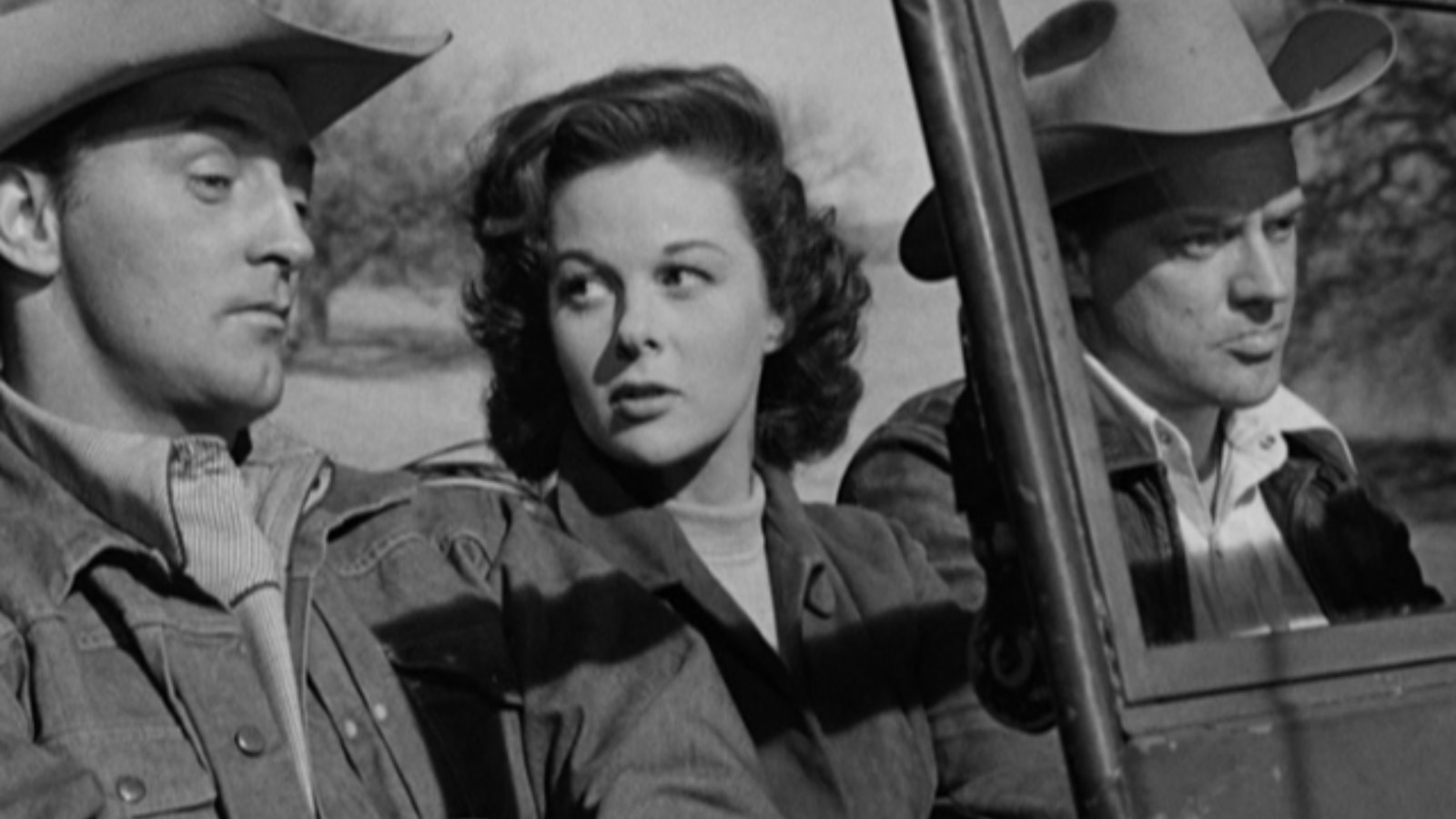
Jeff has already lived through the success Wes imagines. Early in the film, he returns to the dilapidated house where he grew up. Film at Lincoln Center singles out this homecoming, later excerpted in Wim Wenders and Ray's Lightning Over Water, as a key to the movie.[2] The famous rider arrives with a body that needs somewhere to rest. Recognition has traveled farther than comfort.
There is a quiet humiliation in that discrepancy. Jeff's name can impress a stranger without securing his own future. Fame survives as something other people remember; he has to live through the ordinary hours after the performance. For Wes, the encounter is an introduction to possibility. For Jeff, it is a return to what possibility has failed to deliver.
Mitchum makes this contradiction unusually persuasive. UCLA Film & Television Archive's programme notes contrast his apparently casual acting manner with Ray's interest in psychological motivation.[5] His composure lets Jeff remain attractive as a model even when his circumstances should constitute a warning. A visibly broken instructor might be easy to dismiss. Jeff still carries himself like a man worth becoming.
The arrangement therefore contains its own bad lesson. Wes can learn Jeff's skills while imagining that Jeff's disappointments belong to Jeff alone. The veteran becomes evidence that the work is possible; his condition somehow fails to count as evidence of what the work costs. This is my reading of their mentorship: admiration allows the pupil to separate the performance from the life that produced it.
Louise keeps trying to reconnect them. Her wish for a ranch gives the venture a purpose outside the arena. The film's love triangle puts her between a husband attracted to the circuit and a veteran attracted to her; TCM's production essay describes how substantially Hayward's part was developed during the making of the picture.[4] On screen, that position gives her more to do than wait for the men to settle their rivalry. She remembers what the expedition was supposed to accomplish.
It would be easy to treat her resistance as timidity. The film gives us grounds for a different judgment. Agreeing to a dangerous way of reaching a destination is not the same as agreeing to travel indefinitely. When Wes can afford the ranch and still chooses rodeo, he changes the terms of their shared life. The question has become whose wishes are allowed to change, and who must bear the consequences.
Jeff complicates Louise's position further. His longing for her offers sympathy, but it also makes his advice interested. He is both a teacher and a potential rival. TCM places that attraction at the center of the confrontation between the two riders.[4] The audience cannot comfortably appoint him the wise man who will explain the moral. He understands the damage and remains susceptible to the same invitations: desire, competition, the chance to prove himself once more.
Ray gives those invitations physical force. The film incorporates footage of actual rodeos; AFI records shooting at events including the Pendleton Roundup, while TCM describes the resulting documentary texture.[1][4] The spectacle has to be attractive for the dilemma to work. If we felt only dread, Wes's decision would be merely foolish. The excitement makes his reluctance to leave intelligible, even as its effects become intolerable.
The arena also changes the audience's responsibilities. We can enjoy a successful ride and move on. The rider must carry the consequences into the next day. Seen alongside the film's temporary accommodations and restless travel, described in Film at Lincoln Center's programme note, those bursts of public glory occupy a small part of a much larger life.[2] The cheers do not furnish that life. They can make it harder to leave.
Jeff finally enters competition again after Wes challenges his courage. A fatal injury ends the comeback. Only then does Wes commit to returning with Louise, offering the older rodeo hand Booker Davis and his daughter Rusty work on the ranch.[1]
The inclusion of Booker and Rusty gives the ending a generosity beyond the couple's reconciliation. Home can accommodate people the spectacle has worn down. Yet Jeff's absence prevents that prospect from feeling cleanly earned. The money was already there. What Wes lacked was permission, from himself, to stop. Someone else has paid for his change of mind.
Sources
- American Film Institute, “The Lusty Men” — credits, production history, ranch-purchase sequence, and ending.
- Film at Lincoln Center, “The Lusty Men” — homecoming, life on the rodeo circuit, and source of the film still.
- Harvard Film Archive, “The Lusty Men” (July 24, 2010) — the characters' competing desires for security and freedom.
- Roger Fristoe, “The Lusty Men,” Turner Classic Movies (August 5, 2003) — the central triangle, Hayward's role, and rodeo production context.
- UCLA Film & Television Archive, “The Lusty Men / Nevada” (July 9, 2011) — Mitchum's performance and Ray's approach to character.