John Ford's The Searchers (1956) is usually remembered through two kinds of image at once: the enormous openness of Monument Valley and the legendary final doorway shot.[1][2][4] That pairing is useful because the film's real subject is not search in the abstract. It is the unstable line between inside and outside. Ford keeps staging cabins, porches, graves, cavalry posts, riverbanks, and desert ridges as thresholds where belonging has to be tested again. Ethan Edwards rides toward home, away from home, and finally up to the edge of home, yet the film never lets him settle the question of where he belongs.[1][2][3]
That is why the picture still feels more disturbing than a simple rescue western. The plot sends Ethan and Martin Pawley across years of pursuit after Debbie is taken during a Comanche raid, but Ford's deeper structure is always spatial and moral at the same time.[1][2][3] Each new horizon widens the landscape while tightening the argument. Who counts as family? Who counts as recoverable? What kind of violence is smuggled into the language of restoration? The movie's grandeur comes from its vistas; its force comes from what those vistas refuse to heal.[1][3][4]
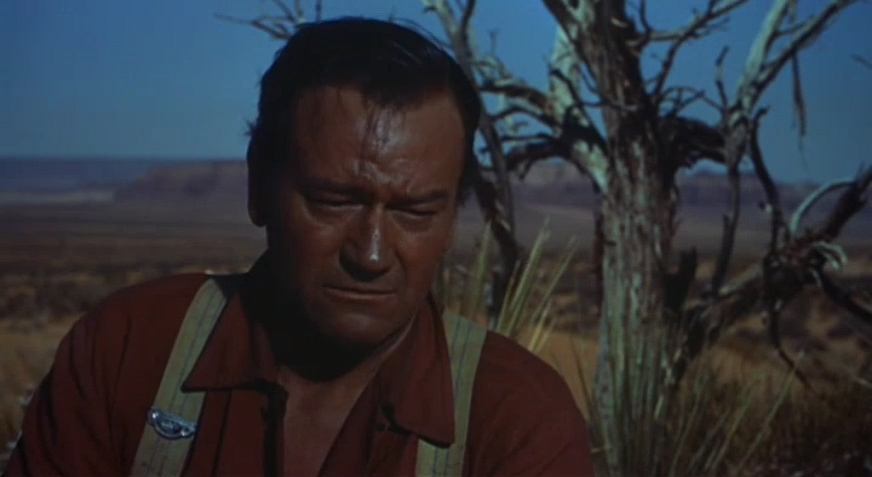
Image context: the lead image uses a real trailer still of John Wayne as Ethan Edwards preserved on Wikimedia Commons. It fits this essay because Ethan's face is one of Ford's main threshold objects in the film: weathered, watchful, and repeatedly isolated against the landscape, it makes belonging look like a strain rather than a fact.[5]
Spoiler warning: this essay discusses the raid on the Edwards home, Ethan's treatment of Debbie, and the ending.
1. The first doorway already tells us Ethan is returning from outside history
Ford opens The Searchers with one of the most famous threshold images in American cinema for a reason.[2][4] A dark interior gives way to blazing exterior light as the cabin door opens and Martha Edwards looks out to see Ethan approaching from the desert.[2][4] The image is beautiful, but it is also an arrangement of position. The family inhabits a frame of shelter, labor, and continuity. Ethan enters that frame from elsewhere, carrying years of absence, Confederate residue, and emotional claims the film never translates into domestic ease.[2][3]
That opening matters because Ford does not treat home as a settled condition earned before the story starts. He treats it as a fragile enclosure exposed to history from the first shot.[2][3] Ethan's arrival is warm on the surface, yet it is never relaxed. He knows the rhythms of the household, but he does not move inside them like a man who has been continuously shaped by them. Even before the raid, he reads as a figure standing near the family rather than fully within it.[2][4]
Glenn Erickson, writing for TCM about Ford's imagery, describes the door-opening shot as dreamlike, and that is exactly its power.[4] It feels less like a record of ordinary arrival than like a myth of return that the film will immediately begin to wound. Once the threshold has been marked that strongly, everything after it can be measured by the same question: can Ethan cross back into ordinary human shelter, or is he only built to defend it from the edge?
2. The horizon in The Searchers is not freedom. It is delay.
The usual shorthand for Ford's western landscapes is freedom, sweep, and visual poetry.[1][4] Those qualities are there, but in The Searchers the horizon almost never functions as release. It functions as postponement. The farther Ethan and Martin ride, the longer Ford makes recovery feel conditional, exposed, and morally expensive.[1][2][3] Vast space does not cleanse the story. It keeps the story from reaching an easy resting place.
Scott Allen Nollen's National Film Registry essay is especially useful here because he emphasizes Ford's use of long takes and wide shots to layer dialogue, action, and meaning at once.[2] The film can place riders, cabins, rock formations, and bodies inside one visual field without rushing to editorial judgment. That compositional patience is central to the movie's power. A horizon line keeps promising orientation, but inside the shot the moral coordinates remain unstable. Ethan knows where to ride; he does not know how to arrive at a humane conclusion once he gets there.[2][3]
This is also why the western outposts in the film do not feel securely "civilized." Homesteads, forts, and trading spaces are repeatedly shown as temporary islands against a larger exposure.[1][3] A cabin can be invaded. A graveyard can become a landmark inside an unfinished landscape. A river crossing can carry one family toward marriage and another toward annihilation. Ford's world is full of shelters, but he films them as conditional shelters. The line between home and wilderness is less a wall than a membrane that keeps failing under pressure.[1][2]
3. Debbie becomes the film's hardest threshold
The most painful version of that pressure gathers around Debbie. Ethan's pursuit is announced as familial duty, but the film gradually shows that duty has been corrupted by racial hatred, grief, and a fantasy of purity that can no longer sustain itself.[1][2][3] BFI is right to describe The Searchers as a work of racism, obsession, and revenge, and right as well to note that its representational archaisms remain part of the viewing experience.[1] The film's treatment of Native characters is inseparable from Hollywood's damaging habits of the era. Ford does not escape that history.
Yet the movie's seriousness lies in the way it makes Ethan's logic unbearable rather than noble.[1][2][3] Debbie returns in his imagination as a threshold problem: kin or contaminant, niece or someone he believes has crossed into an identity he refuses to accept.[2] Martin keeps pressing against that logic, and the film's emotional structure depends on the fact that Martin can still recognize Debbie as a person while Ethan keeps trying to reduce her to a category.[2][3]
That reduction is why the search stops feeling heroic long before it ends. Ethan is not merely traversing distance. He is defending a border inside his own mind, and every mile turns that border more violent. Monument Valley gives the drama scale, but the real frontier in The Searchers is the shrinking space in which Ethan can still imagine home without purification.[1][2]
4. The ending closes the house and leaves the myth outside
The ending lands so hard because Ford finally makes the threshold literal again.[2][4] After years of pursuit, Ethan spares Debbie, lifts her into his arms, and speaks the line that the entire movie has been circling: "Let's go home, Debbie."[2] Relief enters the film at that instant, but Ford refuses to let relief become closure. Ethan delivers Debbie back to the Jorgensen household, looks in, turns away, and walks back into the desert while the door closes behind him and in front of us.[2][4]
Nollen's essay states the point with admirable bluntness: Ethan knows he cannot join the family he has helped restore.[2] The final image is devastating because it does not frame exclusion as punishment imposed from outside. It frames exclusion as the shape of Ethan's own being after the hatred he has carried. The man who made home possible remains structurally unfit to enter it. Ford does not need a speech to explain this. The doorway does all the work.[2][4]
That is why the shot has lasted beyond almost every summary of the plot.[4] The image gathers the film's contradictions into one movement. A western hero returns the family to safety, yet the form of safety requires his disappearance. A mythic rider occupies one of the grandest landscapes in American cinema, yet the decisive visual fact is a house frame narrowing around him. Home survives, but as a border he cannot cross.
5. Why the film still matters
The Searchers still commands criticism because it refuses to let the western homecoming stay innocent.[1][2][3][4] Ford gives the viewer beauty, motion, and legend-scale composition, then keeps threading those pleasures through racism, obsession, and estrangement. The result is a film that looks expansive while growing morally tighter scene by scene. Its greatness is inseparable from its discomfort.
That discomfort is also why the film remains so teachable. It shows how cinema can turn space into argument. A doorway can become a moral test. A horizon can become a postponement machine. A final turn away from a house can rewrite the meaning of an entire genre. Once those forms lock together, The Searchers stops being only a story about finding Debbie. It becomes a story about the cost of restoring home through a man who has already made himself unable to live there.[1][2][4]
Sources
- BFI, "The Searchers (1956)" - film overview describing the picture as a western of mystery, poetry, racism, obsession, and revenge.
- Scott Allen Nollen, "The Searchers" essay PDF, National Film Registry / Library of Congress.
- Turner Classic Movies, "The Essentials: The Searchers" - article on the film's racial anxiety, violence, and lasting canonical force.
- Glenn Erickson, "John Ford: The Man Who Invented America," Turner Classic Movies - includes discussion of Ford's Monument Valley imagery and the dreamlike door-opening shot from The Searchers.
- Wikimedia Commons, "File:The searchers Ford Trailer screenshot (13).jpg" - source page for the lead image.