
Park Circus's 2017 trailer for the 4K restoration of A Matter of Life and Death is only eighty-two seconds long, but it understands the film's governing trick with unusual precision.[1] It does not try to flatten Michael Powell and Emeric Pressburger's 1946 fantasy into a single genre line. Instead it presents the movie as a sequence of crossings: a bomber pilot speaking into darkness, an afterlife that looks less like theology than administration, and a return to earthly color where love starts to function as a legal argument for staying alive.[1][2][3]
That structure matters because A Matter of Life and Death has always been stranger than its reputation as a wartime romance suggests.[2][3] TCM's synopsis gets the premise down to its cleanest form: an injured aviator argues in celestial court for the chance to go on living.[2] Brian Dillon's Guardian essay goes closer to the film's real charge. Powell and Pressburger are not only staging a supernatural melodrama; they are making an end-of-war picture in which the dead, the missing, the British, the Americans, and the machinery of judgment all remain unsettled.[3] The trailer grasps that instability immediately. It sells the film not as a solved fantasy world but as a border zone.
That is why this preview is worth treating as more than publicity.[1] In miniature, it tells you what kind of movie A Matter of Life and Death is before the full narrative has time to unfold. Voices arrive before bodies. Black-and-white authority interrupts Technicolor weather. A giant stairway appears not as religious comfort but as transit infrastructure. By the end, the trailer has quietly argued that the film's central conflict is not whether the supernatural exists. It is whether life can be defended against procedure.
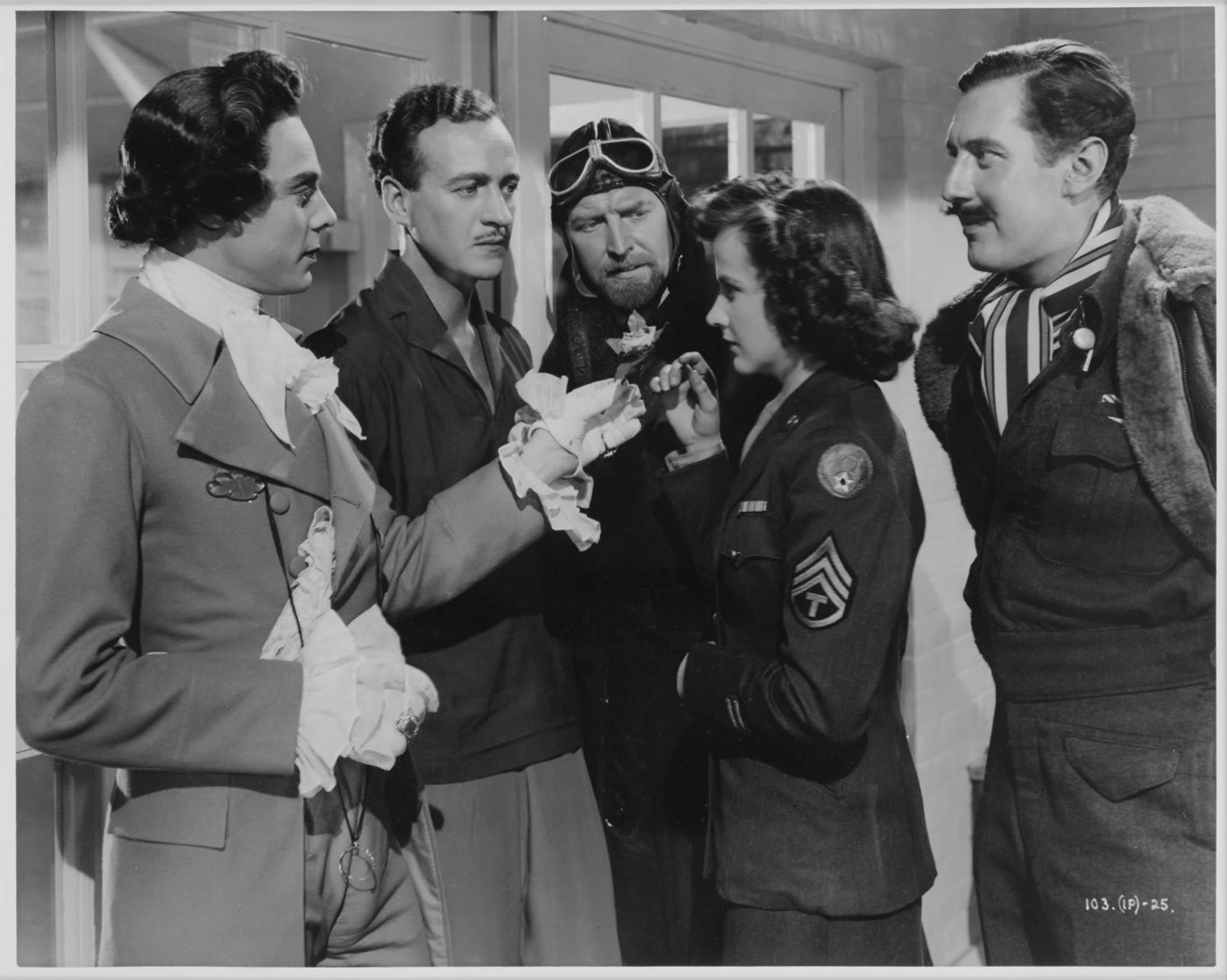
Image context: the lead image uses a 1947 production still of Kim Hunter from Wikimedia Commons. It belongs here because the trailer keeps returning to June as the earthly counterweight to celestial abstraction: once her face and voice arrive, Peter's survival stops being a technical mistake and becomes a claim on color, touch, and ordinary human time.[4]
At 0:00, the trailer makes the film a voice drama before it becomes a fantasy
The opening seconds are the trailer's smartest decision.[1] Before we get spectacle, we get a voice from a failing Lancaster bomber: Peter Carter asking June whether he should bail out, then admitting he has no parachute.[1] The exchange is quick, but it fixes the film's emotional scale at once. A Matter of Life and Death begins not with cosmic design but with a human voice trying to cross impossible distance. The danger is immediate, technical, and intimate at the same time.
That choice is unusually faithful to what makes the film moving.[2][3] War cinema often starts by establishing battle, formation, or mission. Powell and Pressburger start with communication under collapse, and the trailer preserves that order.[1][3] Peter is not introduced as a hero performing mastery. He is introduced as a body about to vanish, still attached to the world by speech. Even in preview form, that matters. The movie's later fantasy apparatus only works because the first bond is ordinary and fragile: one person speaking into static, another listening on the ground.
The trailer also understands that the radio exchange carries a political undertone without needing to explain it.[1][3] Peter is British, June is American, and their connection forms in the last hours of war, before either nation can settle into a clean peacetime story.[3] The romance therefore arrives already routed through alliance, accident, and distance. What might have been a sentimental gimmick becomes the first border crossing in the film: voice crosses the Channel, crosses military hierarchy, and then keeps crossing after death should have shut the line down.
Around 0:18, heaven appears as a records office with a staffing problem
The middle section is where the trailer shows why the film still feels so singular.[1] We move from the emergency of the cockpit into a monochrome afterlife where the key line is not a theological revelation but an administrative one: there has been a mistake, the records do not balance, the bells start ringing, and an escort is sent to retrieve Peter.[1] This is the preview's most revealing compression. It makes clear that Powell and Pressburger's heaven is not soft-focus consolation. It is bureaucracy.
TCM's clip notes help here because they identify the same material objects the trailer flashes past so quickly: the famous stairway, the celestial court, and the arresting blend of spectacle with process.[2] The point is not merely that the afterlife has rules. The point is that judgment has offices, files, and transit systems. In the trailer, the giant escalator-stairway looks less like a path to eternal peace than a piece of institutional design, a way of moving souls with impersonal efficiency.[1][2] The black-and-white palette sharpens that effect. Earthly life is still warm, unstable, and weather-filled. The next world is ordered into gradients, surfaces, and systems.
This is one reason the film does not age into quaint fantasy.[1][3] The monochrome afterlife is funny, severe, and faintly absurd, but it is never random. It feels like the extension of wartime paperwork into metaphysics. Dillon notes the film's peculiar blend of Shakespearean comedy, theatrical artifice, and end-of-war reflection on the missing and the dead.[3] The trailer turns those large ideas into a swift visual argument. Death is not presented as the sublime opposite of earthly life. It is presented as another machine one might have to appeal through.
Around 0:45, earthly color becomes the film's real argument
If the monochrome bureaucracy defines the obstacle, the trailer's color passages define the stakes.[1] Once Peter survives the jump and the trailer settles into beach, field, and close-up images with June, the film's logic becomes clear. Earth is not just "where the living are." Earth is where sensation still has weight. The trailer keeps giving us wind, horizon, skin, flowers, uniforms, and the luminous surface of Kim Hunter's face because the movie needs life to feel materially persuasive before any celestial appeal can matter.[1][4]
This is where the restoration framing is doing more than marketing.[1][3] Park Circus is of course selling a 4K revival, but the preview is careful about what the restoration is restoring. It is restoring the difference between worlds.[1] The contrast is not decorative. The trailer needs the earthly scenes to feel saturated enough that Peter's refusal to report upstairs makes emotional sense. The whole appeal depends on the viewer feeling that color is not excess. It is evidence.
That emphasis also protects the film from a common misreading. A Matter of Life and Death is often remembered for its stairway, its court, and its heavenly conceit.[2][3] The trailer quietly argues that its deeper power lies elsewhere. The movie only works because the living world is worth contesting for. June's presence, Peter's relief, and the sudden spaciousness of the seaside are what turn cosmic error into drama.[1] Without that earthly pull, the afterlife scenes would remain clever design. With it, they become pressure.
In the last half minute, the trailer changes the question from sacrifice to appeal
The sharpest line in the whole preview comes late: "Would you die for him?" followed by June's answer, "I would, but I'd rather live."[1] That reply is the trailer's thesis in miniature. It refuses the noble language that many wartime romances would treat as the natural climax. The point is not glorious sacrifice. The point is the insistence that love should continue in the world of the living if any route remains open.
That distinction is crucial to the film's tone.[2][3] Powell and Pressburger are not interested in making death grander than life. They are interested in giving life enough wit, sensuality, and argumentative force that it can answer death without sentimentality. The trailer understands this and keeps the legal frame visible. Peter is not simply pleading for more time because he fears extinction. He is appealing because the world below has become newly specific: a woman, a conversation, a landscape, a future that war almost erased before it could begin.[1][3]
This is why the trailer still feels modern. It does not sell transcendence as escape from ordinary existence.[1][3] It sells the film as a contest between abstraction and attachment. On one side there is order, balance, and the clean confidence of celestial procedure. On the other there is contingency, romance, and the half-chaotic brightness of surviving the war long enough to want something beyond it. The final title card lands after the movie has already made its preference clear. A Matter of Life and Death is not really asking whether heaven is imaginable. It is asking whether the living world can still make a convincing claim on us after catastrophe.
That is the preview's lasting achievement.[1] In barely more than a minute, it converts one of British cinema's strangest postwar fantasies into a legible sequence of thresholds: radio into silence, black-and-white into color, error into appeal, and death into an argument for returning. The trailer does not reduce the film's weirdness. It clarifies where the weirdness lives. It lives in the fact that the road back to life looks, for a while, like an administrative problem. Then Kim Hunter's face appears, the sea wind returns, and the argument changes completely.
Sources
- Park Circus, "A Matter of Life and Death - official trailer - 4K restoration," YouTube video, published November 10, 2017.
- Turner Classic Movies, "A Matter of Life and Death" watch page with synopsis, cast, and related clip notes.
- Brian Dillon, "War, love and weirdness: A Matter of Life and Death – 70 years on," The Guardian, November 4, 2016.
- Wikimedia Commons, "File: Kim Hunter (1947) A Matter of Life and Death (front-full) (cropped).jpg."