Jean Renoir's The Rules of the Game (1939) is often introduced as a great satire of the French upper class on the eve of war, and that description is true as far as it goes.[1][2][4][5] But the film's lasting shock comes from something more exact. Renoir does not merely say that a ruling class is frivolous, hypocritical, or blind. He shows a social world so committed to movement, flirtation, role-playing, and good form that it can absorb cruelty without needing to stop the party for very long. Doors open, servants cross, lovers miss each other by seconds, a hunt begins, an animal dies, a man dies, and the house keeps reaching for composure.[1][2][3]
That is why the movie still feels more dangerous than many later "decadence" films. It does not separate comedy from catastrophe into two clean zones.[2][3][4] Renoir's famous deep-space staging lets several emotional climates coexist in the same shot: wit in the foreground, panic in the middle distance, social management at the edge of the frame.[2][3] By the time the film reaches its final shooting, the tragedy lands so hard because Renoir has spent the whole picture teaching us how easily this society reroutes disorder into manners.[1][2]
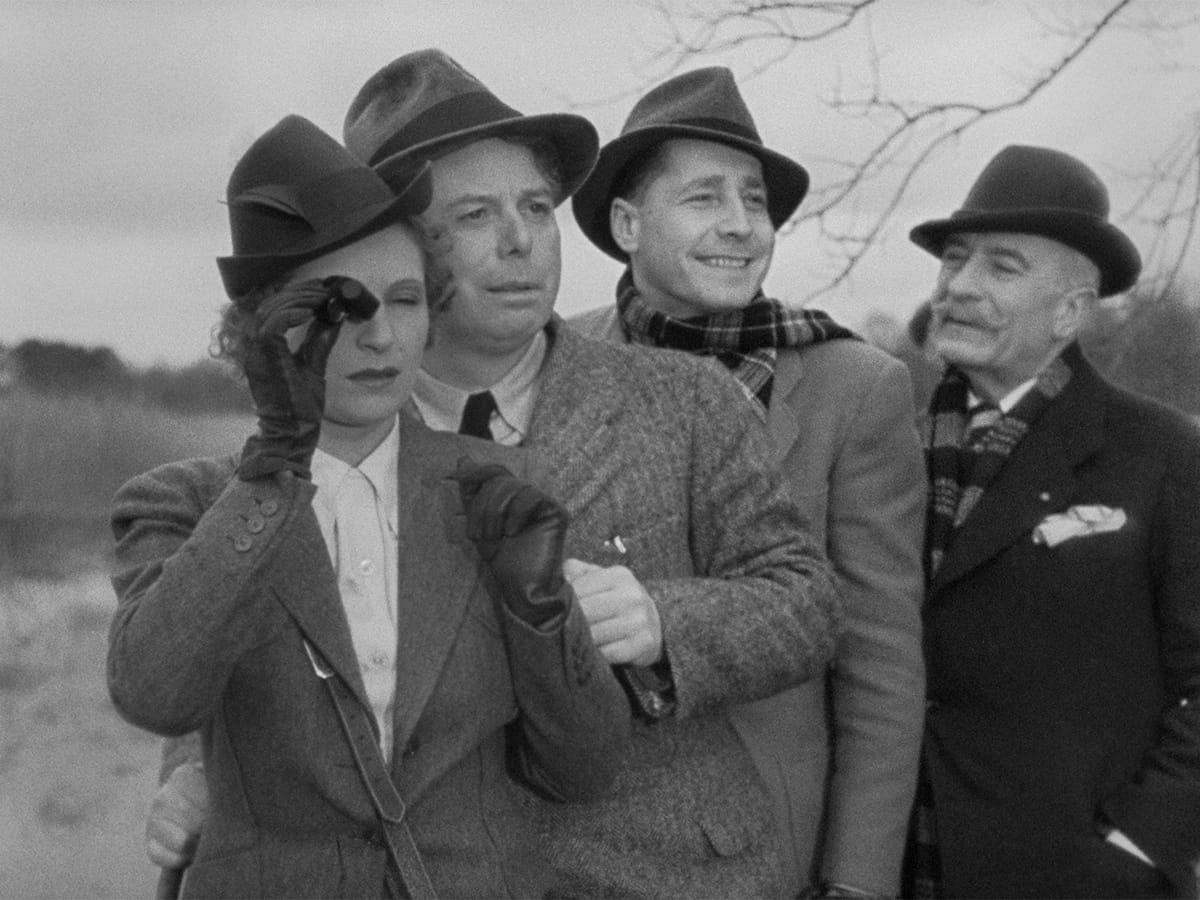
Image context: the lead image uses a real still from Criterion's gallery for the film, showing Christine with binoculars during the hunt.[1] It is the right recognition image for this essay because the hunt is where looking, desire, leisure, and violence collapse into one system. Before the final death, Renoir has already shown a class treating observation as sport and sport as a rehearsal for something far worse.
Spoiler warning: this close reading discusses the hunt sequence and the film's ending.
1. Corridor traffic makes desire look ordinary, not exceptional
One of Renoir's decisive formal choices is that he almost never isolates desire into private close-up confession.[2][3] People in The Rules of the Game are forever passing one another in hallways, entering from the rear of the frame, overhearing from staircases, or talking while some other drama continues just behind them.[1][2] Alexander Sesonske's essay is useful here because it stresses the matched pairs and the film's intricate social design, but that structure becomes fully legible only once Renoir puts it into motion.[2] The movie's morality is spatial before it is verbal.
This is what makes the château feel alive in such a peculiar way. It is not a static aristocratic backdrop. It is a circulation system.[1][3][4] Kristin Thompson's staging note for Criterion points to Renoir's elaborate mise-en-scène, and "elaborate" is exactly the word, provided one also hears how relaxed it looks while it is happening.[3] Characters slip around each other with the casualness of habit. Masters and servants mirror one another. Affairs among the owners echo affairs below stairs. A flirtation that should be secret is treated as one more current flowing through the building.[2][3]
That matters because the film's famous line about everyone having reasons is often remembered as humane tolerance, and it is humane, but only up to a point.[1][2] Renoir gives everyone motives, but he also shows how a social order can become skilled at translating motives into excuses. Corridor traffic is the perfect visual form for that skill. No one has to stop long enough for feeling to harden into moral recognition. The next entrance, the next misunderstanding, the next piece of comic business is already arriving.
2. The hunt is not a symbolic interruption; it is the film's hidden truth becoming visible
The rabbit hunt is the sequence that tears the film open.[2][5] Sesonske calls it the symbolic core of Renoir's critique, and the description holds because the scene suddenly changes the rate and texture of the movie.[2] In a film famous for long takes, layered blocking, and social drift, the hunt arrives as a barrage of cuts, motion, noise, and death. Animals dart across the field, guns fire, bodies drop, and the weekend's polished rituals are revealed as rituals of pursuit all along.[2]
What makes the sequence so brutal is not only the killing. It is the way leisure and massacre occupy the same register.[1][2][5] The country-house guests do not step outside their social role when they shoot. They fulfill it. Hats remain in place; postures stay elegant; conversation keeps its lightness. The violence is not framed as a descent from civilization into savagery. It is framed as civilization enjoying itself.[1][5]
That is why the still at the top of this article matters so much. Binoculars, game, aim, spectatorship: Renoir organizes them into one grammar.[1] Looking in this film is rarely innocent. Lovers watch one another, servants watch masters, guests watch performance, and during the hunt the whole party watches creatures become targets. Once that logic is visible, the rest of the movie changes. Romantic intrigue no longer looks separate from the possibility of violence. It looks like rehearsal for it.
The hunt also clarifies Renoir's view of class. MoMA's capsule description emphasizes the interlocking love triangles and upstairs-downstairs conflict of the weekend party, and the hunt shows why those two levels belong together.[4] The aristocrats may speak more elegantly than the servants, but the structure binding them is the same: competition, jealousy, possession, displacement. The difference is that privilege lets the upper class treat damage as spectacle and keep calling it sport.
3. Farce keeps moving after the hunt because the house has learned how to metabolize shock
What is most unsettling after the hunt is that the movie does not suddenly become solemn.[1][2][3] Renoir returns to chase, disguise, confusion, and romantic scrambling through the château, and this return is essential. A lesser film would turn the hunt into a moral lesson after which everyone must finally understand the stakes. Renoir is too sharp for that. He knows that classes in decline do not become lucid because they have glimpsed their own violence. They become busier. They increase the amount of traffic.
This is where the film's comic energy becomes terrifying. Doors slam, costumes mislead, Schumacher pursues Marceau, Octave improvises, and identities keep crossing in ways that are genuinely funny.[1][2][3] But the laughter grows unstable because the hunt has already told us what lies underneath the tempo. Every chase now feels like it could spill over into something unrecoverable. The point is not that comedy was false. The point is that comedy and danger were sharing the same architecture from the start.
Renoir's deep staging makes that architecture unusually visible. Characters do not occupy one emotional line at a time.[2][3] Someone jokes while someone else despairs. Someone hides while another person misreads the whole room. The frame stays democratic enough to show these competing states together, but the democracy is cruel. Nobody receives the centered revelation that would make action morally simple. The château produces simultaneity, and simultaneity becomes evasion.
That is one reason the film feels so modern. Many satires flatter the audience by making social corruption legible from a safe distance. The Rules of the Game does not. It lets charm keep operating even after charm has been discredited.[1][2][4] You are never allowed to stand wholly outside the machine, because Renoir keeps making the machine delightful in local moments even as it heads toward disaster.
4. The final shooting hurts because etiquette arrives faster than grief
The ending is devastating not only because a man is mistaken for another man and shot, but because the house reacts by restoring form with almost supernatural speed.[1][2][4] A death that should rip the social fabric apart is folded into explanation, protocol, and posture. The marquis speaks. The guests are managed. The event is named in a way that preserves decorum. Tragedy is acknowledged only through the language required to keep collapse from becoming visible.[1][4]
This is the movie's bleakest insight. The upper class in The Rules of the Game is not condemned simply because it is immoral in the melodramatic sense. It is condemned because it is professionally adaptive.[1][2][5] It can survive scandal by converting it into style. Even now, at the end, good manners do not appear as the opposite of violence. They appear as violence's protective shell.
Seen in that light, the final polite handling of death is not a twist but a culmination. Corridor traffic taught us that feeling can be rerouted. The hunt taught us that pleasure and killing can share one social script. The late farce taught us that motion itself can keep recognition at bay. The ending gathers all three lessons into one unbearable gesture: a world on the brink of war proving that it would rather narrate loss correctly than feel it fully.[1][2][4][5]
That is why The Rules of the Game lasts. Renoir does not merely expose hypocrisy; plenty of films can do that.[1][2] He finds a cinematic form for a society whose elegance is inseparable from its failure of moral weight. Movement is graceful, dialogue is witty, rooms are alive, servants and masters reflect one another, and all the while death is moving closer through the same channels as desire. When the final shot comes, the movie does not discover doom. It reveals that doom has been dressed for dinner from the beginning.
Sources
- The Criterion Collection, "The Rules of the Game (1939)" film page with synopsis, credits, trailer, and still gallery.
- Alexander Sesonske, "The Rules of the Game: Everyone Has Their Reasons," The Criterion Collection.
- The Criterion Collection, "Staging in Jean Renoir's The Rules of the Game" with Kristin Thompson on Renoir's mise-en-scene.
- MoMA, "La Règle du jeu (The Rules of the Game). 1939. Directed by Jean Renoir."
- BFI Southbank, "The Rules of the Game / La Regle du Jeu" screening page.