Spoiler note: this article discusses the final airport sequence and Rick's closing decision.
Casablanca is often remembered as the supreme wartime romance, which is true only if one notices how thoroughly the romance has been routed through administration.[1][2][3][4] The film takes place in Vichy-controlled Morocco in December 1941, inside a city defined by waiting: refugees need exit visas, police can stall or release movement, black-market intermediaries hover around every table, and love returns in the same shape as a document problem.[1][2][4] Ilsa's arrival matters because she is Rick's lost beloved, but it matters just as much because she arrives with Victor Laszlo, a resistance figure whose ability to leave Casablanca depends on the circulation of papers, permissions, and favors.[1][2]
That is one reason the movie still feels tighter than its own legend.[1][2][3] BFI describes Curtiz's film as consummately crafted Hollywood drama made on the cusp of America's entry into the war, while TCM stresses the "invisible style" that makes every element look effortless even as the picture quietly envelops the viewer.[1][2] The result is a film whose emotional force comes from compression. Geopolitics becomes table talk, border control becomes a prop that can pass through a coat pocket, and world-historical choice gets staged in a nightclub office, a doorway, or a fogged-out runway. The movie does not merely ask whom Ilsa loves. It asks what kind of moral life can still be built when movement itself has become licensed, priced, and watched.[1][2][4]
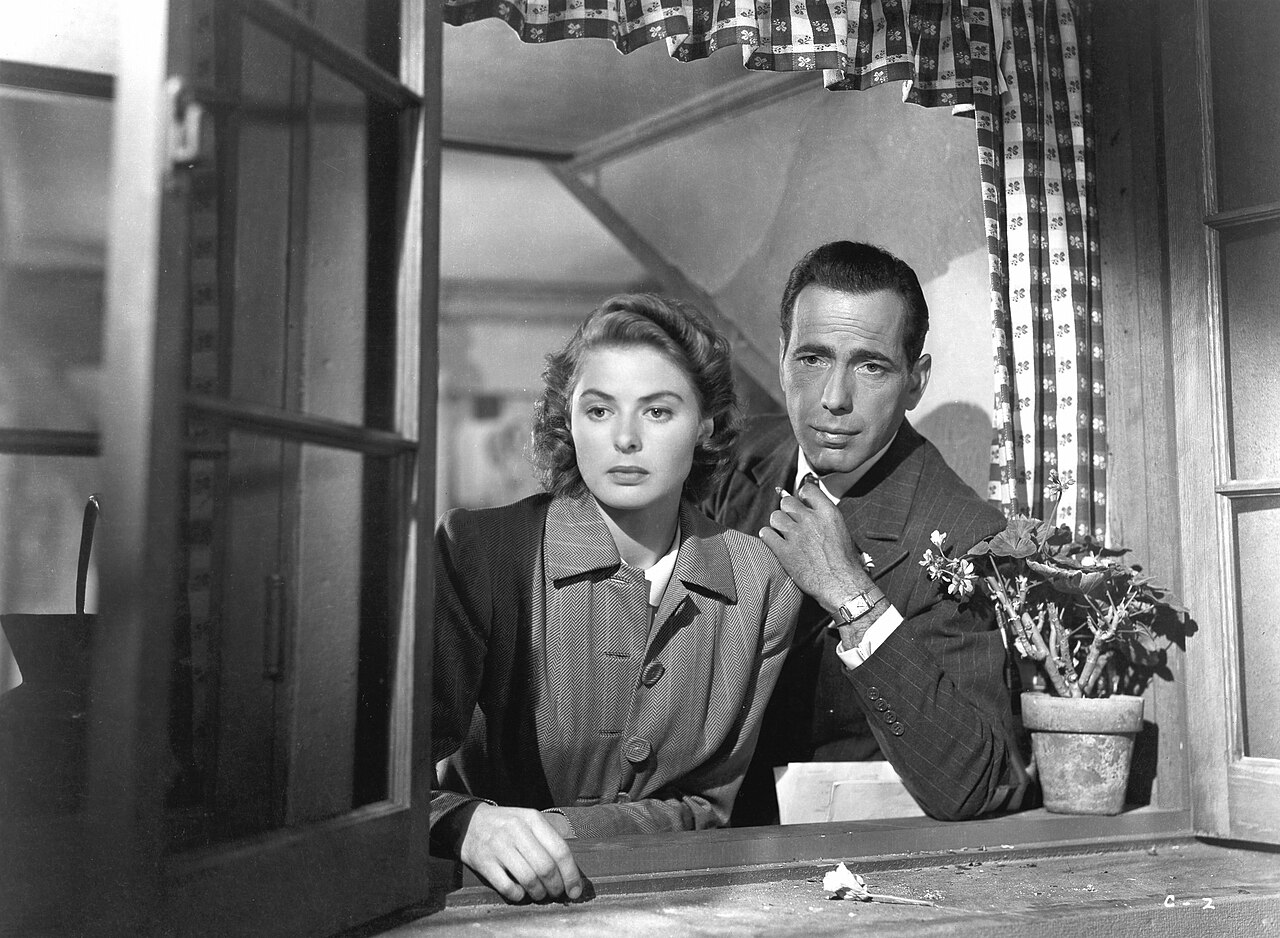
Image context: the cover uses a Warner Bros. publicity still of Humphrey Bogart and Ingrid Bergman from Wikimedia Commons.[5] It is the right recognition image for this essay because the film keeps holding intimacy in suspension. Rick and Ilsa can occupy the same frame, lean into the same light, and still feel separated by schedules, politics, and the exit routes that structure every room around them.
The letters of transit turn sovereignty into something a hand can hold
The letters of transit are among the most famous props in studio-era cinema because they miniaturize the whole political world.[1][2][4] In an ordinary melodrama, the object that concentrates feeling might be a photograph, a ring, or a train ticket. In Casablanca, the crucial object is a legal exception. The letters are treated as near-magical because they bypass the ordinary chain of permissions that traps everyone else in the city.[2][4] Once they enter the film, war stops looking like distant background and starts looking like a question of who can touch, hide, bargain with, or surrender one small packet of paper.
That shift is the movie's first great act of compression.[1][2] TCM's summary of the plot is useful here because it insists on the double bind: Rick is pulled into romantic memory and political espionage at once.[2] The film never separates those pressures. The letters pass into Rick's keeping, which means his old emotional wound and the anti-fascist emergency become materially linked. Every later decision inherits that link. He cannot help Ilsa without helping Laszlo, and he cannot pretend neutrality once the papers have turned his cafe from a place of cynical spectatorship into a point of transit in a wider war.[1][2]
The prop also changes the viewer's attention.[2][4] Once the letters exist, table surfaces, pockets, desk drawers, and private offices all gain new weight. A room in Casablanca is never just a room after that; it is a temporary customs zone. This is one reason the film's dialogue feels so charged even when the camera is calm. The words drift through a space already organized by documents. Rick can talk like a man above politics for only so long because the film has made politics portable. It can sit in his hand.
Rick's Cafe is less a romantic playground than a waiting room for history
BFI's capsule gets at something essential when it describes Rick's nightclub as a place where resistance fighters, refugees, Nazis, and opportunists all converge inside an illicit economy.[1] That sentence explains why the cafe never feels like mere backdrop. It is a sorting chamber. Everyone in it is stalled, negotiating, performing, or watching someone else negotiate. Even the room's pleasures, the band, the drinks, the crowded tables, the faint promise that one might still slip away, depend on the fact that departure has become scarce.[1][2]
Curtiz stages that condition through layered interiors.[1][2] The camera repeatedly looks through arches, doorway frames, curtained passages, and office thresholds, so that privacy in the film always feels partial. Rick and Ilsa can step away from the main crowd, but they seldom reach a truly sealed emotional zone. Sam is near, Renault is circling, Ferrari is listening, Laszlo is about to enter, the police can appear at any moment.[1][2] The movie keeps turning architecture into pressure. A doorway does not only connect rooms. It announces that the public world is never far enough away for feeling to become innocent.
That is why the anthem sequence lands so hard in the middle of the nightclub.[1][2] It is not simply an inspiring interruption. It reveals what the room has been storing all along. The cafe has looked like a cosmopolitan refuge, a place where Rick can remain detached and profitable while Europe burns at the edges. Then song turns the room into a battleground of allegiance. The private business model gives way to public alignment, and the film makes the change legible through bodies filling the same interior with a different kind of sound.[1][2] Love and politics in Casablanca do not alternate. They accumulate in the same room until one can no longer pretend to occupy only half the scene.
Doorway frames keep reunion from becoming rest
Rick and Ilsa's reunion is powerful partly because the film never grants it the full softness a pure romance would seek.[1][2] The Paris flashback offers memory as temporary release, but Casablanca proper is built out of thresholds and interruptions. When Ilsa reenters Rick's world, she does so through a public room thick with witnesses. When they speak privately, the privacy feels borrowed. When they remember Paris, the memory arrives in a film whose present tense is all paperwork, surveillance, and timing.[1][2][4]
This is where the doorway motif becomes more than visual elegance. Frames within frames keep reminding the viewer that every emotional approach in the movie is also a passage under observation. A lover enters as though crossing a checkpoint. A husband appears in the background and changes the meaning of the room. A police captain lounges in a doorway and turns friendship into leverage. The movie's famous dialogue survives because the staging keeps it from floating free as quotation. Each line lands inside a spatial arrangement that asks who is allowed to stay, who must move, and who is already being watched while choosing.[1][2]
The effect is almost cruel in its tact.[1][2] Rick and Ilsa do get intervals of candor, yet the film never lets those intervals pretend the world has stepped aside for them. The close-up may narrow the field, but the architecture of the story keeps reopening it. That is why their relationship remains moving after so many imitations. The film does not treat love as a shelter from history. It treats love as one more thing history can enter through a door.
The airport fog turns sacrifice into disappearance
The last runway scene is one of Hollywood's most durable images because it is both visibly artificial and emotionally exact.[1][2][3] BFI reminds us that the movie's Morocco is a Warner Bros. construction, and TCM emphasizes the production design that made its fog, trench coats, and runway into lasting emblems of longing.[1][2] The airport sequence distills that design to its barest form. By the time Rick makes his choice, the film has cleared away the nightclub's crowded social world and left silhouettes, beams of light, engine noise, and mist. Geography grows vague. Moral shape grows sharp.
The fog matters because it performs two jobs at once.[1][2] It hides the practical mechanics of departure, which lets the scene feel mythic rather than procedural, but it also makes sacrifice register as a form of vanishing. Ilsa does not merely board a plane. She recedes into whiteness with Laszlo, into the war and the cause and the future Rick has chosen not to occupy with her. The mist keeps the scene from closing like domestic resolution. Instead it leaves a visual remainder, the sense that political clarity has been achieved at the cost of personal visibility.
This is also where Casablanca earns the hold described in the Library of Congress essay on its National Film Registry status.[3] The movie turns archetypes into something at once grand and graspable. Rick does not become memorable because he wins the woman. He becomes memorable because the film makes his renunciation legible in the same terms it has used all along: a border crossed, a passage granted, a body left standing on the wrong side of departure. Even Renault's final turn works for the same reason. He steps into the fog of uncertainty too, and the film treats that uncertainty as the first decent thing he has done.
That is why Casablanca does not wear out, even after decades of quotation.[1][2][3] Its script is famous, its stars are luminous, and its politics are condensed into instantly readable types. But the deeper achievement is architectural. Curtiz keeps turning rooms into waiting areas, papers into instruments of destiny, and fog into the visual form of irreversible choice. The romance remains unforgettable because the film never lets it detach from routes of exit, systems of permission, and the sense that history has already entered the room before the lovers do.[1][2][3][4]
Sources
- BFI, "Casablanca (1942)" - film page on the Vichy Morocco setting, Warner Bros. studio-lot construction, and the film's lasting critical stature.
- Bret Wood, "The Essentials - CASABLANCA (1942)," TCM - overview of the film's plot, collaborators, production design, and "invisible style."
- Mike Mashon, '"Casablanca": National Film Registry #1,' Library of Congress Now See Hear! - note on the film's 1989 National Film Registry selection and enduring cultural hold.
- Australian Centre for the Moving Image, "Casablanca" - collection entry with synopsis, credits, runtime, and production metadata.
- Wikimedia Commons, "File:Bergman & Bogart Casablanca still.jpg" - Warner Bros. publicity still file page and metadata.