Elia Kazan's A Face in the Crowd (1957) is often praised for seeing the American media demagogue too early.[1][2][4] That reputation is deserved, but it can also flatten the film into a prophecy machine, as if its only achievement were guessing the future shape of television politics. The sharper achievement is structural. A Face in the Crowd understands that mass persuasion does not arrive through ideology alone. It arrives through format: a microphone placed close to a face, a producer who knows how to package spontaneity, a sponsor willing to monetize intimacy, and a crowd trained to experience performance as personal recognition.[1][2][3]
That is why the film still feels so current. Larry "Lonesome" Rhodes is destructive, but he does not rise by private charisma alone.[1][2][3] He rises because the media around him keeps translating charisma into usable product. A jail-cell song becomes local radio texture. Local radio warmth becomes regional television presence. Television presence becomes sponsor authority, then political leverage. The movie's real subject is not simply a fake country sage. It is the conversion system that keeps rewarding him each time he becomes louder, more intimate, and more saleable.[1][2][6]
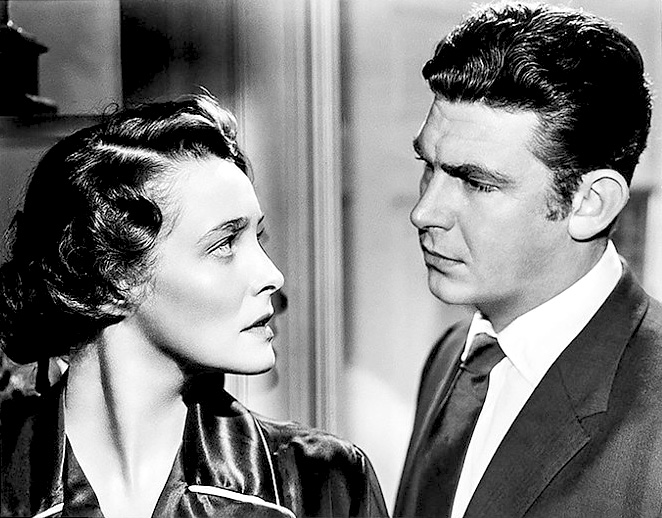
Image context: the lead image uses a real 1957 publicity photograph of Patricia Neal and Andy Griffith from A Face in the Crowd preserved on Wikimedia Commons. It fits this essay because the film's rise story begins as a duet before it becomes a panic: Marcia's professional curiosity and Rhodes's performed ease are the first link in the chain that turns one voice into a mass instrument.[5]
Spoiler warning: this essay discusses the sponsor turn, Rhodes's political rise, and the live-microphone ending.
1. Marcia does not discover authenticity. She discovers a usable voice.
The opening jail sequence matters because it frames media discovery as selection and arrangement rather than miracle.[2][3] Marcia Jeffries is out gathering local voices for her radio program when she finds Rhodes in custody and gives him access to the microphone.[2] The scene can be played as homespun luck, and Rhodes encourages exactly that reading. He appears to be a natural, someone whose drawl, guitar, laughter, and improvised insolence have simply been waiting for a national audience. But the film is too alert to media labor to leave the moment there. Marcia names him, books him, shapes the setting around him, and keeps interpreting his appeal for other people.[2][3]
That makes Patricia Neal's role central to the movie's argument. April Wolfe's Criterion essay is especially strong on this point: Marcia is not a passive witness to Rhodes's rise but the face through which the audience first experiences his charm and then learns to measure its cost.[2] She is curious, ambitious, amused, half seduced by what she has found, and professionally proud of having found it. The movie is merciless about that mixture. Rhodes needs talent, but talent alone does not make a phenomenon. He also needs a handler who can convert rough presence into something that feels fresh without looking manufactured.[2][3]
The film therefore begins with a false promise that remains crucial all the way through: the promise that mass media can deliver unfiltered personality.[1][2] Rhodes looks valuable because he seems to bypass polish. Yet every step of his ascent depends on new layers of polish, routing, and repetition. The more "direct" he seems, the more infrastructure is actually working on his behalf.
2. The movie's scariest insight is that folksiness becomes ad copy very easily.
Once Rhodes moves from Arkansas toward Memphis and New York, the film starts treating regional warmth as a commercial technology.[3] TCM's production history notes the geographic arc directly, and that widening route matters because the movie keeps asking how a local voice survives scale.[3] The answer is brutal: it survives by becoming simplified, branded, and fed back through sponsorship. What sounded like neighborly candor on the radio becomes a sales instrument on television.
That commercial turn is where A Face in the Crowd stops being only a performer study and becomes a systems movie.[1][3][6] Rhodes learns that he can insult, flatter, provoke, and ad-lib in ways that conventional advertisers cannot, and the sponsors learn something equally valuable in return: outrage does not necessarily damage a product if the audience experiences the pitch as personal contact.[3] The film understands this long before the language of "parasociality" or "authenticity branding" became common. A folksy phrase, a wink, a laugh, or an improvised put-down can do more selling than disciplined copy if the viewer feels personally claimed by the speaker.
That logic also explains why the film's politics never feel detachable from its commercials. Rhodes does not suddenly leap from entertainment into influence as though one world ended and another began.[1][2][6] The same skills carry across. He knows how to make crowds feel singled out while addressing them in bulk. He knows how to turn contempt into energy, familiarity into obedience, and repetition into rhythm. Sponsor patter and political command belong to the same performance grammar.
3. Kazan films charisma as a room-to-room relay, not as a mystical aura.
One reason the movie remains so unnerving is that Kazan does not shoot Rhodes as a purely solitary monster.[2][3] He keeps placing him inside rooms full of listeners, assistants, writers, executives, hangers-on, and visible audience faces. Wolfe notes how vivid the background players remain in the deep-focus compositions, and that density matters.[2] Rhodes's power is never merely internal. It is always traveling: from stage to monitor, from microphone to control booth, from one executive calculation to the next.
That relay structure is what keeps the film from collapsing into the safer moral that "the public was fooled by one bad man."[2][3][4] Plenty of people see what Rhodes is. The problem is that his ugliness arrives bundled with returns. He can move product. He can electrify a room. He can make stale programming feel alive. He can turn a politician into a marketable feeling.[1][3] The film's backstage spaces are therefore as important as its stages. Control rooms, offices, and sponsor meetings show how charisma gets ratified long before it becomes a public emergency.
Even the movie's romantic and sexual tensions serve that larger point. Marcia is drawn to Rhodes's force, but she also keeps working inside the machinery that amplifies it.[2][3] Desire and professional complicity occupy the same line. That overlap is one reason the film stays morally abrasive. It does not let intelligent people stand outside the system and diagnose it from safety. It shows them feeding it, trimming it, and only later recoiling from what they helped scale.
4. The open mic ending matters because it briefly cancels the format.
The climax is so powerful because it is technical before it is moral.[3] Marcia throws the switch that sends Rhodes's off-air contempt to the public while he thinks he is speaking only to his producers and staff.[3] The ending is often remembered as exposure, and it is that. But the deeper shock is formal. For one moment, the protective membrane between backstage speech and broadcast persona disappears. The medium stops flattering him. It stops translating. It stops laundering aggression into charm.
That is why the scene lands harder than a conventional unmasking.[2][3] The audience does not discover that Rhodes has a secret private life. They discover that the voice they loved has always depended on separation between performance and infrastructure. Once that separation fails, his command starts collapsing at once. The film is merciless here too: Rhodes is not destroyed by argument, fact-checking, or moral growth. He is destroyed by an accident in format, by the sudden circulation of the wrong version of his own voice.[3]
The Library of Congress later added A Face in the Crowd to the National Film Registry in 2008, and the choice makes sense because the film preserves more than a memorable performance or a period warning.[4] It preserves a durable American mechanism. By the end, Rhodes is left with height, noise, and the dead air of a machine that can no longer guarantee love. The movie's lasting force comes from understanding that mass intimacy is never innocent once it becomes routinized for profit and leverage.
Seen from 2026, that is still the film's clearest lesson. A Face in the Crowd does not argue that audiences are foolish by nature.[2][3] It argues that modern media keeps building conditions under which warmth can be manufactured, amplified, and sold back as trust. Rhodes is monstrous, but the movie is too smart to isolate the monstrosity inside him alone. It lives in the chain: microphone, producer, sponsor, audience, candidate, and one switch that finally lets the whole machine hear itself.[1][2][3][4]
Sources
- BFI, "A Face in the Crowd (1957)" film page.
- April Wolfe, "A Face in the Crowd: American Character." The Criterion Collection.
- Scott McGee and Jeff Stafford, "Behind the Camera: A Face in the Crowd." Turner Classic Movies.
- Library of Congress, "Complete National Film Registry Listing" - includes A Face in the Crowd (1957), inducted in 2008.
- Wikimedia Commons, "File:A Face in the Crowd publicity photo (Patricia Neal & Andy Griffith).jpg" - source page for the lead image. Link
- The Criterion Collection, "A Face in the Crowd (1957)" film page.