
The Red Shoes has been canonical for so long that it can start to look pre-solved: the great backstage melodrama, the great ballet film, the great British Technicolor fever dream.[3][6] But the movie still feels volatile because it does something harder than prestige. Powell and Pressburger do not merely place dance inside a film plot. They let dance reorganize cinematic space, time, and emotional scale. The stage stops behaving like a photographed stage, and the movie begins moving according to artistic obsession rather than everyday logic.[1][3]
That is why these two videos belong together. Criterion's "Three Reasons: The Red Shoes" condenses the film into a short argument about movement, color, and the centrality of the ballet itself.[1] Warner Bros. Motion Picture Imaging's "The Red Shoes Restoration Demo" looks, at first glance, like a technical supplement, but it actually reveals how much of the film's charge depends on material qualities that can decay: density in the reds, weight in the blacks, separation in the painted spaces, and texture in faces, costumes, and stage surfaces.[2][3] One video explains how the film breaks free of theatrical recording. The other explains why that freedom has to be rebuilt for each generation.
The underlying story is familiar enough. In 1948, Powell and Pressburger turned Hans Christian Andersen's fairy tale into a film about a gifted ballerina, Victoria Page, pulled between the composer Julian Craster and the impresario Boris Lermontov, who demands total artistic devotion.[3][4] Yet the movie's lasting force does not come only from the triangle. It comes from the way the film turns that demand into image design: Jack Cardiff's cinematography, Hein Heckroth's production design, the extended ballet centerpiece, and the pressure the camera places on bodies once art becomes destiny.[3][4][5]
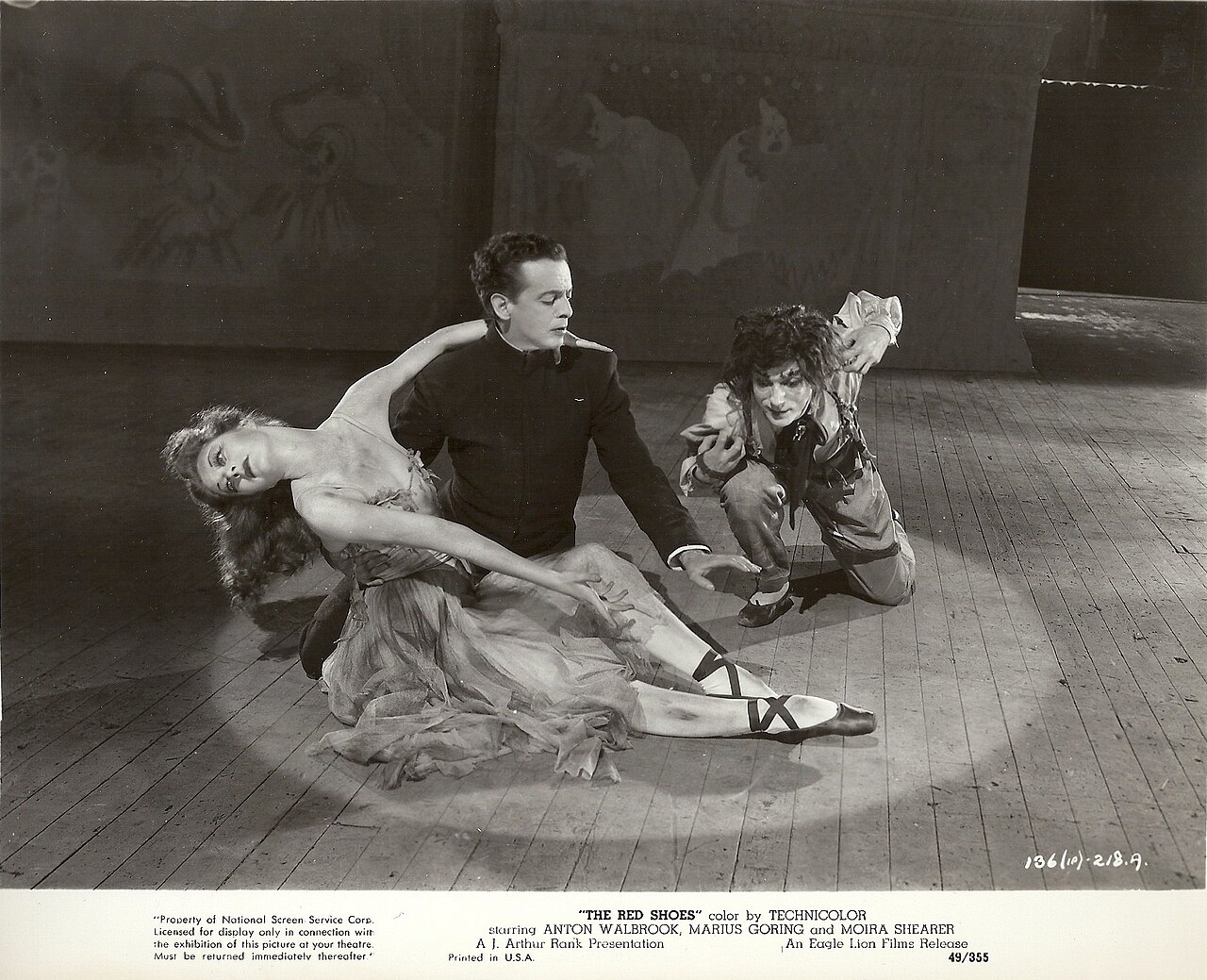
Image context: the cover uses an archival publicity still from Wikimedia Commons rather than a poster. That choice fits this article because the piece is about performance becoming a crisis of bodily commitment, and the still keeps the film's theatrical surface tied to actual dancers in actual photographed space before the argument moves into editing and restoration.[6]
Video 1: Criterion isolates the moment when ballet becomes cinema
Criterion's short is valuable because it does not treat The Red Shoes as a museum object first.[1] In barely more than a minute and a half, it moves straight to the film's governing question: why dance, and what kind of life does that question demand. The montage is fast, but its logic is clear. It puts performance, backstage emotion, and the central ballet in the same current, as if the film's narrative, design, and choreography were all pushing toward one irreversible state.
The best thing about the Criterion clip is that it reminds you how radically the film treats the ballet sequence.[1][3] The center of The Red Shoes is not a filmed stage performance preserved at tasteful distance. Once the ballet begins, painted sets, theatrical flats, impossible changes of scale, and camera-led transitions all loosen the relation between viewer and stage. Space expands, contracts, and mutates around Victoria. Dance is still the subject, but cinema has taken over the terms of perception.
That shift matters because the film's artistic absolutism would feel schematic without it. Lermontov can talk about devotion all he wants; the film has to make devotion visible. The extended ballet does exactly that. It takes a fairy tale about enchanted shoes and converts it into a screen language of compulsion: bodies move forward, backgrounds slide into fantasy, and the heroine's gift starts to look inseparable from entrapment.[3][4][5] Criterion's short gets at this by refusing to separate the famous dance from the emotional machine around it. The same movie that gives us rehearsal, backstage authority, and romantic pressure also gives us a dream zone where those pressures stop being abstract and become environment.
The video also quietly points back to casting and performance. BFI's account of the film emphasizes how crucial it was that Powell and Pressburger built the movie with actual dancers, especially Moira Shearer, Robert Helpmann, and Léonide Massine, rather than treating ballet as something to be faked with doubles and cutaways.[5] That authenticity is only half the achievement. The other half is that the film does not stop at authenticity. It takes the physical credibility of dancers and then lets editing, design, and color push that credibility into hallucination. Criterion's clip understands the film at exactly that hinge: concrete bodies, impossible world.
Seen this way, the short is not just promotional praise. It is a compact theory of why The Red Shoes changed the possibilities of dance on film.[1][3] Before the ballet, the movie is already elegant, tense, and richly designed. During the ballet, it becomes something more severe. It starts treating movement as destiny and performance as a form of surrender that the camera can intensify beyond anything a proscenium arch could hold.
Video 2: the restoration demo shows that color and texture are part of the drama
If the first video explains how the film thinks, the second explains how the film survives.[2][3] The Warner restoration demo is only a few minutes long, but it makes a decisive point: The Red Shoes depends on material richness that can be flattened, stained, or dulled over time. Once that happens, the movie's emotional structure also thins out. The film may remain legible as narrative, yet its dangerous beauty starts to lose pressure.
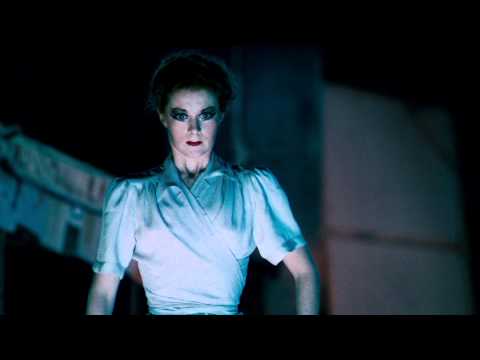
The demo's comparisons are useful because they show that restoration here is not simple polishing.[2][3] What returns in the restored shots is not generic brightness. It is hierarchy. Reds recover their pull. Black costumes and tuxedos regain enough depth to cut sharply against warm interiors. Faces stop looking chalked over and begin to sit properly inside the surrounding set design. The surfaces of dressing rooms, stage floors, curtains, painted backdrops, and cosmetics re-enter the image as active forces rather than decorative blur.
Wikipedia's restoration section makes clear how much labor stood behind that recovery.[3] The 2009 restoration drew on surviving original negatives and a large digital cleanup effort to correct damage, contrast problems, and visible defects before the restored film returned to Cannes.[3] That matters because The Red Shoes is one of those films where production design and cinematography are never secondary pleasures.[3][4][5] The color does not sit on top of the drama. It organizes the drama.
The restoration demo makes that visible in a way criticism alone sometimes cannot.[2][3] In the ballet sequence, restored color gives the fairy-tale world its seductive cruelty. In dressing-room and performance-preparation scenes, restored contrast clarifies the separation between flesh, costume, mirror light, and shadow, which is where so much of the movie's emotional threat lives. A film about total commitment needs more than beautiful hues. It needs colors that feel as if they can claim the body wearing them.
This is why restoration belongs inside the interpretation, not in a technical appendix off to the side. Powell and Pressburger built a film where stage design, costume, makeup, movement, and emotional obsession are locked together.[3][4][5] If the image loses density, the film becomes easier, safer, and more merely tasteful. The Warner demo shows the opposite process: the movie regains risk. What emerges is not nostalgia for old color but a reminder that Technicolor, in this case, was part of the film's violence.
What the two videos reveal together
Put together, the two videos tell a cleaner story than either does alone. Criterion's short isolates the formal leap by which dance becomes cinematic fate.[1] Warner's demo shows the material conditions that let that leap still register with force in the present.[2][3] One is about invention. The other is about transmission. Between them sits the real achievement of The Red Shoes: a film in which performance leaves the stage, enters the mind, and then has to be physically preserved so later viewers can still feel the shock of that transition.
That is also why the movie remains modern. BFI describes it as a "composed film," and the phrase is useful because it suggests more than prestige craftsmanship.[5] Everything in The Red Shoes is being composed toward intensity: music, decor, movement, camera distance, and color relations. The film does not merely illustrate a story about artistic sacrifice. It makes sacrifice into an audiovisual condition. The ballerina's crisis is not contained in dialogue or plot outline. It spreads through the whole frame.
Watch the two embeds in sequence and the movie's reputation sharpens. The Red Shoes is not immortal because it is beloved. It is beloved because it solved a very hard cinematic problem: how to make dance feel both physically real and spiritually coercive.[1][3][4][5] The first video shows the solution in miniature. The second shows how much preservation work is required to keep that solution alive. Together they make the film look less like a monument and more like an unstable, still-dangerous machine for turning beauty into necessity.
Sources
- CRITERION, "Three Reasons: The Red Shoes - The Criterion Collection," YouTube video, 2011.
- WarnerBrosMPI, "The Red Shoes Restoration Demo," YouTube video, 2012.
- Wikipedia, "The Red Shoes (1948 film)."
- BFI, "The Red Shoes".
- BFI, "The Red Shoes at 70."
- Wikimedia Commons, "Original publicity still for the film 'The Red Shoes.'"