Spoiler note: this piece discusses the ending of Charulata in detail.
Satyajit Ray's Charulata (1964) is often introduced as a delicate near-romance set inside a wealthy Bengali household. That description is true and insufficient. The film's stronger achievement is technical: Ray turns attention itself into cinematic material. Longing in Charulata is not mainly expressed through speeches or declarations. It is built through looking, drifting, listening, waiting, and stopping. The house becomes an instrument for those motions, and the camera learns to register them with almost musical exactness.[1][2][3]
That is why the film still feels startlingly modern. Ray does not treat interior emotion as something hidden behind the story. He gives it form. Three craft decisions matter most: the opera glasses that convert looking into a compositional system, the swing sequence that lets desire become camera rhythm, and the freeze-frame ending that arrests the fantasy of smooth repair at the instant it seems available.[1][3][4]
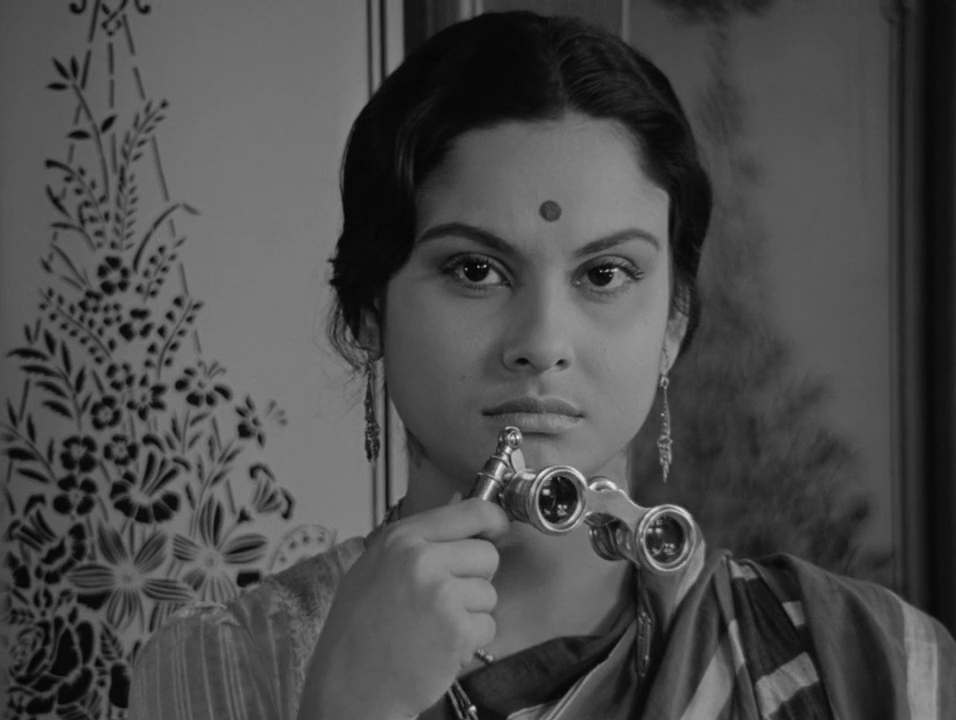
Image context: the cover uses a still of Madhabi Mukherjee as Charulata from the 1964 film itself, matching the article's focus on how Ray builds meaning through facial attention and spatial restraint rather than through plot incident alone.[5]
The opening teaches you how Charu sees
The first lesson arrives before the drama fully declares itself. Ray opens with an extended, nearly wordless passage inside Bhupati's house, following Charu through rooms, thresholds, windows, and corridors as she tries to animate an afternoon that has too much time in it.[1][3] She embroiders, wanders, pauses at the piano, approaches the window, withdraws, and finally reaches for the opera glasses. A less exact film would use these gestures as elegant character shorthand: lonely wife, absent husband, enclosed domesticity. Ray uses them more structurally. He is training the viewer to understand that the act of looking will be the movie's principal motor.
The opera glasses are crucial because they do two jobs at once. Narratively, they show Charu's boredom and curiosity. Formally, they create a repeatable logic of selection. Through them, the outside world stops being a general backdrop and becomes a sequence of chosen fragments: a passerby, a street movement, a patch of life beyond the house's cultivated stillness.[1][3] Charu does not merely observe. She edits. She crops the world into pieces that can momentarily answer the lack inside the room.
Ray's camera neither collapses completely into subjective point of view nor stays coldly outside it. Instead it hovers at an exact middle distance. We feel the pull of Charu's perception, but we also register the systems around her: furniture, balustrades, shutters, drapes, doorways, the architecture of polite wealth.[1][4] The result is that the film never reduces her to a trapped symbol. She is intelligent, sensuous, restless, and technically gifted at directing attention. The craft begins by making that intelligence visible.
The house is not static prison space; it is a moving diagram
Many films about domestic confinement settle for obvious visual imprisonment. Ray works harder than that. The house in Charulata does not operate as a blunt cage image. It is an elastic diagram of intimacy and distance, always changing according to who is in the room and what kind of speech is possible there.[1][4]
Bhupati, immersed in politics and newspaper work, occupies the house without really reading it. Charu glides through it as someone who knows its acoustics and dead zones. Ray maps that difference through movement. Doors and corridors do not simply separate characters; they delay contact and measure how far feeling has to travel before it can become language. In this film, domestic architecture is not background decor. It is timing equipment.
Sound extends that design. BFI's writing on the film notes how Ray lets bird calls, street sounds, vendors' cries, carriage noise, and other traces of life beyond the walls drift into the soundtrack.[3] Those details matter because they keep the outside world present as pressure, not escape. Charu hears a city that remains near enough to animate imagination and far enough to remain inaccessible in practice. The film's emotional atmosphere depends on that ratio.
This is also why Amal's arrival changes the movie so quickly. He does not smash the house open; he alters its circulation. Conversation loosens, wit returns, literary play enters the frame, and suddenly Charu's looking acquires an answering rhythm.[1][2] The house stays the same in plan, yet the film makes it feel newly breathable. Technique, not exposition, carries the shift.
The swing sequence turns thought into motion
The famous garden swing passage is the clearest demonstration of Ray's precision. It is often remembered as lyrical release, and it is that, but the sequence is more exact than "freedom scene" suggests.[1][3] Charu on the swing is not merely enjoying open air. She is discovering a way for sensation, intellect, and attraction to move on the same track.
As the swing rises and falls, the camera adopts that oscillation rather than simply recording it from safety. Vision becomes pendular. The world advances, recedes, advances again. What had been composed inside rooms as glances and pauses now converts into bodily rhythm.[1] Ray does not need a confession scene because the movement itself performs the emotional change. Amal has expanded Charu's imaginative field, and the film answers by expanding the available grammar of motion.
What makes the sequence extraordinary is its control. It does not dissolve into vague romantic intoxication. The play of movement remains tethered to perception, especially to Charu's eyes and to the sense that writing, reading, and desire are converging for her all at once.[1][4] In Charulata, attraction is never just erotic event. It is bound to authorship. Amal matters because he is not simply a possible lover; he is the figure through whom Charu's literary self begins to sharpen.
That link is decisive. Once Charu starts to write, the film's emotional stakes become larger than a triangle plot. The central problem is no longer only whom she loves. It is what kind of life can contain her intelligence without reducing it to ornament.[2][3]
Ray builds the crisis through looks, pauses, and interrupted handoffs
Because the source novella is Rabindranath Tagore's Nastanirh (The Broken Nest), viewers often expect a prestige-literary adaptation built on eloquent dialogue and moral explanation. Ray chooses a sharper path.[2][4] He strips away anything excessive and lets the decisive information travel through looks, interruptions, partial confidences, and carefully managed hesitations.
That is why Bhupati is so moving. He is not rendered as a villain who deserves exclusion. He is decent, absorbed, affectionate in ways he does not know how to make legible, and tragically slow at reading the person nearest to him.[1][3] Ray's craft depends on preserving that complexity. If Bhupati were simply crude or tyrannical, the film could resolve itself into ordinary emancipation melodrama. Instead it remains painfully balanced. Every look carries ethical weight because no one in the triangle can be reduced to one function.
Notice how often hands, notebooks, pages, and unfinished exchanges do the dramatic work. An offered text, a shared literary joke, a delayed glance, an interrupted conversation: these small transfers accumulate until the entire house feels charged.[1][4] Ray understands that longing becomes sharper when it travels through ordinary surfaces. The film's genius is not that it makes emotion bigger. It makes emotion finer.
The freeze-frame ending refuses false closure
The ending is one of the most famous in Ray's work for good reason. After revelation, hurt, and separation, Charu and Bhupati move toward each other. Hands extend. Reconciliation becomes imaginable. Then Ray suspends the action in a freeze frame rather than granting contact.[1][3]
That choice is not decorative modernism. It is the moral and formal culmination of the whole film. For two hours, Charulata has shown that perception precedes speech and that recognition arrives late, after habits and structures have already hardened. A conventional ending would ask us to believe that once everything has finally been understood, feeling can flow cleanly again. Ray refuses that simplification.
The freeze frame does something harsher and truer. It preserves the gesture toward repair while denying the comfort of completed repair. The moment is real; the solution is withheld. In other words, Ray allows grace to enter the frame without pretending that grace automatically solves history.[1][3][4]
That is why the ending keeps working. It is not ambiguity for its own sake. It is a precision cut at the exact boundary between possibility and restoration.
Why this craft still feels alive in 2026
Ray later said Charulata was the film of his own he would change least, and the remark makes sense once you study its construction.[1][3] The movie wastes nothing. Every visual device introduced early returns with greater emotional charge. Looking becomes desire; desire becomes authorship; authorship becomes crisis; crisis becomes a final arrested gesture.
Many marriage films can identify disappointment. Few can formalize its texture this exactly. Charulata remains essential because it trusts cinema to think through movement, framing, and pause rather than outsourcing feeling to explanation. Ray does not ask the audience to admire restraint as a moral virtue. He shows restraint as a physical medium in which longing, intelligence, and regret become visible all at once.[1][4]
That is a rare craft achievement. The film does not simply tell a story about someone whose life is larger than the room assigned to her. It makes that disproportion legible in every shift of camera, every corridor crossing, every glance through glass, and every inch of space the final handshake fails to close.
Sources
- Sam Wigley, "Charulata: the pinnacle of Satyajit Ray's art." BFI.
- Wikipedia, "Charulata."
- Kieron Corless, "Satyajit Ray's masterpiece Charulata gets UK rerelease." BFI.
- Daniel Kieckhefer, "Charulata." The Cinematograph.
- Wikimedia Commons, "Madhabi Mukherjee as the character of Charulata Dasi from the 1964 film 'Charulata', directed by Satyajit Ray." file page.