Charles Laughton's The Night of the Hunter (1955) remains one of the strangest American studio films because it never settles on a single scale of reality.[1][4][5] It is a Depression-era crime story, a child's nightmare, a religious fraud satire, and a river fable at the same time. That mixture could easily have split apart. Instead it becomes the movie's governing logic: evil is experienced by children as something at once ordinary and mythic, close enough to breathe on you and distant enough to feel like weather.
That is why the film still lands so hard in 2026. Many thrillers try to make pursuit frightening by adding procedural detail, explanatory psychology, or a larger body count. The Night of the Hunter takes the opposite route. It strips motive down to emblem, lowers the camera to child height, and keeps turning Robert Mitchum's preacher-hunter Harry Powell into a shape, a voice, and a song before he becomes a fully knowable man.[1][2][3]
Spoiler note: this essay discusses several major late scenes, including the river escape and the hymn standoff at Rachel Cooper's house.
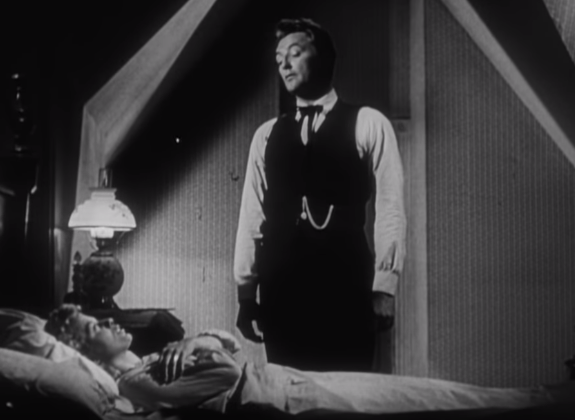
Image context: the cover uses a trailer still of Robert Mitchum and Shelley Winters as Harry Powell and Willa Harper. It is the right image for this reading because the film's first great shock is domestic: Powell does not arrive as abstract evil, but as a husband who turns a bedroom into a death chamber.[7]
The movie thinks at child height
One of the cleanest ways to understand the film is to notice that it rarely grants adult authority the last word. Adults dominate rooms, preach, flirt, accuse, and bargain, but the movie's deepest visual logic belongs to John and Pearl. Criterion's early essay on the film stresses how thoroughly the story is filtered through a child's eye for distortion, fairy-tale terror, and hard moral contrast.[1] That does not mean the movie is naive. It means scale is selective.
Powell keeps entering the frame as a figure children would remember first as silhouette and posture: broad-brimmed hat, long coat, mounted outline against the horizon, hands already marked by the LOVE/HATE sermon he turns into traveling theater.[1][2] Laughton and cinematographer Stanley Cortez do not treat those shapes as decorative Expressionist flourishes. They are the movie's moral geometry. John especially reads adults through mass, shadow, voice, and threat radius long before he can convert them into social explanation.
This is why the film's performances stay slightly stylized without breaking the emotional contract. A child's memory does not file danger under balanced nuance. It stores the sharp edges: the too-soft voice, the song before the face appears, the horse on the ridge, the knife of moonlight across a room. The movie is realistic about fear because it is realistic about how fear is remembered.
The river changes the movie's clock
The river escape is the section that proves the film is not simply a noir with gothic decoration. Once John and Pearl slip away by skiff, narrative time loosens. The chase remains real, but the movie stops moving like a manhunt and starts moving like a ballad.[1][2] Animals watch from the banks. Reeds, frogs, rabbits, and night sky enter the frame with an almost nursery-rhyme calm. The children drift through a world that is still threatened by Powell, yet no longer fully organized by him.
That change in tempo matters. If the entire film stayed inside Powell's predatory momentum, terror would eventually flatten into monotony. The river instead creates an interval where the children occupy a different order of time. They are between households, between names, between adult jurisdictions. The images become less about pursuit logistics and more about suspension: the possibility that innocence can survive by floating through a landscape that is not yet captured by money, police procedure, or false religion.[1][6]
It is also the film's most beautiful formal gamble. Laughton lets stillness do work that other thrillers would hand to escalation. The river sequence enlarges the movie's moral space; it gives the children, and the audience, a temporary world outside Powell's speech. That lyrical detour is exactly why his return later feels so invasive. He is not merely catching up to the plot. He is re-entering a dream.
Shadow turns pursuit into storybook terror
Michael Sragow's Criterion essay calls the film a work where silent-era visual boldness, Southern gothic menace, and tabloid American grotesque all cross one another.[2] You can feel that mixture in the way the movie keeps flattening depth. Powell on horseback against the skyline, the knife-sharp outline of his body on cellar walls, the uncanny underwater image of Willa's hair floating in the submerged car: these are not neutral scene records. They are images arranged to feel half remembered, half illustrated.[1][2]
That quality is what separates the film from ordinary realism. Laughton is not trying to make the world plausible in every corner. He is trying to make it legible in the way folktales are legible. Good and evil do not become simplistic, but they do become readable through shape. Rachel Cooper's farm carries warmth, labor, and communal rhythm; Powell carries intrusion, counterfeit scripture, and a darkness that arrives already framed.
The brilliance here is that the movie never lets stylization become weightless. Willa's murder, John's distrust, and the town's gullibility all keep the story tied to material stakes: money, widowhood, sexual panic, public piety.[2][4] Storybook design and social cruelty sit in the same frame. That is why the film feels both archaic and modern. It understands that evil often reaches children first as a pattern before it becomes an argument.
The hymn is the film's long-distance weapon
The most frightening thing about Powell is that he can colonize sound before he occupies space. Phuong Le's recent BFI piece on Mitchum is especially sharp on this point: Mitchum plays Powell as a seducer of atmosphere, someone whose voice can spread through barns, bedrooms, and dark yards before his body fully arrives.[3] The recurring use of "Leaning on the Everlasting Arms" becomes the movie's acoustic version of silhouette.
The hymn works because it travels across moral boundaries without changing melody. Powell sings it as possession. Rachel Cooper sings it as endurance. The notes are the same, but the force behind them is different. In the late-night standoff outside Rachel's house, the film stages one of cinema's great sound duels without turning it into action choreography.[1][3] A killer waits in darkness. An older woman answers from the porch. The scene becomes unbearable because nobody needs to explain what is at stake. The hymn already carries the whole contest: counterfeit faith against lived conviction, predation against shelter, theater against watchfulness.
That is the article's core claim about the film. The Night of the Hunter does not make evil memorable by overdescribing it. It makes evil audible at a distance. Powell becomes terrifying because children and viewers learn to recognize his approach as a recurrence in the world, like weather returning over the same field.
Why it still feels singular in 2026
The historical outline is familiar now: Laughton's only directorial feature opened to mixed reviews and weak commercial response, then gradually became canonized as one of the great American films.[4][5][6] What matters is why the afterlife was so strong. The movie did not merely age well; it escaped the period categories that first confined it. It is too stylized to sit quietly inside social realism, too emotionally exact to reduce to camp, and too committed to child experience to behave like prestige noir.
Its lasting lesson for filmmakers is severe. If you want to portray danger from a child's point of view, do not just simplify the plot. Change the world's scale. Let shadow, song, and threshold do the explanatory work that adult dialogue usually handles. Laughton understood that fear is often clearest when narrative information is thinnest and formal design is sharpest.
That is why The Night of the Hunter still feels so alive. It turns pursuit into drift, drift into myth, and myth back into a house, a porch, and two voices singing the same hymn for opposite reasons.
Sources
- David Ehrenstein, "The Night of the Hunter." The Criterion Collection, 1988.
- Michael Sragow, "The Night of the Hunter: Holy Terror." The Criterion Collection, 2010.
- Phuong Le, "A child's demon: Robert Mitchum in The Night of the Hunter." BFI / Sight and Sound, 2024.
- BFI Education, "Film 6: The Night of the Hunter (1955)." British Film Institute.
- MoMA, "Charles Laughton's The Night of the Hunter." Museum of Modern Art, 2009.
- Library of Congress / National Film Registry, "The Night of the Hunter."
- Wikimedia Commons, "File: Robert Mitchum and Shelly Winters in Night of the Hunter.png" — trailer screenshot source for the cover image.