Spoiler note: this essay discusses the Countess's secret, her death, and the final card game in The Queen of Spades.
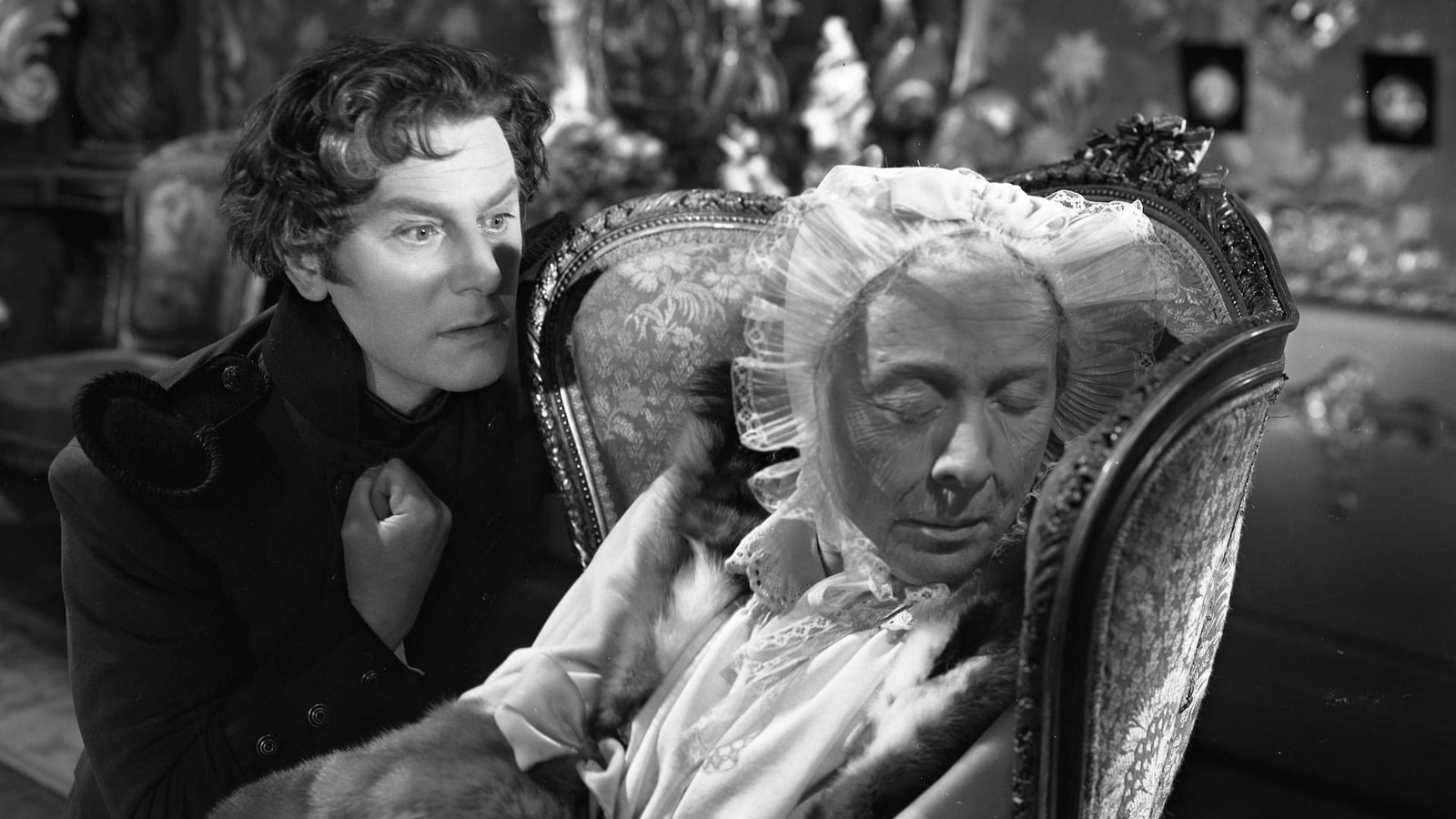
Herman Suvorin bends toward the old Countess, but the chair gets between them. Its carved crest rises beside his face; its pale, patterned upholstery seems to absorb hers. Fur, lace, porcelain, frames, and reflective surfaces occupy nearly every remaining interval. The room does not open behind the actors so much as continue accumulating. It is luxury rendered as congestion.
Nothing in that image advertises the conditions under which Thorold Dickinson's The Queen of Spades was made. The production worked on constricted, poorly soundproofed stages at Welwyn Studios, beside a railway and within earshot of a cereal factory, on a small postwar budget.[1][2] Yet the 1949 film conjures ballrooms, bridges, a crowded bird market, a cavernous apartment, and a St Petersburg winter. Its achievement is not that it successfully hides scarcity. The restrictions became a method: Oliver Messel's designs supply dense fragments, William Kellner's art direction gives those fragments physical continuity, Otto Heller's lenses stretch them, Dickinson's viewpoints conceal their limits, and sound animates what no wall encloses.
The result fits its protagonist with unsettling precision. Suvorin wants the Countess's legendary three-card secret because he believes it can turn chance into a closed system. The film surrounding him does the reverse. It never gives us a stable, complete map. A palace exists as a corner, a reflection, a sound beyond a door. The viewer must keep manufacturing a world from evidence that cannot quite be trusted.
A palace planned at half an inch to the foot
The most revealing survivor of the production is small enough to sit on a table. The BFI National Archive holds a model for the Countess's apartment made at a scale of half an inch to one foot. Doors, screens, chandeliers, furniture, and wall decoration are already arranged in it—not as isolated embellishments, but as a system of obstructions and sightlines. Claire Smith notes that the room was conceived as a place virtually unchanged for fifty years, its contents softened by dust and patina.[1]
That aging matters. Messel did not design a neutral box and then furnish it with expensive-looking things. He designed time as something that occupies volume. Curtains partition the depth; objects interrupt approaches; patterns make walls refuse to recede cleanly. The Countess appears preserved inside her possessions, while Suvorin has to negotiate them as he tries to extract the past's supposedly usable secret. Decadence here is not abundance alone. It is abundance that has ceased to circulate.
The craft credits also deserve precision. The film credits Kellner with art direction and Messel with settings and costume designs.[3][5] That division reminds us that a production image is made between conception and execution. Messel's model could organize color, texture, and relation; Kellner's department had to turn those relations into camera-ready surfaces on a changing studio floor. Heller and Dickinson then determined which part of that material world would become the world of a shot.
The shortage became the method
The Welwyn stages could not accommodate an imperial city at full scale. Lodwick's study of Messel's film work describes a full-size stagecoach that could travel no more than ten feet, sets being dismantled as money ran out, and scenes filmed out of final sequence as the production adapted. Even apparent exteriors—the bridge and bird market among them—were made indoors.[2] Meanwhile, factory machinery began in the morning and trains periodically made synchronized dialogue unusable.[1][2]
Those circumstances encouraged a particular unit of construction: not the vista, but the charged fragment. A carriage needs only enough distance to enter an angle and stop. A market can register through foreground cages, bodies crossing on several planes, artificial snow, and a crowded sound field. A façade can be inferred from a wall edge, a lamp, and a creature carved above a doorway. Each fragment is richly specific, while the whole remains unavailable.
That distinction prevents the usual romantic story about ingenuity triumphing over a low budget. The film does not look like a lavish production assembled by cheaper means. It looks uncanny because its spaces are selectively complete. They possess far more tactile information than geographic information. We can almost feel the Countess's upholstery, but we cannot confidently draw the route through her home. Constraint shaped the expressive language rather than merely testing it.
The lens finishes what the carpenters cannot
Heller's wide-angle photography makes that selective construction expansive without making it restful. A wider lens can include more of a shallow set, but it also enlarges the apparent distance between near and far objects. In the ballroom, that separation lets foreground figures, chandeliers, columns, and dancers imply a social world extending past the built floor. Lodwick connects the sequence's scale directly to Heller's use of wide lenses where physical space was unavailable.[2]
The same principle becomes more audacious in the flashback to the young Countess and the occultist Count Saint-Germain. The production could not afford the grand exterior required for her arrival. It built a small architectural corner with a lamp and a gargoyle-like ornament, then looked steeply down as her coach entered. The high viewpoint suppresses the horizon that would expose the stage, while the isolated ornament gives the darkness a vertical structure.[1][2] The palace is not shown. Height, blackness, and the carriage's reduced scale persuade us to supply it.
Dickinson repeatedly uses point of view this way. A character's look motivates a narrow selection; the reverse angle confirms just enough; the omitted architecture becomes mentally continuous. It is economical, but never merely evasive. Suvorin is himself assembling a fatal conviction from glimpses, hearsay, a book, and the Countess's silence. Every time the film asks us to complete an unseen room, it makes his interpretive habit briefly feel like ordinary spectatorship.
Mirrors turn extension into doubt
Mirrors offer another inexpensive route beyond a wall, but The Queen of Spades makes their extra space unstable. They catch a passage or body that the principal frame cannot hold, converting a finite set into a virtual adjoining room. At the same time, a reflected depth has no door through which an actor can simply walk. It is spatial evidence and spatial deception at once.
The BFI programme notes argue that these mirrors are integrated into the film's visual thinking rather than applied as decorative period detail.[3] That is exactly why they belong in a story about secret knowledge. Suvorin treats every sign as access to something hidden behind it. A mirror seems to reward that instinct by revealing more, yet it only gives him a reversed surface. More information does not produce firmer orientation.
One effects shot compresses this logic further. A foreground crucifix was filmed through glass so that talon-like ceiling forms could remain visible in the same composition.[2] Devotional object, threatening ornament, and impossible depth occupy a single plane. The camera has not passively documented a room; it has reorganized separate elements into a moral trap. What looks like architecture is partly an optical event.
Furniture changes the actors' scale
The cover still reveals why the Countess's apartment needed such exact density. Evans's pale face and clothing merge tonally with the enormous chair. She can seem frail within it, but also enthroned by it—as if the room has grown around her and now lends her its mass. Walbrook's dark, upright Suvorin bends around the carved frame. Although he is the mobile intruder, the furniture dictates the line of his approach.
This is production design acting on performance. Suvorin cannot simply cross an empty room and confront the Countess face to face. Screens, chair backs, fabric, and clustered objects make his desire take a crooked physical route. When he finally corners her for the secret, menace comes not from spatial command but from violating an already saturated enclosure. The apartment feels less like property than an extension of the Countess's memory.
The contrast continues elsewhere. Military interiors organize officers into repeating lines; the ballroom disperses them through light and movement; Suvorin's private rooms isolate his face against darker planes. The film's 1.37:1 frame, listed by Rialto for the 1949 release, is nearly square by contemporary standards.[5] Rather than fight that compactness, the design stacks information vertically and in depth. Ceilings, hanging lights, tall doors, and foreground objects press upon the figures. Palatial scale becomes pressure, not breathing room.
Sound supplies the corridor the camera withholds
There is a productive irony in a film made on stages plagued by outside noise becoming so exact about sounds with no visible source. The finished track does not merely accompany the built rooms; it extends them. Music, voices, footsteps, fabric, and the small percussive signals of movement announce spaces and presences before the camera verifies them. The Harvard Film Archive singles out the rustle of silk and the tap of a walking stick that herald the dead Countess.[4]
Those sounds complete an absent corridor more efficiently than another set could. They give the ghost distance, direction, and pace while withholding a body. Because the living Countess was so strongly fused with fabrics, furniture, and ritual movement, silk and stick are sufficient to reconstruct her after death. The production no longer needs Evans to occupy the frame for her space to return.
Georges Auric's score participates in the same architecture. Period dance music gives public rooms their social rhythm, while darker choral and orchestral passages make private obsession feel ceremonially enlarged.[3][5] But the smallest noises are often the most disturbing. A tap beyond the frame turns the edge of the image into a doorway. In a studio where the actual beyond might have been bare floor, sound creates the most threatening room of all: the one the spectator cannot inspect.
A complete world made from incomplete rooms
Suvorin's dream of mastery culminates at the card table. He believes three named cards will remove contingency, converting the future into architecture: ordered, traversable, guaranteed. The fatal substitution of the queen for the expected ace exposes the fantasy. His system always contained an image he could not control.
The film has prepared that defeat through craft. Its St Petersburg is persuasive, but it is never guaranteed. Wide lenses stretch shallow stages; a high angle makes a fragment monumental; mirrors offer rooms that cannot be entered; furniture turns social position into geometry; offscreen sounds make missing corridors active. Every technique enlarges the world while reminding us, quietly, that enlargement is an act of perception.
This is why the production's cramped origins are more than an anecdote. A truly unlimited build might have offered comprehensive space—long approaches, complete façades, establishing views. Dickinson's film instead makes luxury unknowable one piece at a time. Its palace feels immense because no shot can stabilize it, and inescapable because every fragment seems to imply another just outside the frame. The studio walls disappear, but enclosure remains.
Sources
- Claire Smith, “The Queen of Spades: the set model from a gothic British classic.” British Film Institute, October 14, 2022 — the Welwyn production constraints, Messel's scale model and aged-apartment concept, spatial strategies, restoration context, and the BFI National Archive still used for this article.
- Keith Lodwick, “The Film Work of Stage Designer Oliver Messel.” V&A Online Journal, Issue 1, 2008, pp. 116–125 — production history, studio limitations, partial builds, lens choices, indoor exteriors, optical effects, and the collaboration among Messel, Kellner, Heller, and Dickinson.
- Philip Horne, “The Queen of Spades.” BFI Southbank programme notes, December 2022 — principal craft credits and critical analysis of the film's camera movement, mirrors, music, sound, and Romantic design.
- Harvard Film Archive, “The Queen of Spades,” July 29, 2000 — programme note on the suffocating set design, mobile camera, and ghostly sound cues.
- Rialto Pictures, “The Queen of Spades” — U.S. distributor catalogue entry with the 1949 release year, 1.37:1 presentation, synopsis, cast, and principal production credits.