Spoiler note: this essay discusses both of the film's love stories, their illnesses, and the ending.
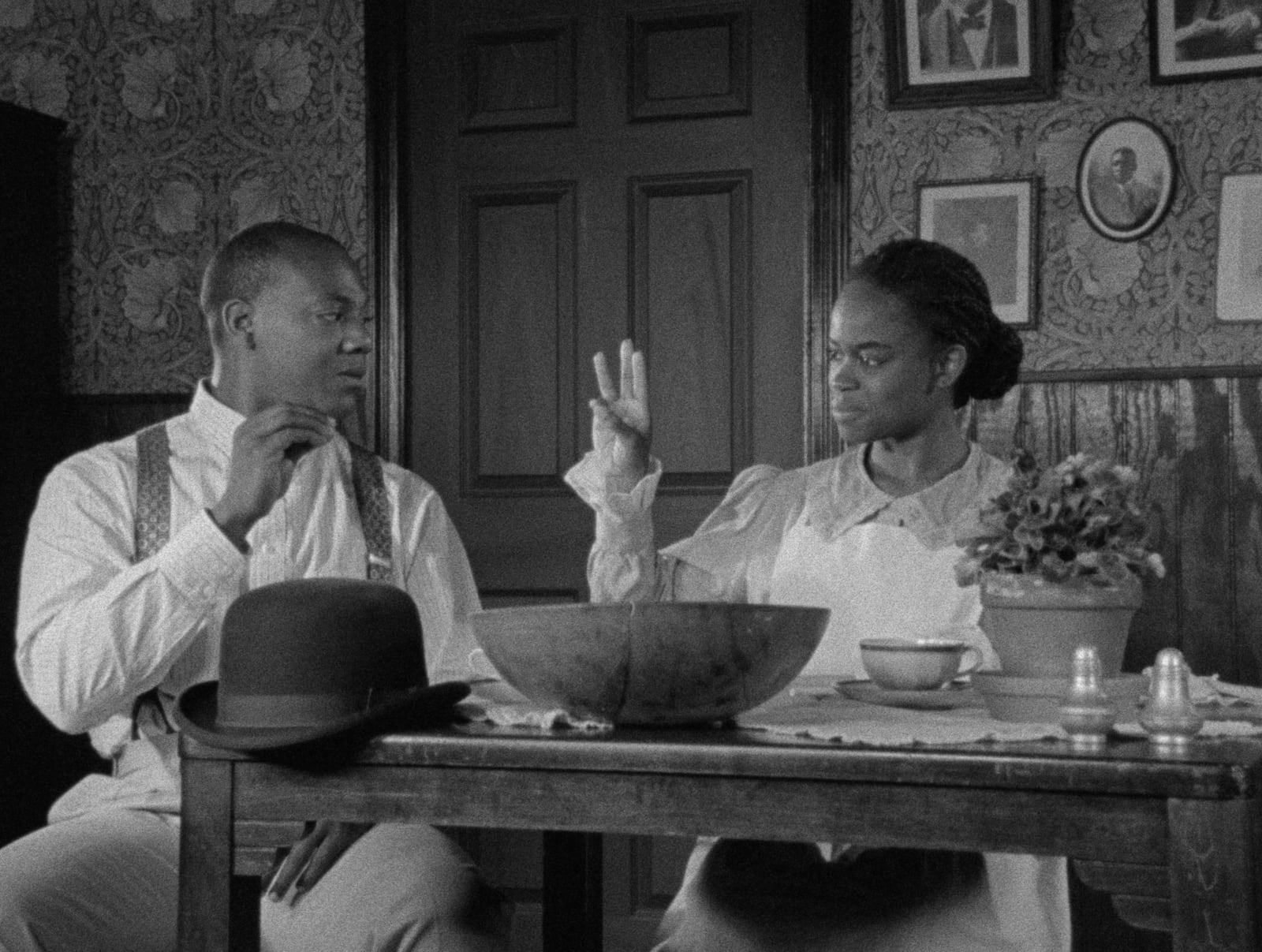
At a dining table in Compensation, Malindy and Arthur watch each other's hands. A broad wooden bowl sits between them; family portraits crowd the wallpaper behind. Arthur's fingers are tentative. Malindy's are exact. The scene does not treat signing as a magic switch that makes difference disappear. It lets courtship look like practice.
That distinction is the quiet strength of Zeinabu irene Davis's 1999 feature. Most romances use failed communication as an obstacle on the way to a more fluent feeling: once the right people recognize their love, the story suggests, understanding should follow. Compensation reverses the order. Feeling supplies a reason to try, but understanding has to be made. Love is not the universal language waiting underneath difference. It is what two people build while learning how the other person communicates.
Davis tests that idea twice. Michelle A. Banks and John Earl Jelks play Malindy and Arthur in early-twentieth-century Chicago, then Malaika and Nico in the city near the century's end. The first pair are a Deaf, educated dressmaker and a hearing migrant from Mississippi who cannot read; the second are a Deaf graphic artist and a hearing children's librarian. Tuberculosis enters the earlier romance and HIV the later one.[1][4] The doubled casting invites comparison, but the film never turns the couples into interchangeable figures in a tidy historical rhyme. The same faces meet different limits, resources, prejudices, and technologies. What persists is not one tragedy repeating. It is the need to create a shared way of knowing.
No one arrives as the complete translator
Malindy and Arthur's differences cross more than the Deaf-hearing line. Malindy has literacy and an established life; Arthur has hearing but has been denied education. She can move easily through sign and print where he cannot. He can hear a world that withholds information from her. Neither person possesses the complete key to the other.
The modern story rearranges those positions. Nico's work as a librarian places him inside the circulation of printed language, while Malaika's art gives her a confident visual practice. He is verbally quick but not automatically fluent in her language. When she teaches him to sign, the lesson is flirtation precisely because it preserves effort. Nico has to slow down, look, imitate, and risk being clumsy. The film makes attention visible as an action rather than using dialogue to announce that he cares.
This balance grew from a production decision. Davis and screenwriter Marc Arthur Chéry had first imagined two hearing couples. After seeing Banks in a Black Deaf staging of Waiting for Godot, they redesigned the film around her, and Davis began studying American Sign Language and Black Deaf culture. Black Deaf performers and technicians joined the production as well.[2][5] Accessibility did not arrive after the movie as a correction to a finished concept. A collaborator changed the concept, and the movie found its form by responding.
That origin matters because Compensation does not present communication as the generous gift of a hearing world. The hearing characters also need translation, education, and patience. Malindy's experience at a white school for Deaf students has not made her socially visible there, while Arthur's illiteracy carries the history of racist exclusion from education.[3][4] Their romance cannot solve those structures. It can refuse to reproduce them in miniature. Each person must stop treating his or her own access to language as the neutral one.
The film does not grant any viewer a neutral seat
For roughly its first fifteen minutes, Compensation has no on-screen spoken dialogue. Davis uses ornate intertitles, tableau-like compositions, archival photographs, ragtime, gesture, and facial response before Arthur's entrance brings speech into the film.[2] The effect is not a silent-era costume draped over a period story. It establishes that cinema has always communicated through several channels at once—and that no single audience receives all of them in the same way.
ASL asks a hearing viewer to read movement and space. Intertitles interrupt the fantasy that spoken words are naturally complete. Open captions place sound and speech inside the image instead of leaving them as privileged information outside it. A glance across a room, a hand held too long, or a failed attempt to follow a sign can carry as much dramatic weight as a line of dialogue. Rather than translating everything into one dominant mode, the film keeps several modes active and lets their overlaps become the story.
Sound is equally deliberate. Davis's production history describes passages built from breath awareness, silence, heavy bass, amplified vibration, underwater textures, and distorted telephones, answering machines, and TTY signals.[2] Those choices should not be mistaken for a universal simulation of Deaf experience. They do something more precise within this film: they make the soundtrack variable and embodied. Sound can press on a body, fail to deliver a message, or become noise around a device that was supposed to connect people.
The result is a romance in which spectators also have to adjust. A hearing viewer cannot simply sit inside Nico's presumed normality. A viewer who reads the signs may know something before he does. Someone attending to the captions may notice rhythm that another spectator treats as support text. Compensation does not flatten those positions into a slogan about inclusion. It composes the film so that access changes from moment to moment.
A missing movie becomes a social scene
The most audacious bridge between the two centuries is a film within the film. Malindy, Arthur, and their friends go to see William Foster's The Railroad Porter, an early Black-cast comedy that no longer survives. Davis reconstructs part of the lost movie from traces in the Black press, then reconstructs something archives preserve even less often: a Black audience watching it.[3][4]
The spectators do not behave like solemn witnesses to a recovered artifact. They laugh, warn the characters, and talk back to the screen. Their responses complete the performance. The scene proposes that a film's history includes the habits, jokes, and collective intelligence of the people who received it—not only a print, a credit list, or a catalogue record.
This is also why Compensation's archival photographs never feel like neutral proof inserted between fictional scenes. Trains, streets, Black Chicago institutions, and portraits of leaders place Malindy and Arthur within a past that left uneven visual evidence. Davis combines record and invention without pretending the difference is irrelevant. The photographs certify that lives and places existed; the fiction asks what desires, conversations, and moviegoing pleasures might have moved among them.[3]
Communication across time therefore resembles communication between lovers. The surviving archive does not contain a complete message waiting to be opened. Someone must approach its gaps, learn its available signs, and answer without claiming total fluency. Davis's recreation of The Railroad Porter is not a counterfeit replacement for a lost film. It is an honest act of address to people whose cultural life exceeds what institutions managed to keep.
The two epidemics do not cancel each other out
The film's title comes from a short poem by Paul Laurence Dunbar. Davis encountered it while making A Powerful Thang, when performer Asma Feyijinmi connected Dunbar's writing about love and death to friends lost during the AIDS crisis. Chéry developed the screenplay from the parallel between Dunbar's tuberculosis and that contemporary grief.[2][5]
In Compensation, tuberculosis threatens Arthur in the earlier story; in the later one, Malaika is living with HIV. The rhyme is unmistakable, but Davis does not use one epidemic as a decorative metaphor for the other. The changed position of illness matters. So do the different histories of stigma, medicine, sexuality, race, and public language around each disease. Repeating the actors makes continuity available while the specific lives prevent equivalence.[3][4]
Even Dunbar's poem travels by more than one route. In the period story, a pastor reads it as part of Arthur's farewell to Malindy. In the contemporary story, a Deaf dancer performs a musical version in a jazz club.[2] One text crosses page, voice, music, body, and time. Its meaning is not preserved by keeping its delivery fixed. It remains alive because a new community gives it another form.
The title's notion of compensation is therefore uneasy. Nothing repays Malindy for Arthur's illness, and no historical parallel compensates Malaika for hers. Love does not balance a ledger of suffering. What it can offer is a practice of refusing isolation: a letter made accessible, a poem embodied, a sign learned carefully enough to answer, a person's way of perceiving treated as part of the world rather than a barrier to it.
The restoration had to keep learning too
The film's long afterlife extends that argument. Compensation was shot largely in 1993, premiered in 1999, and reached Sundance in 2000, but did not receive a conventional theatrical release until 2025.[3][6] By then even its 1990s Chicago locations had become historical evidence. A city filmed as the present had joined the archive beside the period photographs.
The new 4K restoration was made from the 16 mm original camera negative by the Criterion Collection, the UCLA Film & Television Archive, and Wimmin with a Mission Productions, in conjunction with the Sundance Institute and with Davis's approval. The team also mastered the intended stereo sound and created new open captions designed by Alison O'Daniel with the film's caption collaborators.[2][3] This was more than removing scratches from an image. The work revisited how the film meets an audience.
Davis has called the result a rejuvenation rather than merely a restoration.[3] The word fits. A movie devoted to responsive communication could not treat accessibility as a fossilized decision from 1993. Its return required another collaboration, another round of listening, and another design for making information felt and seen.
After selection for the National Film Registry in 2024 and its belated theatrical release, the film continued reaching new audiences on disc and in repertory screenings through 2026.[5][6] That chronology is satisfying, but canonization is not the most important ending. Compensation matters because it turns connection from a sentiment into a craft. A hand learns a shape. An image waits for a response. A caption joins the composition. An absent film is addressed through reconstruction. A restoration changes so that more of the audience can enter it.
Love, in this film, is never the reward for already understanding another person. It is the decision that understanding is worth working toward.
Sources
- Janus Films, “Compensation” — official film page with synopsis, format details, press materials, and the official still used for this article.
- Zeinabu irene Davis, “Production History,” in the official Janus Films press notes for Compensation — casting and research, ASL and silent-film form, sound design, Dunbar's poem, crew composition, credits, and 4K restoration details.
- Racquel Gates, “Compensation: Archiving the Spirit.” The Criterion Collection, August 26, 2025 — parallel narrative, Black cultural archive, The Railroad Porter reconstruction, Chicago locations, collaboration, and the restored captions.
- UCLA Film & Television Archive, “Compensation” — archival catalogue essay and credits covering the two romances, tuberculosis and AIDS, Deaf-hearing communication, title cards, and the film's reconstruction of Black silent cinema.
- Library of Congress, “Interview with Filmmaker Zeinabu Davis” — Davis on the film's origin in Dunbar's poem, its epidemic parallel, Black Deaf casting, Chicago history, and its 2024 National Film Registry selection.
- Sarah Hotchkiss, “A Jewel From the World of Black Film Arrives at YBCA.” KQED, July 10, 2026 — distribution history, restoration, theatrical release, home-video availability, and renewed audience circulation.