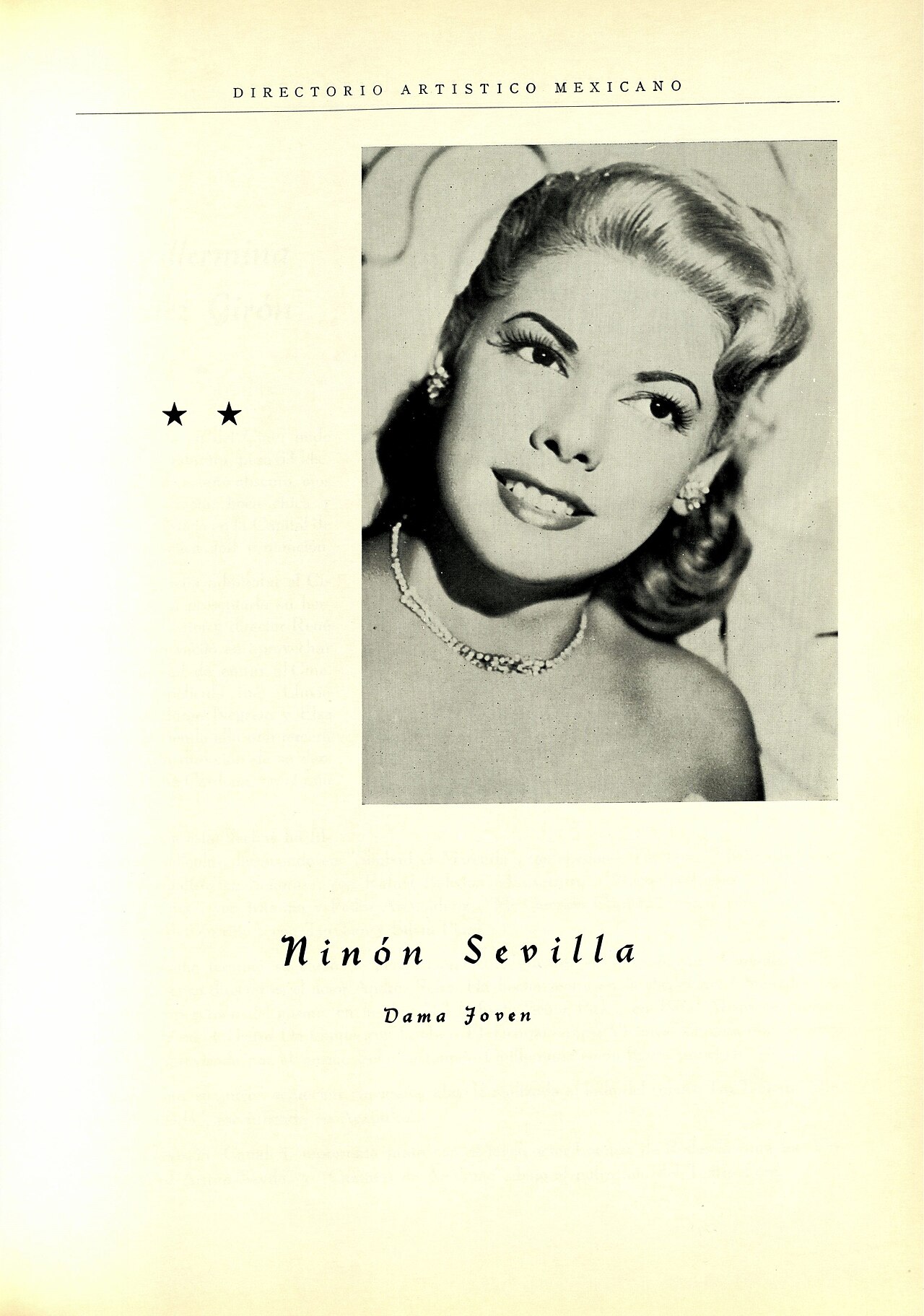
Ninón Sevilla is perfectly still in the portrait above. Her gaze turns just past the lens; earrings, necklace, coiffed hair, and the pale curve of one shoulder make a careful studio image. The photograph comes from a 1954 directory of Mexican artists, made just after the short, incandescent peak of the films that had taught audiences to expect the opposite from her: speed, percussion, fabric in flight, a dancer taking command of a room.[9]
That contrast is a useful entrance to cabaretera cinema, the Mexican cycle of nightclub melodramas that flourished around the late 1940s and early 1950s. Its stories often place a woman inside an old moral machine. Betrayal, poverty, sexual coercion, crime, and social shame drive her from domestic respectability toward the cabaret; danger waits behind the curtain, and the ending is asked to restore an order that her presence has disturbed. Yet when the music starts, the films build another machine. The stage expands. The camera rises, dives, and multiplies the dancer. A heroine defined by what has been done to her becomes, for several minutes, the person who determines where everyone else looks.[1][2][4]
The genre's great contradiction lies there. Cabaretera films did not reliably liberate their women from punitive narratives, and their glamour could turn race, sexuality, and Afro-Caribbean culture into spectacle. But neither did their musical numbers merely decorate the punishment. In Aventurera (1950), Salón México (1948), Sensualidad (1951), and Victims of Sin (1951), melodrama, noir, and dance pull against one another so vigorously that no single moral can close the film without remainder.[1][4][5][7]
The dance floor outruns the punishment not because every heroine escapes. It outruns it because movement gives her an expressive scale the plot cannot take back.
The fallen-woman story acquired an orchestra
Cabaretera cinema did not invent the woman cast out by respectable society. Mexican sound cinema had already made a foundational success of Santa (1932), adapted from Federico Gamboa's 1903 novel. Its familiar trajectory—seduction, abandonment, migration to the city, sex work, decline—made female sexuality the site on which social order could be broken and then mournfully repaired. Music was present, but largely as contained performance: a bolero or danzón offered within the world of the story.[1]
The later cabaretera retained that narrative inheritance while crossing it with other forms. Joanne Hershfield describes a recognizably Mexican mixture of the seduced-and-abandoned melodrama, the hard urban edge of cine de arrabal, and tropical popular music: Cuban danzón and rumba, Brazilian samba, and the live-performance traditions that traveled with them.[2] Crime brought guns, pimps, corrupt officials, wet pavement, and chiaroscuro into the musical. The musical brought orchestras and dancers into noir. Melodrama supplied family sacrifice, betrayal, and impossible respectability to both.
This hybrid took shape during the presidency of Miguel Alemán, from 1946 to 1952, amid rapid urban growth, official modernization, corruption, and changing public behavior. Large cabarets presented musical talent from across the Americas to growing urban audiences. They were spaces where dancing, drinking, smoking, paid intimacy, class display, and female public presence met under one roof.[1] The films made that roof unstable. A club could be workplace, prison, refuge, marketplace, stage, and social map within the same reel.
The word cabaretera therefore names more than a location. It names the woman whom the story tries to classify through that location: dancer, sex worker, victim, provider, dangerous spectacle, or star. The category is never neutral. What makes the genre exciting is that performance keeps interfering with classification.
In Aventurera, the room grows to fit Sevilla
The first major dance number in Alberto Gout's Aventurera offers the clearest formal demonstration. Elena, played by Sevilla, has been deceived into a nightclub world and assigned the role of dancer. Before her entrance, the club's performance area appears modest: a low platform, tables, and floor space for patrons. Her number does not remain inside those measurements.[4]
Through framing and editing, the stage suddenly acquires arches, stairs, and a tower. The camera alternates high views with close approaches and follows Sevilla at angles unavailable to the seated customers visible in the fiction. The film spectator is no longer watching from a nightclub table. Cinema has detached the performance from the room that supposedly contains it.[4]
Then the number ends. The curtain and applause return us to a smaller, more plausible stage. The mismatch is the point. The expanded set was not a continuity error or a claim about the club's architecture. It was an audiovisual privilege granted to performance. Later, a photographic effect multiplies Elena's figure; in Aventura en Río (1953), slow motion, concealed cuts, and instantaneous costume changes push a related dance into dream logic. The cabaret provides a pretext, but the camera and edit produce a space no cabaret audience could see.[4]
It would be too easy to call that expansion liberation and stop. Elena is still enmeshed in coercion, and the viewer's privileged gaze can turn virtuosity into possession. What the sequence changes is not her legal or economic condition but her formal weight. During the number, she is no longer simply the object passed between men and plot points. Her timing organizes the edit. Her path discovers the set. Her body establishes the image's scale.
This is why the genre's dances cannot be removed as interruptions without changing the argument. Narrative time asks what will happen to the cabaretera. Performance time asks what she can make happen now.
Noir waits just beyond the orchestra
The orchestra never seals the room. Cabaretera cinema repeatedly lets noir enter through a side door: a gangster at a table, a bargain backstage, a weapon, an official whose virtue proves conditional. Daniel Chávez Landeros's study of Mexican noir identifies a “rumbera noir” within the broader cabaretera tradition. In Sensualidad, Sevilla's dancer sets out to destroy the reputation of a celebrated judge, turning the supposedly stable man of law—not only the nightclub woman—into the genre's fallen figure.[5]
That reversal matters because it moves moral danger away from a woman's sexuality alone. The judge brings corruption into the courtroom and home; respectability ceases to be a shelter and becomes something that can perform as deceptively as any nightclub act. Noir does not correct the musical's excess. It spreads instability through institutions that claim to stand outside it.
In Salón México, Emilio Fernández and cinematographer Gabriel Figueroa locate the dance hall within the corruption of the Alemán-era city, but the room is not simply a sewer from which the heroine must be rescued. Marga López's Mercedes works there to support her younger sister. MoMA's program note reads the hall, and her alliance with an idealistic policeman against a gangster, as an image of communal solidarity.[7] Smoke and shadow can signal threat while the same crowded space sustains work, music, and reciprocal care.
Fernández's Victims of Sin sharpens the collision. Sevilla's Violeta is introduced as a rumbera who takes pleasure and pride in her work, not an innocent whose first dance proves a spiritual fall. After she adopts an abandoned baby, violence and economic pressure push her between two clubs: the lavish Club Changoo and the working-class La Máquina Loca near the railway. Figueroa's chiaroscuro joins crime to dance, while the change in venues makes the city's class divisions visible.[1]
The musical numbers are essential pauses in that pressure. Violeta does not become safe when she dances, but she becomes legible as more than the sum of the injuries directed at her. The film's unusual refusal to make the rumbera herself the final object of punishment does not dissolve the genre's contradictions. It reveals how much of its moral machinery had always depended on containing the performer after giving her the screen.[1]
A Mexican genre moved on Cuban feet
The cabaretera is rightly situated within Mexico's Golden Age, its studios, stars, censorship, urban history, and mass audience. Yet its sound and movement make a purely national account impossible. Gabriela Pulido Llano places María Antonieta Pons, Amalia Aguilar, Ninón Sevilla, and Rosa Carmina within a larger migration of Cuban performers to Mexico between the 1930s and 1950s. They built their Mexican careers inside a hemispheric traffic in theater, nightclubs, records, touring, and film.[3]
Pons, often treated as the first great screen rumbera, arrived with experience in Cuban performance. Sevilla moved from Havana to Mexico City, danced at the Teatro Lírico, and became a Calderón productions star. Her work extended beyond executing steps devised elsewhere: she choreographed her own showcase sequences and exercised unusual influence over collaborators.[1][3]
That authorship complicates the phrase “exotic dancer.” The industry certainly marketed foreignness, tropical abundance, costume, sexuality, and racialized ideas of danger. But the performer was not just raw material for a Mexican camera. The rumberas carried techniques, musical knowledge, professional networks, and star personae across borders; they helped decide how the genre moved.
The circulation continued outward. Cabaretera films found audiences elsewhere in Latin America; Aventurera later won fervent critical attention in France.[5][6] That travel was not an accidental afterlife added to an already complete national form. Transnational music and labor had been inside the form from the beginning.[3]
This does not make cabaretera cinema a frictionless celebration of cultural mixture. Afro-Caribbean music could be welcomed while Blackness and Afro-diasporic religion were framed as sensual, primitive, or threatening.[8] A useful reading has to hold appropriation beside collaboration, and stereotype beside the unmistakable centrality of Cuban women to the genre's creation. The films are most revealing where those facts refuse to resolve into a single verdict.
The contradiction was also a business model
Form alone does not explain why the cycle burned so brightly or changed so quickly. The rumbera film was attractive industrially because it could promise sensational titles, music, glamorous stars, urban danger, and moral resolution without requiring every spectacle to leave the studio. Research on Producciones Calderón describes the formula as relatively economical and exportable, well suited to audiences experiencing related dramas of modernization across Latin America.[6]
The films could celebrate the city's energy while warning against it. That double address was commercially nimble. Nightlife looked like the future—loud, cosmopolitan, sexually charged—and like evidence that the future required stronger moral policing. A viewer could be invited to desire the spectacle and approve its containment without ever leaving the same sequence.[6]
The balance altered after the cycle's 1946–52 peak. Tighter censorship, reduced credit, production contraction, and exhibition pressures encouraged the Calderón company to place greater melodramatic weight and fewer direct references to prostitution in later Sevilla vehicles. By 1953, the rumbera's particular union of urban provocation and musical command was already being redirected.[6]
That industrial history keeps the genre from becoming a romantic tale in which charismatic performers simply defeated conservative stories. The stories were designed to sell provocation and reassurance together. Censorship did not arrive from outside an otherwise free form; negotiation with permissibility helped shape the form's thrills from the start.
Yet the formula never achieved perfect control. To sell Sevilla's dance as spectacle, a film had to give it duration, space, rhythm, collaborators, and a camera capable of registering mastery. The image could be moralized before and after. While the number lasted, it still had to persuade.
What the ending cannot repossess
Genre labels usually help us gather similarities: the nightclub, the fallen woman, the rumbera, tropical music, criminal intrigue, the sacrificial family plot. Cabaretera cinema becomes more interesting when the label reveals a conflict among those parts.
Melodrama tries to explain the woman's situation through suffering. Noir discovers rot in the city and its respectable institutions. Dance suspends explanation long enough for skill and pleasure to become facts in their own right. None of the three modes wins permanently. That is why the films can feel censorious and unruly, exploitative and star-making, bound to their political moment and unexpectedly alive.
Return to Sevilla's portrait. The directory fixes a professional identity on paper: one artist, one face, one year. Her films keep refusing that stillness. In Aventurera, the modest platform becomes an impossible palace because she moves through it. In Victims of Sin, performance interrupts a plot organized by male violence and makes another center visible. Across the genre, the cabaretera may be driven toward a punishment, a rescue, or a moral category.
But the dance has already changed the size of the room.
Sources
- Jacqueline Avila, “Victims of Sin: Dancing in the Dark.” The Criterion Collection, June 19, 2024 — the fallen-woman tradition, Alemán-era nightlife, cabaretera conventions, Ninón Sevilla's career, and the spatial and musical logic of Victims of Sin.
- Joanne Hershfield, “The Cinema of the Cabaretera,” in Mexican Cinema/Mexican Woman, 1940–1950. University of Arizona Press, 1996 — the genre's combination of prostitute melodrama, cine de arrabal, tropical music, and anxiety over women's changing social roles.
- Gabriela Pulido Llano, “Las mil y una rumbas. Cuatro cubanas en México.” Dimensión Antropológica 44, 2008 — María Antonieta Pons, Amalia Aguilar, Ninón Sevilla, and Rosa Carmina within Cuban performers' migration to Mexico.
- Silvana Flores, “Relaciones intermediales en el cine mexicano: los números musicales y el espacio teatral.” Cuadernos.info 56, 2023 — close analysis of how framing, editing, effects, and camera movement expand the cabaret stage in Aventurera and Aventura en Río.
- Daniel Chávez Landeros, “The Fall of Virtuous Men: Mexican Film Noir, and the Crisis of Values in the Postrevolutionary State, 1950–1959.” Latin American Research Review 58, no. 4, 2023 — the “rumbera noir” and the relocation of moral collapse onto male authority in Sensualidad.
- Fernando Mino Gracia, “Crisis, censura y búsquedas de la industria del cine mexicano en los años cincuenta: el caso de Sombra verde de Producciones Calderón.” Historia Mexicana 69, no. 1, 2019 — rumbera-film economics, modernization, censorship, export appeal, and the cycle's post-1952 turn.
- The Museum of Modern Art, “Salón México. 1948. Directed by Emilio Fernández” — production record and curatorial account of the dance hall as both big-city noir setting and space of communal solidarity.
- Rodrigo Daniel Hernández Medina, “Noches de fiesta africana: el cine de rumberas y el miedo a la religiosidad negra.” Estudios de Historia Moderna y Contemporánea de México 63, 2022 — analysis of how rumbera films joined Afro-diasporic religion to colonial stereotypes, urban fear, and nightclub spectacle.
- Wikimedia Commons, “Ninón Sevilla en 1954” — Asociación Nacional de Actores portrait from the Academy of Motion Picture Arts and Sciences' Mexican Players Photographs collection, and source record for the article image.