The Palm Beach Story begins with one of the strangest promises in romantic comedy: a wife decides the cleanest way to save her marriage is to leave it.[1][2][3] Gerry Jeffers loves her husband Tom, believes in his engineering idea, and concludes that the only workable route forward is financial triage through divorce, remarriage, and strategic patronage.[1][2][3] Preston Sturges does not treat that premise as an embarrassing detour before true feeling can reassert itself. He treats it as the film's central intelligence. Money is not the vulgar interruption of romance in this movie. It is the medium through which romance has to think.[1][2]
That is what makes the film feel so peculiar and so fresh.[1][2][4] Criterion's page describes it as a wild story of wacky wedlock built around a couple in trouble both financially and romantically.[1] Stephanie Zacharek's essay sharpens the deeper point: the movie opens full of question marks, never offers reassuring certainty, and understands that having too little money can wound a marriage as surely as emotional drift can.[2] TCM's synopsis, meanwhile, states the plot with almost brutal clarity. Gerry splits from Tom while they are still "young enough to make other connections," then goes south in search of wealth that might rescue the future she still wants with him.[3] My inference from these sources is that The Palm Beach Story remains one of screwball's hardest films because it refuses the comforting lie that love and material structure belong to separate genres.
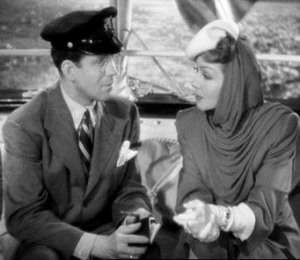
Image context: the lead still from Wikimedia Commons shows Gerry Jeffers and John D. Hackensacker III in one of the film's crucial comic pairings.[6] It belongs with this essay because Gerry's relation to wealth is never simple gold-digging or pure innocence. She is at once calculating, affectionate, improvisational, and morally exposed, and Sturges keeps staging those contradictory energies through scenes where money arrives as conversation, hospitality, wardrobe, transportation, and possibility.
Gerry treats marriage like a financing problem because the film does too
The movie's first real shock is how little shame it attaches to Gerry's premise.[1][2][3] Tom is an inventor with a dazzlingly impractical dream of an airborne airport suspended on steel nets above Manhattan, and the dream needs capital long before it can become dignity.[1][2][3] Gerry sees the problem with a directness romantic comedy usually avoids. If the husband cannot currently support the marriage, perhaps the marriage should reorganize itself around another source of backing.
Zacharek is especially useful here because she takes Gerry's proposition seriously rather than reducing it to farce setup.[2] The essay argues that Sturges knew exactly what money could and could not buy, and that he understood the real damage caused by not having enough of it.[2] That makes Gerry's scheme feel less like frivolous madness than like a screwball version of emergency restructuring. She is reckless, but not deluded. She knows Tom's pride is injured, knows her own tastes cost money, and knows affection by itself will not pay rent or underwrite invention.[2][3]
This is why Claudette Colbert's Gerry feels so modern.[1][2] She is neither the dutiful wife waiting to be rescued nor the cold opportunist whose appetite must be punished. She behaves more like a venture capitalist of intimacy, trying to reroute resources toward a future she still emotionally prefers. Sturges does not ask us to approve every step. He asks us to recognize the steel inside the fantasy. Gerry's scheme is comic because it is outrageous. It is also lucid because she has correctly diagnosed the marriage as an economic structure before she treats it as a spiritual one.
The train turns wealth into circulation, and circulation is the movie's real romance engine
Once Gerry boards the train, The Palm Beach Story stops looking like a domestic comedy and starts behaving like a floating exchange floor.[2][3][4] Millionaire sportsmen, porters, sleeping cars, borrowed pajamas, chance encounters, uncoupled compartments, and fresh benefactors all move through the same rolling system. Money is never still in this film. It is always being transferred, offered, displayed, or converted into a new social arrangement.[2][3][4]
TCM's "Big Idea" article matters here because it ties the film's train delirium to Sturges's own life.[4] Frank Miller notes that the sleeping-car chaos, including the uncoupling episode, grew out of the director's childhood travel memories with his mother.[4] That biographical detail helps explain why the train sequences feel so fully imagined. They are not generic screwball commotion. They are a whole worldview in motion: luxury as accident, transport as class theater, and mobility as the precondition for comic reinvention.
The train also clarifies Gerry's peculiar gift. She attracts capital without ever fully becoming its possession.[2][3] TCM's synopsis lays out the chain cleanly: she rides with the Ale and Quail Club, catches the attention of Hackensacker, reaches Palm Beach, and keeps turning one financial encounter into another without settling into simple transaction.[3] Zacharek makes the same point more elegantly by describing how Gerry's gifts, dresses, and protections arrive through men with money while she continues to act less like property than like a force field of movement.[2] Sturges keeps making wealth liquid enough to keep the plot airborne.
Hackensacker and the Palm Beach rich are ridiculous, but the movie needs their generosity
One of the film's subtlest moves is that it does not treat rich people as a single moral category.[1][2][3] Hackensacker is absurd, sheltered, and gently comic, yet he is also the person who most clearly grasps that money's highest use may be to reduce friction for other people.[2][3] Even his notebook of purchases, which Zacharek describes item by item, becomes less an instrument of control than a record of delighted expenditure.[2]
That matters because Sturges is not making a socialist satire in which wealth only corrupts.[2][4][5] He is making a farce in which wealth becomes infrastructure. Palm Beach itself is less a realistic destination than a climate-controlled zone where money can accelerate mistaken identities, wardrobe changes, leisure rituals, and new pairings at impossible speed.[3][5] The BFI entry is sparse, but even its metadata and linked Florida essay position the film inside a sunlit world where luxury is environmental rather than incidental.[5] Palm Beach is not just where the story goes. It is the temperature at which the story can become this bizarre.
This is why the movie's extravagance feels both intoxicating and unsettling.[1][2] Hackensacker's hospitality is real, yet it exposes the fragility of Tom and Gerry's ordinary life. The richer the film becomes in surfaces, the more naked the original marriage looks. Tom needs money to build; Gerry needs money to live as herself; Hackensacker and his world can provide both, but only by rearranging the couple's emotional geometry. In a sentimental comedy, this would be the point where virtue rejects luxury. Sturges is tougher. He lets luxury make itself genuinely useful before asking what the bill might be.
The ending blows up moral clarity on purpose
What finally makes The Palm Beach Story so enduring is that it never pretends to solve its own contradictions.[1][2][3] Zacharek says the movie opens with question marks and ends with fifty more, and that is exactly right.[2] The famous closing twist with twins does not tidy the plot so much as expose how little Sturges cares for tidy moral accounting. The ending is a comic detonation under the idea that romantic destiny needs a single orderly line of legitimacy.
This is where the film's money logic and its love logic finally become identical.[1][2][3][4] Throughout the picture, assets, partners, names, and futures have all proved transferable. Why should identity itself remain fixed when the whole movie has been built on substitution and exchange? The twin ending sounds like a gag, and it is a magnificent one, but it also tells us what kind of faith the movie believes in. Not moral certainty. Not domestic sobriety. A wager. A leap taken in full view of absurdity.[2]
Seen this way, The Palm Beach Story is one of the great screwball films not because it is merely fast or bizarre, but because it is unusually honest about the bargains hiding inside glamour.[1][2][3][4][5] Gerry and Tom do love each other. Sturges never mocks that. He simply refuses to pretend that love arrives detached from rent, invention, travel, benefactors, clothing, or class weather. By the time the film reaches its delirious final switch, it has already taught us how to read romance as a moving market: irrational, comic, dangerous, generous, and impossible to regulate for long. Very few movies have made marital instability feel so reckless, or so alive.
Sources
- The Criterion Collection, "The Palm Beach Story (1942)" film page with synopsis, credits, and restoration details.
- Stephanie Zacharek, "The Palm Beach Story: Love in a Warm Climate," The Criterion Collection.
- Frank Miller, "The Essentials - The Palm Beach Story," Turner Classic Movies.
- Frank Miller, "The Big Idea - The Palm Beach Story," Turner Classic Movies.
- BFI, "The Palm Beach Story (1942)" film page.
- Wikimedia Commons, "Rudy Vallee and Claudette Colbert.jpg" still from The Palm Beach Story.