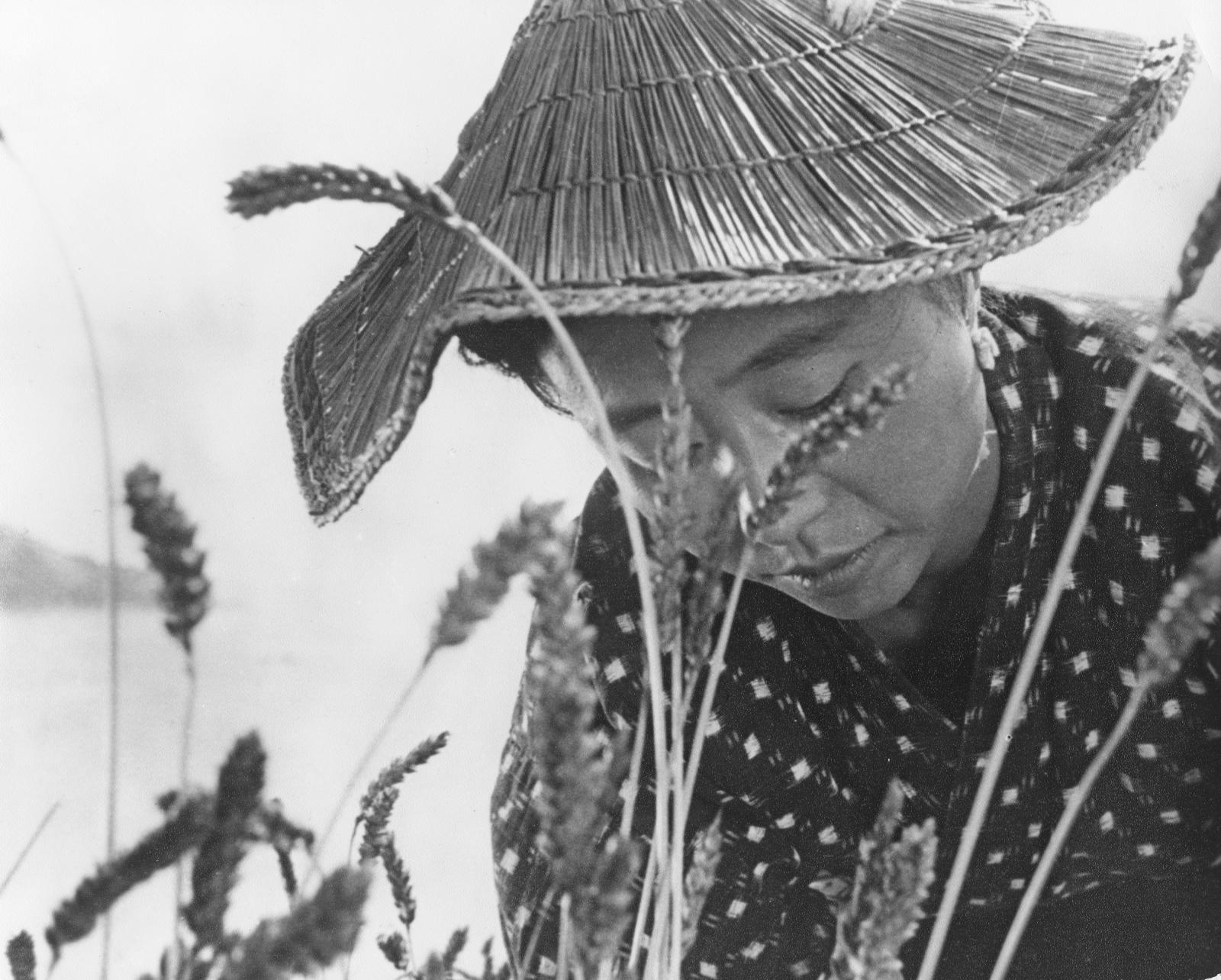
Spoiler note: this essay discusses the death of a child and the film's ending.
Water in The Naked Island is never simply poured. Toyo bends, steadies a bucket with both hands, and tips a narrow allowance onto one plant. The dry soil darkens. She steps to the next plant and repeats the movement. Her husband, Senta, works another row. By the time the family has crossed the sea, filled four wooden buckets, rowed home, and climbed the island's steep path, the water reaches the ground in measures small enough to make abundance look impossible.
Kaneto Shindō's 1960 film is nearly dialogue-free, but it is not silent. Oars knock, water shifts, feet scrape rock, wind moves across the Inland Sea, and Hikaru Hayashi's score returns with the labor. Shot in black and white by Kiyomi Kuroda in the unusually wide 2.35:1 frame, the 96-minute film follows a farming couple and their two sons on a small island without fresh water.[1][2] Its story can be summarized in a few verbs: row, fill, carry, pour, plant, harvest. Its drama lies in what happens when those verbs recur.
Repetition is often treated as the absence of an event. Here it is the event. Shindō makes the viewer learn the exact shape of a working day, then lets fatigue, violence, pleasure, modernity, and death alter that shape without replacing it. The bucket does not become physically heavier. Our knowledge of what it costs keeps accumulating inside it.
The yoke writes weight across the frame
The first climbs teach us how to watch. A shoulder yoke bows under two full buckets. The carrier's torso leans forward while the containers swing on either side, so every step has to correct the last one. Kuroda's CinemaScope compositions do not turn the human figure into a heroic monument. The wide frame leaves room for the long shore, the diagonal path, the cultivated summit, and the water below. Destination and burden remain visible together.[2][6]
That geography matters because the sea is both the family's route to survival and the reason survival takes so much work. Water surrounds the island, but none of it can irrigate the crops. The film repeatedly converts a beautiful expanse into an unusable resource. A view that might promise freedom in another movie becomes the distance between the family and the next four buckets.
Shindō does not compress the trip into a brisk montage that merely tells us labor occurred. He keeps returning to its parts. We see the boat settle under the adults' weight; the pails fill at the neighboring shore; the oars pull; the yoke bends; the path steepens; each plant receives its portion. The repetition gives work duration, and duration gives water value. One bucket now contains a crossing, a climb, and a section of the day.
This is why an early spill lands with such force. Toyo loses her footing and water pours into the dirt before it reaches the crop. Senta strikes her. The blow is abrupt, ugly, and inseparable from the arithmetic the film has already taught us: lost water also means lost rowing and lost bodily effort. Understanding that pressure does not excuse the violence. It reveals how scarcity has been enforced inside the family, with the exhausted woman made answerable not only to the land but also to her husband.[2][5]
Toyo resumes the climb. The film does not grant the strike a separate argument, apology, or reconciliation. Work absorbs it. That absorption is more disturbing than a dramatic quarrel would be. The routine can contain violence and still look, from a distance, like admirable endurance.
A repeated melody is not the same feeling
Hayashi's music follows a similar logic. Its central theme returns so persistently that it begins to function like another tool: a musical yoke laid across successive passages of labor. Haden Guest describes its cadence as close to a work song, while the BFI emphasizes the counterpoint between that score and the elemental sounds of wind and water.[3][5] The melody gives the days continuity, but it does not tell us that the days are emotionally identical.
At first, repetition can feel stately. The family appears coordinated with the landscape, and the score lends their motions a grave composure. As the journeys accumulate, the same music can feel coercive. Emilie Bickerton notes that its meaning darkens even when its melody remains stable.[6] That is the film's crucial musical insight: context can change while form stays put.
The effect protects The Naked Island from a simple celebration of hardship. If the score swelled differently for every setback, it would translate labor into familiar dramatic cues. Instead, the recurring theme makes the viewer do the moral listening. Is this perseverance or entrapment? Family coordination or a system that cannot pause? The film refuses to settle the question because the same gesture can hold more than one truth.
Modern Japan is visible across the water
The family's life can initially look detached from historical time, as if the island were a fable rather than a place in postwar Japan. A trip to the mainland breaks that illusion. The family encounters shop windows, a television, crowds, and a funicular climbing above the Inland Sea. Guest reads this interlude as the film's sharpest contrast between rural labor and Japan's accelerating consumer modernity.[3]
The television is especially pointed. On the island, every image has been earned through physical access: the family rows toward a shore, walks a path, or looks across real distance. In the shop window, the screen delivers another place without demanding a crossing. The family can see modern abundance, but seeing is not sharing. Their island is not outside the twentieth century; it is close enough to watch the century proceed without them.
That proximity changes the water sequences again. The labor is not presented as the last trace of an untouched, timeless peasantry. Shindō used professional actors on an uninhabited island, creating a deliberately constructed situation rather than documenting an established island community.[3] The Japan Film Database records a production team of only thirteen, working through Shindō's independent company Kindai Eiga Kyokai.[1] The austerity on-screen and the precariousness behind the camera echo one another, but neither should be mistaken for accidental realism.
Shindō was testing what cinema could make an audience feel through bodies, framing, sound, and recurrence. The film's international breakthrough—including the Grand Prix at the 1961 Moscow International Film Festival—came from a wager that such formal severity could travel without explanatory dialogue.[1][4]
Grief breaks the action before it breaks the cycle
The film's longest interruption begins when the elder son falls ill while his parents are away. Distance, previously measured as labor, becomes delay. The water route has organized the family's life so completely that an emergency must travel through the same geography: someone has to cross, fetch help, and return. The boy dies before the ordinary world can be made to arrive in time.[1]
After the funeral, his classmates leave the island and the family faces the field again. Toyo shoulders the yoke. She begins the familiar climb. Then the movement that has been controlled for most of the film comes apart. She flings the water away, tears at the plants, strikes the earth, and cries while Senta watches.[6]
The action answers the earlier spill. The first loss of water is accidental and punished; this one is deliberate and cannot be disciplined back into meaning. Early in the film, a bucket is too valuable to waste even when a body fails under it. Now the crop itself looks intolerable because keeping it alive cannot recover the child. Toyo destroys in seconds what the film has taught us to count in crossings and climbs.
Her revolt is also cinematic. For most of the running time, emotion has been routed through repeated action. Grief suddenly makes the action unusable. The yoke cannot balance it, the measured pour cannot express it, and the score cannot convert it into dignified perseverance. Otowa's body, so often bent toward a task, turns against the task's entire grammar.
Then she pours again.
That return is not a restoration of the opening order. A cycle can resume without healing. The surviving family still needs food, the plants still need water, and no alternative has appeared across the sea. The final repetition therefore holds two incompatible meanings at once: continuing is the only form survival can take, and continuing is proof that survival has offered no mercy.
The same image cannot be seen twice
Shindō's close is severe because it refuses the consolations usually attached to endurance. The family does not master the island. Modernity does not rescue them. Grief does not ennoble the work, and the work does not cure grief. What changes is the viewer's capacity to see recurrence as sameness.
By the final climb, a bucket carries more than water. It carries the memory of the wasted crossing that provoked a blow, the mainland abundance available mainly as spectacle, the emergency that could not move fast enough, the crop torn up in mourning, and the child who will not meet the boat again. None of those things is visible in the container. The film has placed them there through duration.
That is why The Naked Island needs so few words. Its argument is not hidden in silence, waiting to be decoded into a slogan about nature or fortitude. It is built in the difference between the first time a body performs an action and the last time we watch it. The bucket returns unchanged. The film makes it heavier.
Sources
- Japan Film Database, “The Island / 裸の島” — official film record with 1960 release details, cast and crew, synopsis, production-company credit, thirteen-person crew note, festival history, and official stills.
- The Criterion Collection, “The Naked Island” — film page with synopsis, restoration information, 96-minute running time, 2.35:1 format, and principal cast and craft credits.
- Haden Guest, “The Naked Island: The Silence of the Sea.” The Criterion Collection, May 17, 2016 — essay on repetition, the score, independent production, postwar modernity, and the constructed island setting.
- Jasper Sharp, “Where to begin with Kaneto Shindo.” British Film Institute, April 18, 2019 — career context, independent production history, Moscow award note, and the BFI still used for this article.
- British Film Institute, “10 great films with little or no dialogue” — critical note on the film's water-carrying labor, environmental sound, recurring score, and interpretive openness.
- Emilie Bickerton, “Kaneto Shindo — master of Japanese cinema.” The Guardian, June 22, 2012 — career profile connecting the film's bending yoke, repeated score, child’s death, and Toyo's breakdown to Shindō's cinema of survival.