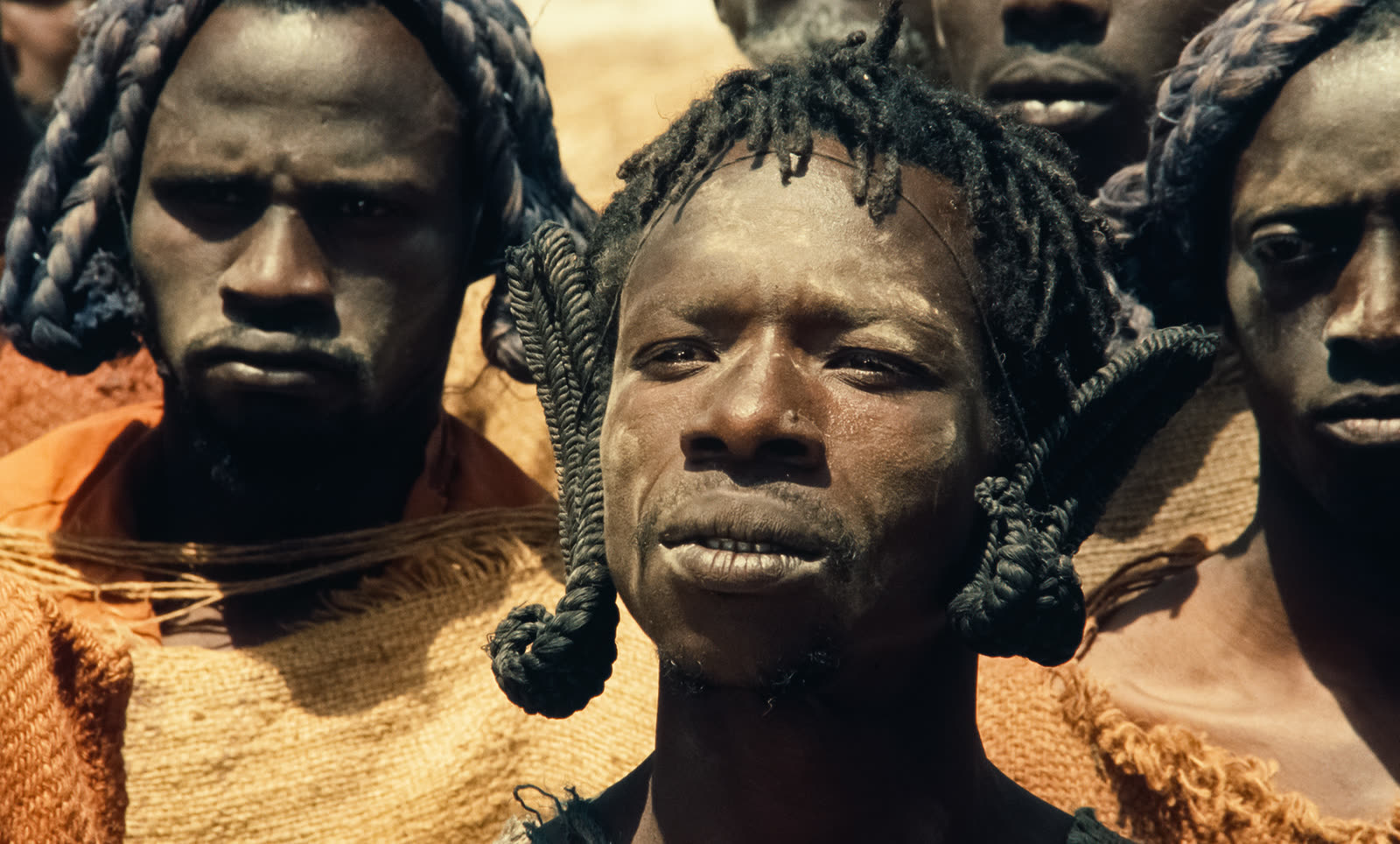
Spoiler note: this essay discusses the full film, including its ending.
The yellow shoes arrive before the murder. That order is the cold joke at the center of Djibril Diop Mambéty’s Hyenas. The residents of Colobane insist that they will never accept Linguère Ramatou’s offer of a fortune in exchange for Dramaan Drameh’s death. Then Dramaan notices the new footwear. His neighbors say they bought it on credit. Their pockets have not changed, and Linguère has not yet paid the town, so the shoes can be financed by only one expected event: Dramaan will die.
No ballot has been cast. Nobody has confessed to changing sides. Yet every bright pair is already a vote.
That is why Hyenas is sharper than a parable in which money simply corrupts good people. Mambéty’s 1992 film shows consumer desire reorganizing time. Colobane begins to spend a murder before committing it, then treats the purchases as practical facts that make the murder inevitable. Shoes, cigars, typewriters, a chandelier, refrigerators, and televisions do not merely symbolize greed. They are small contracts with a future the buyers publicly disavow and privately expect.[1][4]
A debt is waiting at the welcome banquet
Mambéty adapted Friedrich Dürrenmatt’s The Visit but made its bargain answer to Colobane, the Dakar neighborhood where he grew up. He imagined Linguère as connected to Anta, the young woman who has the courage to leave Senegal at the end of Touki Bouki. Nearly twenty years later, the returning exile has become fabulously rich and powerful.[3] Ami Diakhate plays her with an authority so complete that the village’s frantic welcome looks obsolete before she speaks.
Her demand is not arbitrary. As a teenager, Linguère became pregnant by Dramaan. He denied paternity, bribed witnesses, and allowed the local court to disgrace and expel her. He then married a wealthier woman and eventually became Colobane’s generous grocer. Linguère returns with the judge who heard the old case and offers to rescue the bankrupt town if it reverses that injustice and kills the man who profited from it.[1][2][4]
The history prevents an easy division between innocent village and corrupt outsider. Linguère has a legitimate claim against Dramaan and the institutions that helped him. Dramaan’s present generosity also rests partly on an advantageous marriage made after his betrayal. Colobane was never morally pure; its celebrated shopkeeper and its compromised court belong to the same past Linguère forces into public view.[4]
But her offer does not repair that past. It prices a new injustice high enough to make the old one visible. Linguère refuses the town’s habit of forgetting her, then reproduces its logic of collective punishment around Dramaan. She does not conceal the terms. The villagers are the ones who need to convert a bargain into a destiny.
The ledger changes direction
Before Linguère arrives, Dramaan’s shop runs on a forgiving kind of credit. Neighbors drink together, children receive sweets, and customers can pay when they have money. The ledger records relationships that already exist. Adrian Fielder’s close analysis of the film describes this as a horizontal interdependence: imperfect and compromised, but built on reciprocal life within the town.[4]
Linguère’s fortune reverses the direction of obligation. Once her offer is known, customers ask Dramaan to write up expensive imported food, liquor, and tobacco. Their new credit does not rest on trust between buyer and shopkeeper. It rests on capital above and outside the relationship—money Linguère will release only after the shopkeeper has been killed.[4]
This is the film’s most vicious economic transformation. Dramaan must personally extend the loans whose settlement requires his death. Every entry in his book says two things at once: we are still your neighbors and we expect to outlive you. The familiar ritual of buying on account remains, but its social meaning has inverted.
Mambéty makes that inversion visible rather than explaining it away. Oumou Sy’s costumes, Matthias Kälin’s cinematography, Loredana Cristelli’s editing, and Wasis Diop’s music build a world where objects announce the decision that dialogue keeps postponing.[1][2] The yellow shoes are especially cruel because they are wearable evidence. Each pair turns a private appetite into a public color code. Dramaan can scan the street and see the verdict moving on other people’s feet.
The institutions go shopping first
When Dramaan looks for protection, he does not discover a secret conspiracy. He discovers upgrades. The police chief has the fashionable shoes. The mayor has new office equipment. The church has acquired electrical goods, including a chandelier, despite Colobane’s unreliable infrastructure. Each authority still speaks the language of law, civic improvement, or faith; the new props reveal which future it has budgeted for.[1][4]
This is cinema doing work that a speech about corruption could not. Mambéty lets décor cross-examine dialogue. A policeman can deny that Dramaan is in danger, but his shoes disclose the wager. A mayor can talk about prosperity, but every new object in his office has been purchased against a death he claims nobody intends. Institutional neutrality becomes impossible to believe because the set has already spent it.
The objects also make responsibility pleasantly divisible. Buying one pair of shoes is not murder. Installing one chandelier is not murder. Ordering one refrigerator is not murder. No single purchase seems large enough to carry the weight of Dramaan’s body, yet all depend on the same outcome. The town builds unanimity through transactions too ordinary to feel like votes.
Mambéty was explicit about the wider target. He named money, the International Monetary Fund, and the World Bank while describing Hyenas as a story whose system of power crosses West, Africa, and Asia.[3] The point is not a one-to-one code in which Linguère simply “is” a foreign institution. She is from Colobane, her grievance is local, and her wealth returns through a personal history the town created. The sharper analogy lies in the structure of the offer: immediate access to goods is tied to a condition that reorganizes the recipient’s future, while the condition can still be narrated as rescue.
A marketplace rehearses the verdict
The consumer fair turns that structure into entertainment. Fireworks break overhead. Appliances accumulate on a stage. A host presents imported goods with the energy of a game show, and townspeople choose what they want. Even Dramaan’s wife claims stock for her store. The scene is exuberant enough to be funny and frightening enough to make the laughter catch: Colobane rehearses prosperity while the human cost stands nearby.[4]
This is where Mambéty’s satire becomes a movie rather than an illustrated thesis. The fair has rhythm, color, music, bodies, and comic excess. Desire is not shown as a spreadsheet error. It feels communal and festive. Refrigerators and televisions promise relief from scarcity, but they also offer roles in a modern spectacle—customer, winner, proprietor, connected citizen. People are not only buying things. They are buying a picture of themselves after Dramaan.
The film borrows some of its scale and iconography from the western: an exposed landscape, a threatened man, a train that might carry him away, and a community gathering for judgment. Dayna Oscherwitz argues that Mambéty bends those forms against the materialism and imperial power the Hollywood western has often helped naturalize.[5] Here the showdown is delayed because the whole town must first pretend there will be none.
When Dramaan tries to board the night train, the crowd surrounds him without quite declaring itself a mob. Mambéty cuts between the gathering people and scavenging hyenas. The townspeople need Dramaan to remain available, because their credit needs its collateral. Preventing his escape is therefore the moment their purchases become physical custody.[4]
Costume makes a crowd out of alibis
By the final tribunal, ordinary clothes have given way to rough rice-sack garments and animal-like hair. Mambéty explained that the shared costume was necessary to the killing: dressed as mayor, professor, or other recognizable individuals, the citizens might retain individual responsibility. Made visually alike, they can distribute guilt across the group until no one appears to act alone.[3]
The costume is not a descent into some timeless “savagery.” The film has already shown a modern bureaucracy, consumer spectacle, imported commodities, credit, and institutional self-justification producing the crowd. Sackcloth arrives at the end of that process as a technology of anonymity. It lets the citizens look archaic precisely when they execute a thoroughly modern transaction.
Their ceremony completes the disguise. The town does not admit that it is killing Dramaan for goods. It stages a collective judgment, surrounds him, and turns the promised payment into the solemn consequence of a public decision. Procedure launders appetite. Because everybody participates, each person can imagine that nobody in particular did it.[3][4]
Dramaan disappears inside the ring of bodies; what remains is clothing in the dust. The image answers the ledger. Earlier, objects accumulated because the town expected a body to vanish. Now the body vanishes and an object is left behind.
Development clears the scene
The closing movement does not preserve Colobane as the beneficiary of a terrible bargain. A bulldozer cuts through the landscape as urban development overtakes the old town.[4] The machine turns the murder’s promised future into an image of clearance. Prosperity does not simply arrive and improve what was there. It remakes the ground on which the bargain occurred.
That ending keeps Hyenas from becoming a comfortable warning about uniquely greedy villagers. Mambéty assembled a deliberately transnational film: a Swiss play transformed in Senegal, animals brought from elsewhere in Africa, a Japanese member of Linguère’s entourage, and carnival imagery drawn from France. He wanted the target to exceed any single nation.[3] Colobane’s error is painfully specific, but the mechanism travels.
The mechanism is the advance vote. First a future act becomes financially imaginable. Then people enjoy its proceeds in the present. Next the institutions adapt to those new facts. Finally, a public ceremony announces the choice as though it has only just been made. By the time hands close around Dramaan, the moral decision has been amortized across shoes, drinks, appliances, offices, festivities, and excuses.
That is the bleak precision of Mambéty’s title. The hyena does not need to make the first wound; it waits for vulnerability to become a meal.[3] Linguère sets the condition, but Colobane feeds on its anticipated result. Every purchase brings the town closer, not because objects possess magical corrupting force, but because accepting the benefit makes refusing the cost harder.
The murder happens once. The vote happens all film long.
Sources
- trigon-film, “Hyenas” — distributor film page with synopsis, production credits, festival history, consumer-credit context, and the official still used for this article.
- Festival de Cannes, Hyènes (Hyenas) Cannes Classics press kit — official record of the 2017 restoration and 2018 2K presentation, with 1992 production details, synopsis, principal craft credits, and image credits.
- N. Frank Ukadike, “The Hyena’s Last Laugh: A Conversation with Djibril Diop Mambéty.” Excerpted from Transition 78 (1999) and republished by Metrograph — Mambéty on adapting The Visit, Anta and Linguère, the IMF and World Bank, the film’s transnational imagery, and costume as distributed guilt.
- Adrian Fielder, “The Politics of Reading the ‘Postnational’: Hybridity and Neocolonial Critique in Djibril Diop Mambéty’s Hyènes.” Jouvert 3, no. 3, 1999 — close analysis of Dramaan’s shop, credit, yellow shoes, institutional purchases, the consumer fair, train station, tribunal, and final development image.
- Dayna L. Oscherwitz, “Of Cowboys and Elephants: Africa, Globalization and the Nouveau Western in Djibril Diop Mambety’s Hyenas.” Research in African Literatures 39, no. 1 (2008), 223–238 — western iconography, globalization, materialism, and cultural power.