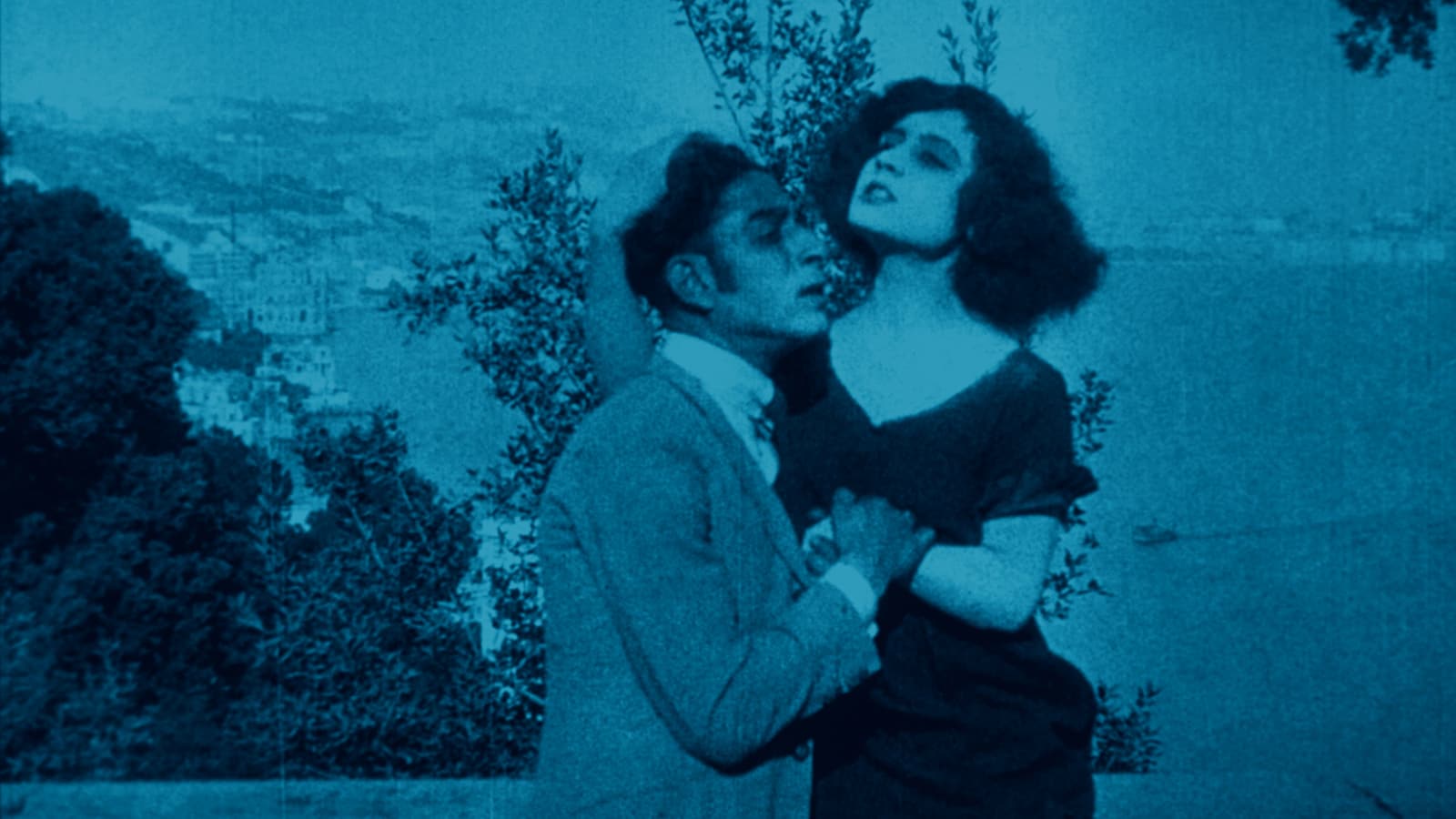
In a surviving frame from 'A Santanotte, a man clutches a woman above the Bay of Naples. His face is buried against her neck; her head tilts back in an agony large enough for the last row of a theater. Behind them, however, the city refuses to become painted scenery. The slope drops toward stacked buildings, water and a hazy opposite shore. Passion is being performed, but the place is present on its own terms.
That friction is the quickest way into Elvira Notari's cinema. She did not have to choose between popular melodrama and the observed street. She made each intensify the other. A song supplied emotional memory; an exterior supplied social fact. Amateur performers brought bodies that had not been standardized by the studio, while tinting and emphatic gesture kept realism from becoming plain reportage. Her Naples was at once a material city and a machine for feeling.
Notari, born in 1875, founded Dora Film with her husband Nicola in Naples in 1906. Across the company's life she directed, wrote, acted, produced, edited, taught performers and helped distribute its work. Historians credit her with roughly sixty features and hundreds of shorts and documentaries, yet only three complete features are known to survive, alongside fragments and shorter material.[1][2] The disproportion is brutal: a large working career has reached the present as a small archipelago.
A director profile can therefore not proceed as if a complete filmography were waiting to be screened in order. Notari's authorship has to be read through what remains: street locations, popular-song structures, recurring performers, production records, censorship, migrant exhibition and the material history of restoration. Seen this way, her central achievement was not simply that she became Italy's first woman film director. It was that she made direction into a route connecting a city, a workshop and an audience an ocean away.
The street was a working surface, not a postcard
The temptation is to call Notari a precursor of Italian neorealism and leave the matter there. The comparison catches something real. Harvard Film Archive notes her preference for urban exteriors and amateur actors, as well as the frequent appearances of her son Eduardo and of Rosé Angione, a schoolteacher who became a recurring lead.[1] Yet a backward glance from the 1940s can also flatten what is most peculiar in her work. Notari did not strip the street of theatricality. She brought theatricality outside.
'A Santanotte makes the distinction visible. The 1922 feature grew from a popular Neapolitan song. Angione, trained in Notari's acting school, plays Nanninella, a wage-earning young woman exploited by her father; Eduardo appears as the recurring Gennariello figure. Il Cinema Ritrovato describes the exterior photography as almost documentary in flavor while emphasizing the film's roots in the sceneggiata, a form built from song, betrayal and emotional excess.[3] The film does not ask location realism to calm melodrama down. The recognizable city gives the melodrama consequences.
In the cover frame, the landscape is not an establishing shot placed politely before the actors enter. Naples and the embrace occupy the image together. The bay opens space while the bodies knot it shut. Blue tint makes the moment feel nocturnal or fated, but the buildings below remain stubbornly specific. What could have been a generic pose of distress becomes distress happening somewhere, above lives that continue beyond the lovers' crisis.
This combination also explains why songs mattered so much. Screenings could be accompanied by live singers, allowing a story already carried in popular memory to arrive with a familiar melodic charge.[1][2] Cinema did not replace an older form; it reorganized song, performance, landscape and moving images around one another. Notari's realism was never a promise that the camera had caught life unshaped. It was an argument that popular artifice could reveal whose lives a polished national culture preferred not to see.
Directing meant running a handmade system
Dora Film belonged to an early cinema before creative labor had fully hardened into specialized departments. Giuliana Bruno describes such production as manifattura cinematografica: handmade and homemade cultural manufacture.[2] That context matters, but it should not dissolve Notari into a vague family collective. The unusually long list of her documented roles—screenwriter, director, producer, editor, distributor and acting teacher—shows how extensively she organized what eventually appeared on screen.[6]
Her direction began before the camera rolled. Training performers shaped the available gestures. Adapting songs and popular narratives brought an audience's prior knowledge into the scenario. Choosing streets rather than neutral studio space placed fiction amid visible class relations. Editing joined heightened action to the interruptions and textures of the city. Distribution decided which version of Naples could travel, and to whom.
This is why the phrase “family company” can mislead if it is heard as “small ambition.” A household-scale enterprise could bind decisions together that a larger factory separated. Eduardo was not only the director's son but also a recurring screen presence; Angione moved from teaching into Notari's performance network; the city supplied both locations and spectators.[1][3] The system was intimate, but intimacy here was infrastructure.
It also complicates the familiar image of the director as a solitary eye. Notari's signature does not reside only in framing. It appears in the repeatable passage from a known song to a scenario, from an acting lesson to a body in the street, from photographed exterior to tinted print, and from a Neapolitan workshop to a public that recognized the world being staged. Direction was the coordination of those passages.
Her films migrated with their audience
Dora Film's local density did not limit its range. The company developed a significant route to the United States, where its features screened for Italian immigrant audiences. Bruno describes the films themselves as participants in cultural migration: prints crossed the Atlantic, sometimes with singers who supplied the live soundtrack. Harvard Film Archive adds that Italian Americans commissioned Dora Film to make hundreds of short dal vero documentaries showing landscapes and customs of home.[1][2]
That exchange changes the meaning of location photography. A street in Naples was not merely proof that the production had escaped a studio. For a viewer in New York, it could be an encounter with a place remembered, revised or inherited through family stories. Eva Pelayo Sañudo's study of Notari's city films treats their urban movement as especially important to immigrant and female audiences, connecting the films' geography to changing possibilities for women in public space.[4]
The surviving evidence does not let us reconstruct every audience response, and nostalgia should not be assumed to have been uniform. But the distribution circuit supports a stronger, narrower inference: Dora Film understood place as something cinema could make portable. Its movies did not offer the detached completeness of a travelogue. They carried dialect, song forms, class conflict and expressive habits—a social texture that could make distance briefly feel inhabited.
The Atlantic route was therefore not a secondary market attached after production. It belonged to the form. A popular melody could prepare recognition before the first image. A live singer could make a silent print locally audible. A documentary commission could send a custom or landscape toward people who had left it. Notari made a cinema specific enough to travel because, not despite the fact that, it knew exactly where it came from.
Censorship wanted a different Naples
The same specificity created friction with official culture. Bruno's study locates Notari's censorship troubles in her films' sexuality, popular language and “plebeian metropolis”—precisely the features that kept their Naples from becoming a respectable national emblem.[2] Under Fascism, Harvard Film Archive notes, that rough urban world conflicted with the regime's preferred image of Italy, and Notari's films were repeatedly cut or obstructed.[1]
This pressure was political even when the films were not organized as direct political argument. To center a working woman such as Nanninella, to put marginal lives in recognizable streets, or to let dialect culture carry serious feeling was to dispute which bodies and voices could stand for the nation.[3][4] Melodrama could still punish its women, and heightened suffering was not the same thing as emancipation. Yet Notari gave popular female figures weight, desire and public space rather than asking them to serve as tasteful background.
Censorship alone does not explain Dora Film's end. The spread of synchronized sound and the growing industrial concentration of film production also made its artisanal model harder to sustain. The company ceased production in 1930, after twenty-four years.[1] That mixed causality matters. Notari was not simply silenced by one decree, nor did she merely fail to modernize. A regional, handmade and transatlantic system met political hostility at the same time that the industry's technical and economic terms were changing beneath it.
A ruined archive can still show a route
Loss has shaped every later encounter with Notari. Bruno built Streetwalking on a Ruined Map around the problem of writing film history when absence outweighs surviving complete texts.[2] The gap is not a neutral accident added after the career. It determines which achievements can be demonstrated directly, which must be reconstructed from records, and which may be gone beyond recovery.
Restoration has nevertheless changed the map. CSC-Cineteca Nazionale now preserves, restores and digitizes the surviving Notari material in its care.[5] In 2026 it issued a six-work collection that gathers those holdings, including the recently recovered fragment of Carmela, la sartina di Montesanto and documentation for the lost A Piedigrotta.[6] The restored 'A Santanotte itself combines a black-and-white element held in Rome with color information from a nitrate print supplied by George Eastman Museum.[3] Even one coherent blue frame is therefore the result of institutions rejoining materials that history separated.
That provenance gives the cover image a second meaning. It first shows Notari's method: conspicuous performance embedded in an actual landscape. It also shows the fragility of the route by which that method reaches us. The city, the actors and the tint survived in different material circumstances and had to be brought back into relation.
Notari's career should not be reduced to a priority claim, important though that claim is. “First woman director” places her at a gate; it does not tell us what she did after walking through it. She turned Naples into a production surface without turning it into scenery. She made popular song into cinematic structure without treating popularity as artistic embarrassment. She ran direction across writing, teaching, editing and distribution. Then she sent a fiercely regional cinema to viewers whose lives had already crossed the Atlantic.
The archive remains ruined. The route remains visible.
Sources
- Harvard Film Archive, “Songs of Love and Loss: Elvira Notari's Cinematic Realism” (2023 retrospective essay covering Dora Film, surviving works, street production, song, migrant audiences and censorship).
- Giuliana Bruno, Streetwalking on a Ruined Map: Cultural Theory and the City Films of Elvira Notari. Princeton University Press, 1993 (JSTOR edition; production, migration, censorship, melodrama and archival loss).
- Il Cinema Ritrovato, “'A Santanotte” (film and restoration record; song source, cast, exterior photography, female perspective and surviving color materials).
- Eva Pelayo Sañudo, “Staging (E)motions: The Importance of Elvira Notari's ‘City Films’ for Twentieth-Century Immigrant and Female Audiences,” Altre Modernità 27, 2022.
- CSC-Cineteca Nazionale, Elvira Notari holdings and cultural-loan catalog (preservation, restoration and digitization record).
- Comitato Nazionale Elvira 150, “Elvira Notari: Pioniera del cinema italiano” (2026 Cineteca Nazionale collection, roles, surviving works and archival materials).