Spoiler warning: this article discusses the film's final ballroom sequence and ending choice.
Luchino Visconti's The Leopard (1963) is often introduced through scale first: the Risorgimento, Burt Lancaster as Prince Fabrizio, Claudia Cardinale's entrance, Alain Delon's opportunism, Nino Rota's score, the famous line about things changing so they can stay the same.[1][3][4][5] All of that belongs to the film, but it can make the movie sound more declarative than it really is. Visconti does not stage history as a sequence of sharp ideological revelations. He stages it as a change in pressure, rhythm, and bodily stamina. The old order does not simply discover that it is doomed. It keeps moving through ceremonies, meals, travel, and dances until its own elegance starts to feel heavy.[2][4][5]
That is why The Leopard works so powerfully as a craft film. The politics matter, and the politics are clear.[1][3][4] But the movie's deepest intelligence lies in how it converts politics into atmosphere. Public events are arranged like theater. Family interiors are shot so that status looks inseparable from fatigue. The final ball, celebrated for its beauty, becomes almost unbearable because beauty is being used to prolong the life of a class that already knows it has lost the future.[3][4][5]
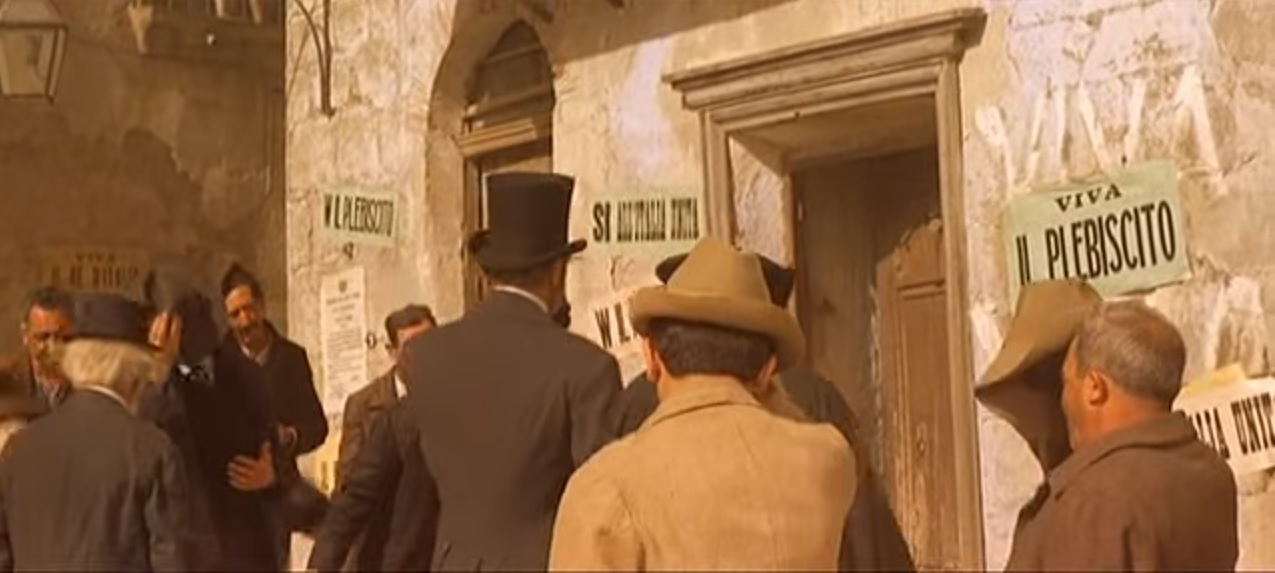
Image context: the lead image uses a real frame from the Donnafugata plebiscite scene in The Leopard. It is the right recognition image for this essay because the film's historical argument is concentrated there. A vote that should announce democratic transformation is presented as a managed ritual, full of bodies, costumes, and local hierarchy, so that "change" arrives in the same visual language as continuity.[6]
1. The public scenes make revolution look like managed pageantry
One of Visconti's key craft decisions is that large historical events are rarely treated as cleanly heroic turning points.[2][4][5] Michael Wood's Criterion essay notes that the film remains faithful to the spirit of Lampedusa's novel even while shifting details and adding the Palermo battle sequence.[2] Chris Fujiwara's TCM piece adds the crucial political frame: Visconti wanted the film to stress trasformismo, the way ruling systems absorb upheaval rather than simply being swept away by it.[4] Those two facts belong together. Visconti expands history on screen, but he expands it in order to show how history is staged, negotiated, and redistributed.
That is why the Donnafugata plebiscite matters so much. The sequence is not there merely to provide historical texture.[4][6] It demonstrates the movie's governing idea that public life is choreographed before it is explained. People gather, wait, observe, and move through the formal motions of political renewal, but the visual arrangement keeps suggesting that the personnel of power are learning how to remain present inside the new order. The frame does not deny change. It denies the fantasy that change arrives untheatrically.[3][4][5]
Visconti's large-scale scenes therefore avoid the uplift that costume epics often chase.[1][3] The camera gives them room, but not innocence. You are always aware of who is watching, who is standing where, who is being flattered, who is being absorbed, and how quickly the rhetoric of a new Italy can be housed inside old habits of display.[4][5] In craft terms, that means crowd staging is doing ideological work. The masses are not a backdrop for aristocratic feeling; they are the medium through which aristocratic adaptability is exposed.
2. Meals, pauses, and interiors turn class into tempo
If the public scenes show power being reorganized in the open, the domestic scenes show what that reorganization feels like from the inside.[1][2][5] Visconti insisted on real locations, refurbishing them as needed to recreate the 1860s world with material density.[4] That choice matters because the rooms in The Leopard never feel like neutral historical decoration. They are heavy with fabric, heat, distance, ritual, and inherited posture. The Prince's authority survives there, but it survives in a tired form. He is still obeyed, still observed, still central, yet the movie keeps asking how long a body can continue to carry that kind of historical mass.[3][4][5]
This is why the dinner-table and family-interior scenes are so important. They slow the film down without making it inert.[2][5] Conversation in The Leopard often arrives between glances, interruptions, or stretches of observation in which Fabrizio seems to be measuring not only the people around him but the dwindling legitimacy of the world that made him. MoMA's note on the film is useful here because it describes the prince as ensuring the survival of the old order through political cunning while also placing him inside moral decay.[5] Visconti's technique gives that contradiction a bodily register. Fabrizio is not filmed as a pure martyr to history. He remains perceptive, privileged, ironic, and complicit, and the languor of the interiors keeps all of those qualities active at once.
In lesser hands, this would become prestige slowness. Visconti avoids that trap because the pauses are never empty.[2][4] Every hesitation does two things. It honors a world trained to value ceremony, and it reveals the attrition built into that ceremony. Meals take time because a class still believes in the form of dining, blessing, receiving, and being received. Yet each extra beat also suggests that this belief has become labor. The old order is not simply being attacked from outside. It is wearing itself out by continuing to perform itself.
3. The ballroom turns visual splendor into duration and fatigue
The ball is one of the great set pieces in cinema, but it is easy to misremember it as a reward for sitting through the rest of the film.[3][4][5] It is almost the opposite. Fujiwara notes that over a month of shooting was devoted to the sequence and that the result justifies Visconti's perfectionism because the ball gathers the film's themes and classes into one immense flow.[4] MoMA calls it breathtaking, and it is, but "breathtaking" should not be confused with simply lush.[5] The sequence works because it makes beauty drag.
The camera glides, bodies circulate, rooms open into other rooms, uniforms and gowns shimmer, couples are formed and displayed, and all the while Fabrizio moves through the event as if through the afterlife of his own class.[3][4][5] The point is not that he suddenly discovers the new Italy in one epiphanic instant. The point is that the film makes him inhabit the duration of replacement. The bourgeoisie has already entered the palace. The younger generation has already begun converting historical rupture into marriage, flirtation, and future position. The military, the aristocracy, and the nouveaux riches now share one field of ceremony.[3][4]
This is where Visconti's technique becomes unusually severe. The ball does not refute the pleasure of spectacle; it lets pleasure continue long enough to become diagnostic.[2][3] Fabrizio's fatigue is inseparable from the sequence's grandeur. If the scene were cut faster or staged more crudely, the idea would remain literary: an old prince realizes his time is ending. Because Visconti sustains the sequence at such length and with such compositional luxury, the viewer feels the cost in the body. History becomes a matter of staying in the room too long and understanding exactly why the room will belong to someone else after you leave.[4][5]
4. Ending at the ball makes exhaustion the film's final form
One of the sharpest structural decisions in the film is to stop where the novel keeps going.[2][4] Fujiwara notes that Visconti and his collaborators omitted the book's later sections and instead used the ball to imply the future fate of the prince and his class.[4] Wood also emphasizes that the film remains faithful in spirit while changing timelines and emphasis.[2] This is not just an adaptation footnote. It is the key to why the movie lands so hard.
By ending at the ball rather than moving into a more explicit account of decline, Visconti refuses explanatory closure.[2][4][5] He does not need epilogue machinery to tell us what history will do. The sequence has already taught us. The Prince's withdrawal, his moments of solitude inside the crowd, and his awareness that Angelica and Tancredi belong to the future are enough. The film's subject is not merely the fact of aristocratic decline. It is the sensation of watching decline become socially elegant.[3][5]
That is what makes The Leopard more than a beautifully mounted historical drama.[1][2][5] Criterion's film page calls it a cinematic masterpiece of the Risorgimento years, and that is fair, but the masterpiece quality comes from form, not scale alone.[1] Visconti finds a way to make politics legible without reducing politics to speeches. Pageantry, rooms, pauses, travel, and dance all keep saying the same thing from different angles: classes do not disappear the moment history turns against them. They persist through ritual, manners, marriages, and surfaces. The tragedy of Fabrizio is that he is perceptive enough to see this clearly and aristocratic enough to remain beautiful inside it.
That is why the film keeps feeling modern. It understands that social orders often die in costume.[2][3][4] They go on hosting, dining, flirting, blessing, bargaining, and decorating themselves while power changes hands in the next room. The Leopard makes that process visible with extraordinary patience. Its real subject is not one prince alone, nor one revolution alone, but the long, exacting craft by which history teaches a ruling class to recognize itself as already finished.
Sources
- The Criterion Collection, "The Leopard (1963)" film page with synopsis, release context, restoration notes, and production details.
- Michael Wood, "Remembrance of Things Past: The Leopard," The Criterion Collection.
- Sam Wigley, "The Leopard celebrates its 50th anniversary," BFI.
- Chris Fujiwara, "The Leopard (1963) - The Leopard," TCM.
- MoMA, "Il Gattopardo (The Leopard). 1963. Directed by Luchino Visconti."
- Wikimedia Commons, "File:Plebiscito a Donnafugata 01.jpg" - frame source for the lead image.