Edgar G. Ulmer's Detour (1945) is often praised as one of noir's purest statements of fatalism.[1][4][5] That description is true as far as it goes, but it can make the movie sound more metaphysical than it feels on screen. What gives Detour its bite is not fate as an abstract principle hovering above the plot. It is the way the film lowers every promise around its hero into a second-hand register. The road is fake, romance is already threadbare, Los Angeles arrives through a diner counter instead of a skyline, and the decisive struggle takes place in a hotel room so bare that it seems to have been rented by despair itself.[2][3][5]
Criterion's film page describes Detour as a Poverty Row picture that turned bargain-basement conditions into "pulp poetry," while Noah Isenberg's Criterion note stresses Ulmer's ability to make a masterpiece on a tiny budget and a punishing schedule.[1][2] Dana Polan's essay for Senses of Cinema sharpens the insight further. For him, Detour is less the glamorous, shadow-drunk noir of private eyes and luxurious apartments than a bleaker, washed-out "film gris" of ordinary losers, cheap rooms, diner work, and dead-end options.[5] Put those views together and the movie's method comes into focus. Detour does not ask us to believe in doom before the trip begins. It makes doom persuasive by draining the American road story of openness, shine, and upward fantasy.
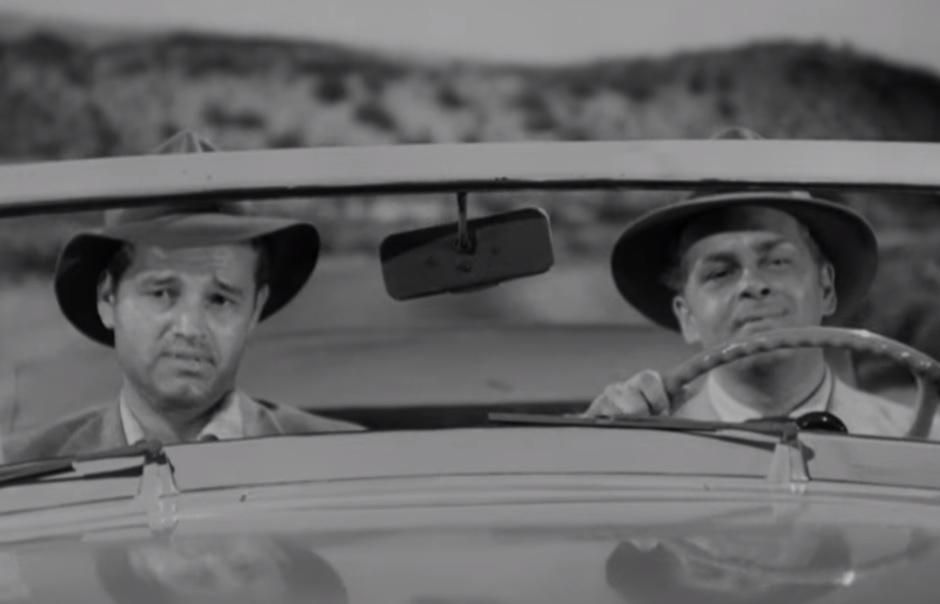
Image context: the lead image uses a real still from Detour showing Al Roberts and Charles Haskell Jr. in the car before the journey curdles into disaster. It fits this essay because the image already contains the film's central reversal. Mobility is present, but freedom has gone thin; the road has become a cramped moving room carrying its own catastrophe.[6]
1. The road is obviously artificial, and that is exactly why it works
One of the first things viewers notice in Detour is how little the cross-country road persuades as physical space.[3][5] Harvard Film Archive's capsule note is blunt about the production reality: the film was made in a mere six days, almost entirely on a Poverty Row stage, and its extensive road scenes were achieved with rear projection.[3] In a richer film, such process work might register as a flaw to be overlooked. In Detour, the slight fakery becomes thematic. Al Roberts does not seem to be traveling through an open nation so much as passing through a prefabricated idea of movement, one already flattened into a screen behind him.
That matters because Al keeps narrating his life as if chance had singled him out for exceptional punishment.[1][4][5] The movie answers by giving him a road that never looks free enough to sustain that fantasy. Even before Charles Haskell Jr. dies in the passenger seat, the car feels less like a machine of possibility than like a borrowed enclosure that can be repossessed at any moment. The famous bad luck in Detour therefore lands with unusual force. The film has already prepared us to see the road not as expansion, but as a corridor with scenery pinned behind the glass.[3][5]
2. The movie keeps demoting every destination it names
Polan's essay is especially useful on this point because it notices how systematically Detour strips noir of glamour.[5] Al heads west with the ordinary American idea that California might repair a stalled life, and the movie keeps shrinking that horizon. Sue is not waiting inside a glowing success story. She has become a hash-slinger in a diner, another worker pinned to a counter.[5] The Los Angeles car lot, the roadside cafes, the anonymous cabins, the service interiors that fill the movie all perform the same operation: every new stop lowers the temperature of expectation.
This is why Detour feels meaner than many richer noirs.[1][5] A more lavish picture can let corruption masquerade as elegance for a while; the fall itself supplies the thrill. Ulmer gives Al almost nothing that high to fall from. The world is already low-rent when the story begins. Cheap booths, stale rooms, and washed-out daylight do the work that expressionist glamour does elsewhere.[5] They tell us that the problem is not that paradise will be lost. The problem is that paradise may never have existed outside Al's self-dramatizing narration.
Read that way, the film's fatalism becomes economic and geographic rather than merely cosmic.[3][5] People move because they are broke, improvise because their options are bad, and keep lying because the next room or next ride is always just flimsy enough to collapse. Detour never stops asking what happens when the national myth of westward reinvention survives only in service spaces and temporary lodging.
3. Vera turns one bare room into a class war of two voices
Criterion's synopsis calls Ann Savage's Vera one of cinema's most vicious femme fatales, and the description is earned.[1] Yet what makes Vera frightening is not the deluxe danger associated with many noir seductresses. She does not arrive trailing opulence, satin, or metropolitan mystery. She arrives with grievance, appetite, and an ear for weakness. Savage's voice is the film's nastiest special effect. The sneer, the rasp, the speed with which she hears the cowardice inside Al's excuses all make the picture suddenly feel closer, hotter, and more humiliating.[1][5]
Polan writes that the long hotel-room sequence between Al and Vera resembles a no-exit chamber, a barren space where the pair play out their duet of doom.[5] That is exactly the scene where Detour reveals what its cheapness has been building toward. The room is ugly enough to deny fantasy and empty enough to amplify every accusation. Because Ulmer has so little décor to hide behind, the scene becomes a contest of nerves, class resentment, and verbal pressure. Vera does not merely threaten exposure; she makes Al feel like the sort of man who was always going to expose himself sooner or later.
This is where the film's production poverty becomes a moral instrument.[2][3] With more resources, the sequence might have been softened by atmosphere or expanded into a broader blackmail plot. Here it keeps tightening. A bed, a telephone, a few walls, and Savage's performance are enough to make the room feel socially total. Al wants luck to explain his life. Vera keeps dragging the explanation downward, back into weakness, money, resentment, and the cheapness of the places where such people end up cornered.
4. Why this disreputable little movie still feels indestructible
The Library of Congress notes that Detour became the first so-called B movie admitted to the National Film Registry in 1992.[4] That institutional honor matters because it recognizes something deeper than cult affection. The film lasts not in spite of its meagerness, but through it. Criterion's restoration notes and Isenberg's emphasis on Ulmer's scrappy artistry point in the same direction: Detour converted shortage into worldview.[1][2] Nothing in the picture is padded enough to soften its judgment.
That is why Detour still feels harsher than many noirs with grander reputations.[1][3][5] Its rear projection makes movement look trapped. Its diners and car lots make aspiration look hourly. Its hotel room turns intimacy into extortion. And Al's voice-over, instead of granting tragic grandeur, keeps sounding like an alibi that has already begun to rot from the inside. The film does not decorate doom. It cheapens the world until doom seems like the only scale left that matches it.
Seen now, Detour looks like one of the great American movies about how failure changes texture.[3][4][5] Space becomes thinner, destinations become smaller, and language becomes more self-serving the longer a person keeps insisting that luck alone did the damage. Ulmer's genius was to understand that a low-budget movie could make those textures visible with almost no margin for comfort. The result is a noir whose deepest shock is not that fate exists. It is that fate can look this shabby, this portable, and this close to ordinary life.
Sources
- The Criterion Collection, "Detour (1945)" film page with synopsis, restoration context, and production credits.
- Noah Isenberg, "A Recipe for Quick and Dirty Noir," The Criterion Collection.
- Harvard Film Archive, "Detour" screening note on the six-day shoot, Poverty Row production, and rear-projection road scenes.
- Library of Congress, ""Detour": National Film Registry #4" (2018).
- Dana Polan, "Detour," Senses of Cinema 21 (July 2002).
- Wikimedia Commons, "File:Tom Neal-Edmund MacDonald in Detour.jpg" - source page for the lead image still.