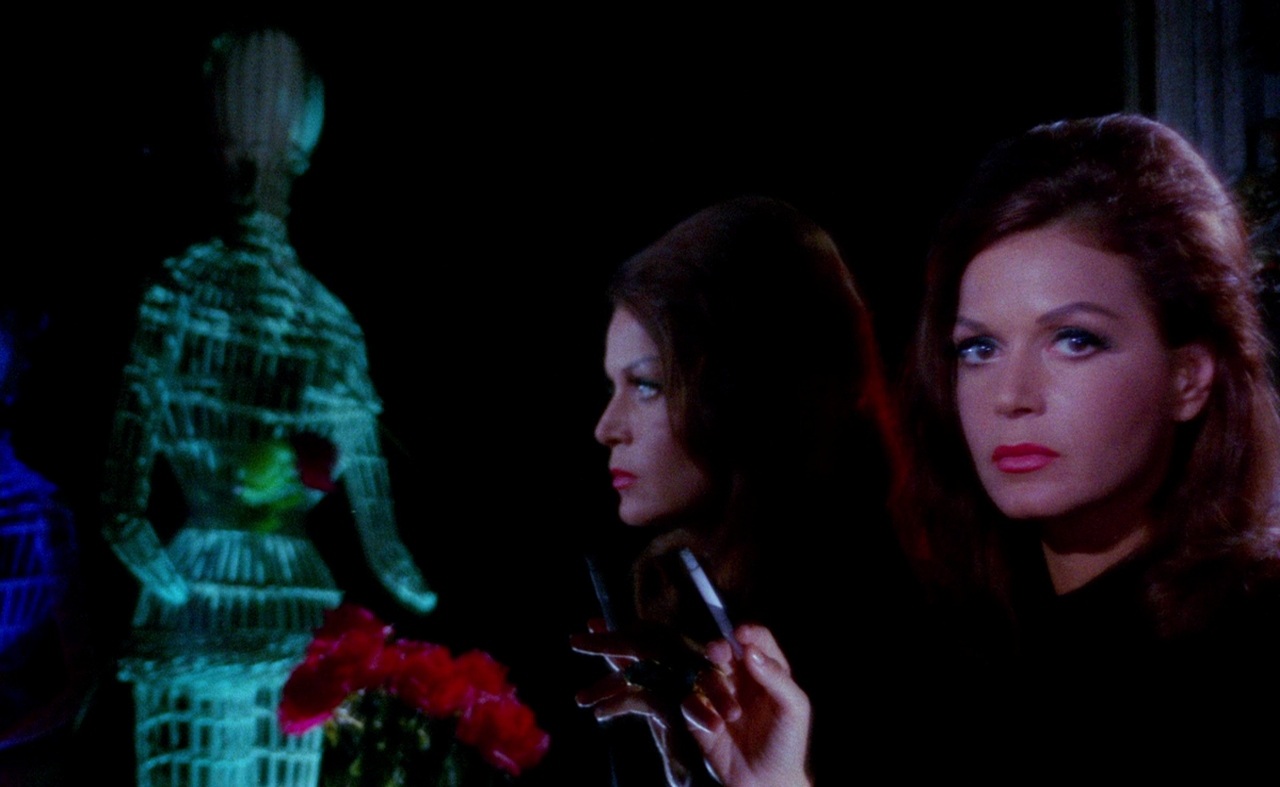
Giallo is often introduced by its props: black gloves, knives, glamorous victims, lurid titles, red telephones, bright blood, and cameras that seem to stalk before any character does. That inventory is useful, but it can make the genre sound like a costume trunk. The stronger way to read giallo is as a movement that changed the purpose of the murder mystery. Instead of treating a killing as a puzzle to be solved, the films make murder into a problem of perception: what did someone see, what did they misread, what image will not leave the mind, and why does style seem to know more than the detective?[1][2]
The name itself comes from yellow-backed Italian crime fiction, and BFI's guide notes that, inside Italy, un giallo could mean crime or mystery fiction broadly. Outside Italy, film culture narrowed the term toward a more specific thriller tradition: stylized murders, amateur investigators, confused memories, black gloves, enigmatic titles, and a willingness to mix art-film brilliance with exploitation bluntness.[1] That unstable definition is part of the point. Giallo is not a clean genre container. It is a set of pressures: the detective story pulled toward horror, fashion, erotic display, trauma, and painterly excess.
Mario Bava's Blood and Black Lace is the key hinge because it makes that shift legible in one place. MUBI's film page summarizes the premise plainly: after a fashion-house model is killed by a masked assailant, her diary exposes blackmail, vice, and secrets while more models are murdered.[3] BFI's giallo guide places Bava's earlier The Girl Who Knew Too Much near the beginning, but it treats Blood and Black Lace as the darker, more influential step: saturated color, a fashion-model murder cycle, and a tone much closer to the gialli that would multiply after Dario Argento's The Bird with the Crystal Plumage in 1970.[1]
The Killer Is Also a Designer
The fashion-house setting in Blood and Black Lace matters because it makes the genre's cruelty visible as arrangement. A conventional whodunit needs suspects, motives, clues, and a final explanation. Bava keeps those elements, but he shifts the viewer's attention toward surfaces: mannequins, lamps, curtains, display rooms, mirrors, gowns, cosmetics, and bodies posed as if the crime scene were another kind of showroom.[2][3][5] Murder does not interrupt design. Murder becomes design's most violent extension.
That is why giallo's visual excess is not decoration pasted onto thin plots. Reference accounts of Blood and Black Lace keep returning to its exaggerated color photography and its shift away from traditional mystery mechanics toward set-piece murder.[1][2] The film's reds, blues, greens, purples, whites, and golds are emotionally motivated; they create a fevered viewing state where the plot can almost blur behind the intensity of the image. The viewer is not just asking who killed. The viewer is being trained to ask why the room looks complicit.
This is also where giallo breaks with a purely rational model of mystery. In a deductive story, a detail becomes useful when it can be converted into evidence. In giallo, details often become useful because they are excessive, repeated, or lodged in perception. A phone is not merely a phone. A painting is not merely wall decor. A glove is not merely concealment. A mannequin is not merely a shop fixture. Objects look back at the viewer as if they were fragments of a half-remembered crime.
Argento Made Mis-seeing the Plot
The genre's later explosion after The Bird with the Crystal Plumage clarifies what Bava had opened. BFI describes Argento's debut as a kind of manifesto: an American writer in Rome witnesses an attack in an art gallery, then becomes trapped by what he thinks he saw and what he failed to understand.[1] That structure is essential. The mystery turns on perception, but perception is compromised from the first scene. The eyewitness is not simply missing a clue. He is trapped inside a faulty image.
That faulty-image logic becomes one of giallo's most durable ideas. The genre keeps returning to people who see too much and not enough at once. A witness sees a murder but misorders the image. A detective follows a trail but overtrusts pattern. A viewer recognizes a visual code before understanding its cause. The plot often appears to move forward through investigation, but the deeper motion is backward into memory, fantasy, or repression.[1][2]
This is why the genre can feel both crude and sophisticated in the same scene. Its exploitation elements are real: beautiful women endangered, bodies turned into spectacle, fear made stylish. The films can be morally queasy, and any serious account of giallo has to admit that. But the best examples are not interesting only because they are transgressive. They are interesting because they make transgression formal. Looking itself becomes unstable. Pleasure becomes suspect. The camera's elegance does not absolve the violence; it implicates the viewer in the appetite for arrangement.
Bava's Craft Was Cheap, But Not Casual
One mistake in discussing giallo is to treat low-budget genre production as if it automatically meant accidental style. BFI's programme note on Bava stresses the opposite: he was a cinematographer, effects artist, and director whose low-budget horror and thriller films were formally sophisticated, and it credits Blood and Black Lace with helping define the style of Italian giallo.[4] The resource limits matter because they sharpen the craft. Bava could make a lamp, curtain, colored gel, mannequin, or tracking movement carry more force than a more expensive production might wring from spectacle.
The economy of the genre helped create its grammar. A fashion house is practical because it is a reusable interior; it is also thematically perfect because every room is already about display. A masked killer is useful because the production can hide identity; the mask also turns the murderer into a walking blank, a human mannequin, a design object with agency.[2][3] Colored light can cover production constraint, but it also makes realism feel beside the point. The movie does not ask whether a room would really look that way. It asks what kind of fear becomes possible when a room looks as if desire, commerce, and death have all hired the same decorator.
That is the broader giallo lesson. These films are not polished because they are respectable. They are polished because polish is part of the threat. Their shiny surfaces do not hide decay; they stage it. The better the room looks, the more disturbing it becomes when violence treats it as a composition.
What the Genre Left Behind
Giallo's influence on later horror and thriller cinema is easy to trace in external signs: masked killers, body counts, weapon close-ups, subjective camera movement, and set-piece deaths. BFI explicitly connects Blood and Black Lace to the American slashers of the 1970s, while MUBI frames the film as a work that codified giallo and helped clear a path for later slashers.[1][3] But the more important inheritance is not the checklist. It is the idea that a thriller can be organized by visual obsession as much as by plot mechanics.
That inheritance travels widely because it is flexible. A later filmmaker can borrow the black gloves and miss the point. Another can discard the gloves but keep the perceptual trap: the witness who cannot trust the image, the room whose design reveals moral rot, the color that behaves like memory rather than lighting, the crime scene that seems arranged by the culture that produced it.
Giallo matters because it makes the murder mystery impure in a productive way. It lets pulp fiction, art direction, horror, fashion photography, unreliable memory, and bodily fear contaminate one another. At its best, the genre does not merely ask who killed. It asks why the image of the killing has been made so seductive, why the witness cannot stop replaying it, and why the viewer keeps searching the beautiful surface for the thing that is wrong.
Sources
- Chris Gallant, "Where to begin with giallo," BFI, December 12, 2017 - genre history, conventions, Bava, Argento, and the 1970s giallo cycle.
- Wikipedia, "Blood and Black Lace" - film credits, release dates, production context, color/style background, and legacy notes with cited references.
- MUBI, "Blood and Black Lace" - synopsis and programming note on Bava codifying giallo and influencing later slasher cinema.
- BFI Southbank Programme Notes, "Black Sunday" - context on Mario Bava's low-budget craft and his role in defining Italian horror and giallo style.
- FilmGrab, "Blood And Black Lace" - frame stills and production credits for Mario Bava, cinematographer Ubaldo Terzano, costume designer Tina Grani, and 1964 release year.