Spoiler note: this close reading discusses the robbery structure and ending of The Killing.
Stanley Kubrick's The Killing is a heist movie that distrusts the pleasure of heist movies. It gives Johnny Clay a clean objective, a compact crew, a racetrack routine, a clock, a gun, a bag, and a series of assigned tasks. On paper, the scheme looks almost beautifully impersonal. In the film, every clean part arrives already contaminated by human need. The plan is not broken by one unlucky event at the end. It is broken from the moment time has to pass through people.[1][2]
That is why the film still feels so sharp. AFI's record fixes the production frame: a 1956 Harris-Kubrick Pictures feature, directed and written by Kubrick, produced by James B. Harris, photographed by Lucien Ballard, and built around Sterling Hayden, Coleen Gray, Vince Edwards, Elisha Cook Jr., Marie Windsor, and other hard-edged character actors.[1] Criterion's account stresses the elements that make the movie more than a tidy genre exercise: a racetrack robbery, time-shuffling structure, Jim Thompson's dialogue, and a black-and-white precision that already feels unmistakably Kubrickian.[2]
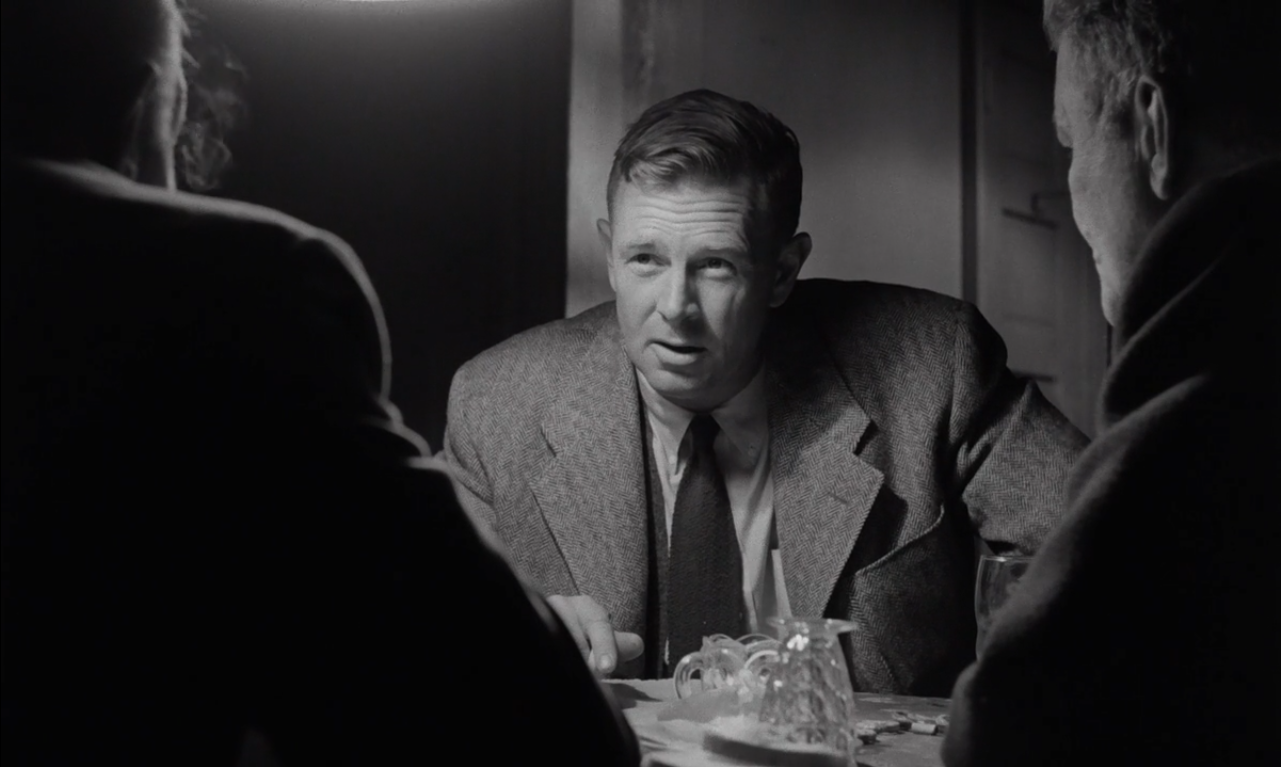
The still above is useful because it shows the film's method in one face. Hayden's Johnny Clay is not glamorous in the usual criminal-mastermind sense. He looks heavy, competent, and already tired of explaining what must happen next. The image comes from the film's trailer rather than from a poster or later design, so it carries the same real photographic grain as the world the movie studies: a face trying to hold a system together.[5]
The Narrator Turns Time Into Evidence
The most famous formal decision in The Killing is its fractured chronology, but the trick is not merely clever arrangement. AFI notes that Art Gilmore's offscreen narration gives the film a mock-documentary manner while repeatedly locating events out of chronological order with precise time cues.[1] Roger Ebert described the plot as moving like a chess player's mind, with the narration confirming that what we see is not unfolding in ordinary sequence.[4] That is the key: the narrator does not make the story smoother. He makes causality feel inspected.
Most heist films use time to build suspense forward. Kubrick uses time to expose dependency sideways. A bartender's need, a cashier's humiliation, a crooked policeman's debt, a sharpshooter's job, and Johnny's desire to escape with Fay do not line up as a simple chain. They overlap like pieces of machinery whose tolerances are too tight. Every return to an earlier moment makes the plan look less like mastery and more like a diagram with hidden stress points.
The narration's hard scheduling also gives the film its coldness. A warmer movie might enter each character through motive and psychology first. The Killing enters through function. This person must be here at this minute; that person must open that door; another must create a diversion; a horse race must produce a crowd and a cash flow at the same time. Human life is translated into timetable logic. The trouble is that the translation never fully holds.
The Racetrack Is a Machine, Not a Backdrop
The location matters because a racetrack already behaves like a heist system. Money moves through windows. Crowds swell and disperse on schedule. Attention rises and falls with the race. Workers repeat tasks because repetition is the point. AFI records that the race sequences were shot at Bay Meadows outside San Francisco, and Haden Guest's Criterion essay emphasizes the distance between that documentary racetrack material and the more enclosed interior world of the robbery.[1][3] The film's power comes from forcing those two textures to touch.
Johnny needs the racetrack because it produces money in motion. Kubrick needs it because it produces impersonal rhythm. The horses, bettors, cashiers, bartenders, guards, and public address system make an ordinary institution feel like a machine that briefly allows crime to hide inside routine. The robbery is not a rupture from daily business. It is daily business exploited at the exact point where habit has become blind.
That is why the film's planning scenes feel different from later glossy capers. There is little sense of luxurious expertise. The rooms are plain, the faces worn, the motives small enough to hurt. Johnny's plan requires precision, but the people inside it are not precision instruments. George Peatty wants to be admired by Sherry. Mike O'Reilly needs money for his wife. Randy Kennan needs to settle a debt. Marvin Unger seems to need Johnny's success with a loyalty that is already emotionally dangerous. The plan borrows their weaknesses and calls them roles.
Doors and Boxes Keep Opening Onto Risk
Guest's Criterion essay is especially useful on the movie's object logic. He reads the racetrack robbery through a pattern of boxes, lockers, mailboxes, suitcases, instrument cases, police call boxes, car trunks, and doors opening and closing through the plan.[3] That detail gets to the film's real close-reading grammar. The Killing is full of containers because every container promises control: the money can be packed, the weapon concealed, the body routed, the secret held, the future carried away.
But Kubrick makes containers unreliable without turning them magical. A door may be useful until the wrong person comes through it. A suitcase may hold money until the world jostles it loose. A locker or mailbox may seem anonymous until the timing around it changes. A back entrance may be a clever route until it reveals how many other bodies have claims on the same space. The film treats physical containment as a fantasy of moral containment.
This is where Johnny's professionalism becomes tragic rather than triumphant. He understands tasks, sequences, and tools. He understands that the heist must be built out of small timed gestures, not heroic improvisation. What he underestimates is leakage. Information leaks through marriage. Desire leaks through contempt. Panic leaks through posture. Bad faith leaks through a room before anyone pulls a trigger. Johnny can plan the movement of money more accurately than he can plan the humiliations people are carrying into the job.
Sherry Turns the Scheme Into Social Weather
Marie Windsor's Sherry Peatty is often remembered as a destructive noir wife, but the film is sharper if she is read as a pressure system rather than a simple villain. George tells her too much because he wants status in the one room where he feels poorest. Sherry weaponizes that weakness because she has already measured the marriage as a failed bargain. Her betrayal is ugly, but it is not random. It comes from the same economic hunger that made the heist attractive to everyone else.
This is why The Killing does not need a single criminal genius on the other side of Johnny. The opposition grows out of the crew's own domestic and social arrangements. George's apartment is as dangerous as the racetrack. Sherry's lover Val is as important to the collapse as any guard. A plan that pretends private life can be bracketed off from operational life is already doomed.
Kubrick's cruelty lies in how efficiently he lets those worlds touch. George wants Sherry to see him as a man with access to money. Sherry wants access without loyalty. Val wants the score without the discipline. Johnny wants the score without acknowledging how much contempt, loneliness, and dependency surround it. The robbery does not fail because criminals are foolish in some abstract moral sense. It fails because each participant brings a private story that the plan has no room to absorb.
The Ending Makes Chance Look Like Judgment
The ending is famous for its brutal neatness: after all the arrangement, the money is lost in transit. What makes the moment hurt is that it does not feel like a lazy twist. The movie has spent its whole running time showing that systems are only as strong as their handoffs. The racetrack handoff, the apartment handoff, the gun handoff, the suitcase handoff, the airport handoff: each looks procedural until it becomes a point of exposure.
Ebert's reading of the film as a heist played like chess helps here.[4] Chess thinking can calculate lines, but it cannot make the board immune to being knocked over. Johnny's final problem is not that he failed to think ahead. It is that thinking ahead is still trapped in the material world: luggage, wheels, animals, clerks, police, fatigue, public space. The plan becomes most vulnerable precisely when it tries to become portable.
That is the film's coldest joke. The money finally exists as an object Johnny can carry, but objecthood does not save it. Containment fails one last time. The suitcase is not a vault; it is a temporary belief. Once the belief is opened by accident, the heist's abstract perfection becomes paper in the wind.
Why the Film Still Feels Modern
The Killing remains modern because it understands planning as a psychological trap. Modern crime films often inherit its non-linear confidence, but the deeper lesson is not "shuffle the timeline." The deeper lesson is that fractured time can reveal fractured obligation. By showing us the same operation from different temporal angles, Kubrick makes the viewer see how each part of the plan depends on ungovernable human weather.
Criterion frames the film as a key early Kubrick work, while Guest places its dark irony and fractured narrative at the start of concerns that would recur across Kubrick's career.[2][3] That afterlife is deserved, but the movie should not be reduced to apprentice work for later masterpieces. Its achievement is already complete. In 84 minutes, it turns a racetrack into a machine, a crew into a set of liabilities, a narrator into a forensic instrument, and a suitcase into the most fragile container in noir.
The perfect plan feels broken because the film never confuses order with control. Johnny can set the hour, assign the tasks, and rehearse the route. He cannot make George less hungry for dignity, Sherry less contemptuous, Val less opportunistic, Randy less indebted, or public space less indifferent. The Killing is devastating because it lets the machinery run. Then it shows that the machinery was never sealed.
Sources
- AFI Catalog, "The Killing (1956)" - production record, release details, cast, credits, narration note, non-chronological structure, Bay Meadows location note, and production history.
- The Criterion Collection, "The Killing (1956)" - archived film page with synopsis, cast, time-shuffling narrative note, Jim Thompson credit, format details, and restoration supplements.
- Haden Guest, "The Killing: Kubrick's Clockwork," The Criterion Collection, 2011 - archived essay on the film's fractured narrative, heist structure, boxes/doors motif, racetrack material, and Kubrick's early style.
- Roger Ebert, "A heist played like a game of chess," 2012 - archived Great Movies essay on the film's chess-like construction, narration, character network, locations, and heist mechanics.
- Wikimedia Commons, "File:Sterling Hayden in The Killing.png" - trailer screenshot source for the article image.