The most famous shock in Rupert Julian's The Phantom of the Opera is usually remembered as a face. Christine pulls away the mask; the skull-like visage appears; the film enters monster-movie memory. But the 1925 film does not work because one makeup design is frightening in isolation. It works because the face arrives as the visible end of a whole built system: boxes, trapdoors, cellars, staircases, stage machinery, crowds, color exceptions, and hidden passages that have been pressing on the viewer long before the reveal.[1][2]
That is why Phantom is best read as a craft problem rather than a plot souvenir. AFI's catalog fixes the industrial scale: Universal produced the film with Lon Chaney, Mary Philbin, Norman Kerry, and director Rupert Julian, released it in 1925, and built an enormous Paris Opera House environment on the Universal City lot.[1] Scott MacQueen's American Cinematographer history stresses the same production problem from inside the shop: scripts were revised, endings changed, the opera-house set became the "money set," and Technicolor was used to sell the spectacle of the expensive build.[2] The famous image of Chaney's face is therefore not a lone trick. It is the moment when all that machinery suddenly has a body.
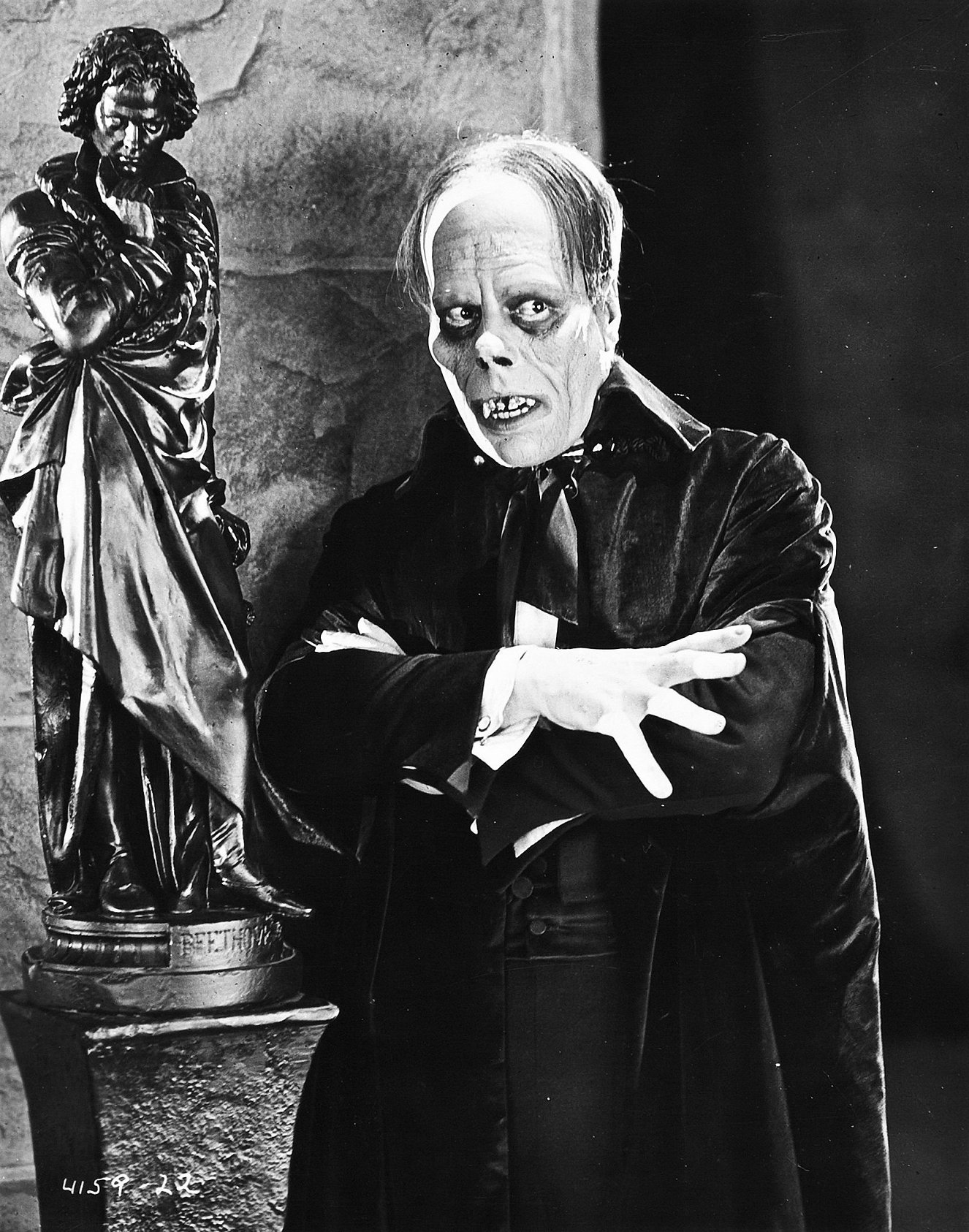
Image context: the cover still is a real Universal publicity photograph, published in 1925 and cataloged by Wikimedia Commons as Chaney characterized as the Phantom.[5] It is not a fan edit, poster redesign, diagram, or generated monster image. The still is useful because it shows how carefully the film turns the Phantom into a sculptural object: pale forehead, sunken eyes, hard hand shape, black cape, stone wall, statue, and darkness all pushing the same visual argument.
Hiding Is Spatial Before It Is Facial
The film's strongest craft decision is to make hiding a property of architecture. Erik does not simply conceal his face. He occupies a building that is already full of concealed routes and social partitions. The opera house separates auditorium from stage, patron from performer, box from crowd, surface glamour from basement labor. The Phantom's power comes from knowing those divisions better than everyone else.
Universal built that logic physically. AFI records contemporary production reports describing the opera house's catacombs and caves, the ornate replica based on Paris Opera plans and research materials, and the grand-opera scene with thousands of extras.[1] MacQueen adds the production-design mechanism behind that scale: Ben Carre's underworld sketches, the stage large enough to require steel and concrete support, sculptors and scenic artists building opera-house decoration, and a Grand Staircase and auditorium planned as visual attractions in themselves.[2] Those details matter because they make the film's horror unusually civic. This is not just a chamber nightmare. It is a public institution with a private underside.
The unmasking scene works because the movie has taught us that every elegant surface may have a hidden service space behind it. Christine's dressing room is not secure. Box 5 is not just a seat. The lake below the opera house is not fantasy decoration. The stage can become a trap. The chandelier can become a weapon. By the time the mask comes off, the viewer has already learned the grammar: what appears frontal and ceremonial may be controlled from below, behind, or inside.
That makes the face architectural. Chaney's makeup is not just a deformity revealed to a frightened woman. It is the human equivalent of the building's secret corridors. The skull-face says, in one image, that the opera house's hidden structure is not abstract. It has been watching.
Chaney's Makeup Is a Lighting Plan
American Cinematographer's account makes two things central to the film's power: Chaney treated makeup as a camera-and-light problem, and the Phantom design had to remain expressive rather than hardening into an immobile mask.[2] That distinction is not a colorful anecdote beside the film. It is part of the effect. The reveal had to feel like a living event, not a display of prosthetic material.
The Natural History Museum of Los Angeles County gives a practical glimpse into Chaney's craft through his wax life-cast head. The museum describes it as an overlooked but important tool that Chaney used while practicing hairlines, sideburns, and cotton-and-collodion facial build-ups, and it connects the Phantom look to pale undertone, dark eye area, elongated nostril effects, and strong contrast around the mouth.[3] MacQueen's article adds the harsher details of the built face: raised cheek contours, skullcap, blackened eye sockets, teeth, greasepaint, nose putty, and painful nostril wires.[2] The point is not that we can reverse-engineer every choice. The point is that Chaney's horror depends on controllable planes of light and shadow.
Look at the still. The forehead is high and exposed. The eyes are not merely dark; they sit in pockets that make the gaze seem both alive and excavated. The nose area is narrowed into something less human. The mouth is not a clean monster mouth but an unstable set of teeth, lips, and shadow. The hairline does not soften the face; it leaves the skull more exposed. Even the hands matter. They are pale, long, and theatrical, extending the face's shock into gesture.
This is why the makeup still reads on small reproductions and damaged prints. It is not built from tiny detail alone. It is built from silhouette, contrast, and readable zones: pale skull, dark eyes, black cape, angular fingers. Chaney designed a face that could survive distance.
Scale Makes the Close-Up Cruel
The opera-house scale is not merely there to impress viewers. It controls the emotional physics of the close-up. AFI's production history describes the film's enormous set, the grand-opera staging, the ball, and the public spectacle surrounding the production.[1] That scale keeps reminding the viewer that the Phantom's private wound exists inside a giant system of looking.
The opera is a machine for public attention. Audiences watch singers. Patrons watch each other. Managers watch money. Dancers, stagehands, musicians, and extras fill the frame as organized bodies. Against that social machine, the Phantom's mask is a desperate control device. It lets him move through a world built on display while refusing to become fully displayable himself.
That is why the reveal is cruel rather than merely startling. It forcibly converts secrecy into spectacle. Christine's gesture does not only uncover a man; it turns the film's hidden operator into an object of looking. The horror comes from both directions. We recoil from the face, but the film also makes us aware that looking is an act with consequences.
The set gives that awareness a frame. Without the vast opera house, Chaney's face might become one excellent makeup demonstration. Inside the opera house, it becomes the building's suppressed truth. The institution has produced beauty, hierarchy, desire, rumor, fear, and technical control. The face is where those pressures condense.
Color Is an Exception, Not a Blanket
Phantom also has a complicated color history, and that complexity helps explain why the film feels less smooth than later studio horror. MacQueen describes Technicolor as part of Universal's attempt to reproduce the spectacle of the sets and costumes, with the Masked Ball, Faust excerpts, ballet interludes, Grand Staircase, and auditorium material tied to two-color Technicolor photography.[2] AFI adds that Universal reissued a shorter sound and partly-Technicolor version in 1929, with the Bal Masque scene reshot in Technicolor and advertised around music, dialogue, Technicolor, and sound.[1]
The important craft lesson is that color does not behave as ordinary continuity. It behaves like an exception. The Phantom's world is mostly remembered in black, white, and tinting logic, but the masquerade sequence opens a separate register of public spectacle. Red Death, costume, crowd, and ceremonial space become an eruption rather than a stable palette.
That matters because the face and the color scene solve opposite problems. Chaney's makeup concentrates horror through subtraction: pale skin, dark sockets, severe planes, black costume. The masquerade concentrates horror through excess: crowd, costume, pageantry, display, a death figure moving through a public room. One says terror can be found by stripping a face down to bone. The other says terror can hide inside too much visual abundance.
The film's craft keeps those modes in tension. The Phantom is both underworld and pageant. He belongs to cellars and trapdoors, but he also understands theatrical display better than the official theater does. His monster design is not anti-performance. It is performance sharpened until it becomes exposure.
Survival Turns the Movie Into a Version Problem
The film's afterlife adds one more layer to the craft story. David Pierce's CLIR report, commissioned for the National Film Preservation Board and Library of Congress, gives the larger context: only 14 percent of U.S. features from 1912 to 1929 survive as complete works in the original 35mm format, with another 11 percent surviving in full-length foreign versions or smaller gauges.[4] Silent film is not simply old; it is materially wounded.
The Phantom of the Opera is a particularly vivid case because its visible form was already unstable before preservation entered the story. AFI tracks the 1929 reissue, shortened running time, and sound-and-color sales pitch, while MacQueen reconstructs the previews, replacement material, abandoned endings, and Technicolor decisions that made the film a version problem almost from the start.[1][2] In other words, this extremely famous film reaches us through an afterlife of cuts, repairs, restorations, and format histories rather than as a pristine single object.
That should change how we talk about its craft. We are not studying a perfectly stable object that floated untouched from 1925 to now. We are studying a film marked by reissues, altered versions, missing or changed material, color complications, and archive survival. The horror image is durable, but the movie around it has always been a little unstable.
That instability suits the film. Phantom is about hidden originals, substitutions, masks, mistaken surfaces, and the violence of exposing what has been kept below. Its preservation history repeats that logic in material form. What survives is powerful, but survival itself has left fingerprints.
Why the Face Still Holds
The reason Chaney's Phantom still holds is not that the makeup was merely ahead of its time. It is that the makeup has partners. The set teaches hiding. The staging teaches spectatorship. The color exceptions teach rupture. The archive teaches fragility. The face then gathers all of that into one sharp image.
This is why the film remains more than a prehistory footnote for Universal monsters. Later sound-era horror would refine the studio's creature branding, voices, music cues, and repeatable iconography. Phantom is rougher and stranger. Its terror has not yet been smoothed into a franchise grammar. It still feels like a building discovering that one of its own shadows has a will.
The unmasking endures because it is not only a monster reveal. It is an architectural reveal. For a second, the opera house's hidden routes, class divisions, theatrical machinery, public appetite, and private shame all look back through Chaney's eyes. The face frightens because the film has made it structural.
Sources
- American Film Institute Catalog, "The Phantom of the Opera (1925)" - film record, credits, release details, production history, set construction, 1929 reissue, and Technicolor notes.
- Scott MacQueen, "The Phantom of the Opera: A Silent-Era Masterpiece," American Cinematographer, 2023 - production history, set construction, Chaney makeup detail, Technicolor use, reshoots, and version instability.
- Stephanie Castaneda, "Lon Chaney's Hidden Makeup Secret," Natural History Museum of Los Angeles County - museum note on Chaney's wax life-cast head and practical makeup methods.
- David Pierce, The Survival of American Silent Feature Films: 1912-1929, CLIR, 2013 - report commissioned for the National Film Preservation Board and Library of Congress with silent-feature survival statistics.
- Wikimedia Commons, "File:Lon Chaney as The Phantom.jpg" - Universal Pictures publicity still, published 1925, used as the article image.