Spoiler note: this essay discusses Professor Rath's collapse and the film's ending.
Josef von Sternberg's The Blue Angel is usually remembered as the movie that made Marlene Dietrich a world figure. That is true, but it can make the film sound like a star-is-born anecdote with a tragic professor attached. The harder reason it lasts is that the film understands humiliation as an acoustic event. Rath does not merely fall in love with Lola Lola, lose his position, marry badly, tour with a troupe, and die broken. He is gradually moved from a world where his voice governs the room into a world where other sounds make him ridiculous before he can defend himself.[1][2]
That makes The Blue Angel more than an early sound landmark. It is a film about what sound can do to rank. BFI frames the central relation cleanly: Emil Jannings's Professor Rath is stolid and bourgeois; Dietrich's Lola becomes the subject, not just the object, of obsession.[1] Filmportal's synopsis follows the fall through the schoolroom, cabaret, marriage, touring stage, public degradation, and final return to the classroom.[2] But the sequence is not only moral or erotic. The movie keeps asking a precise formal question: what happens when a man who has lived by discipline, correction, and classroom command enters a performance space where noise answers him back?
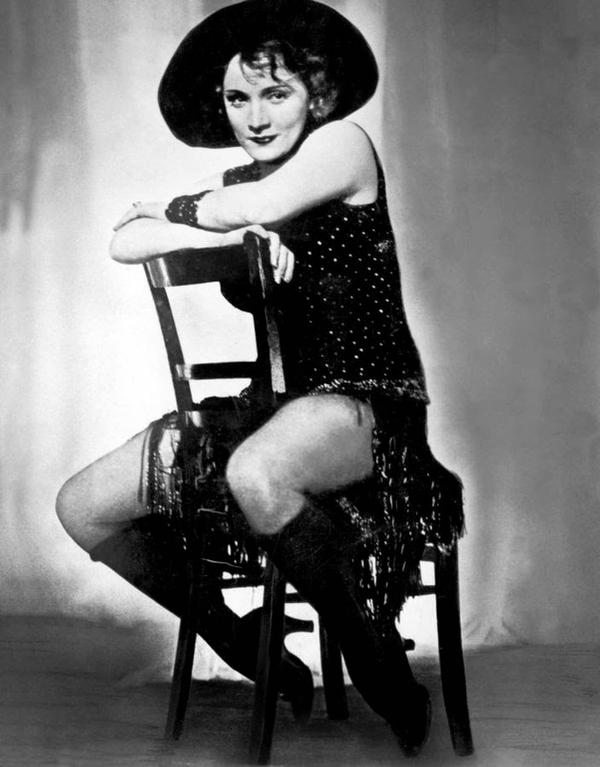
The cover image is useful for that reason. Wikimedia Commons identifies it as a Paramount promotional still from the 1930 film, published in the January 1931 National Board of Review Magazine.[6] It is not a generic Dietrich glamour portrait. Lola sits backward on a chair, arms resting with casual ownership, face turned toward the viewer as if she has already measured the room and found no reason to hurry. The pose contains the film's whole argument: she does not need to chase power. She waits inside performance until other people start reorganizing themselves around her.
The Schoolroom Cannot Stay Sealed
Rath's authority begins as a closed-room fantasy. The school gives him rows, desks, rules, vocabulary, punishment, and a position from which speech descends. He corrects boys because correction is his social function. The classroom lets language become hierarchy: one voice tests, others answer; one adult names error; adolescent bodies must sit still and be legible.
The Blue Angel cabaret breaks that grammar before Rath fully understands it. In filmportal's account, he visits the club because his students are fascinated by Lola, and he intends to investigate the source of their indecency.[2] That motive matters. Rath enters as a censor, not as a customer. He thinks he is carrying the classroom into the nightclub, but the film reverses the direction of contamination. The club's songs, laughter, posters, backstage movement, and sexual display travel back into his schoolroom. What he tries to inspect ends up inspecting him.
Early sound cinema gives that reversal its bite. Robert J. Cardullo's essay places The Blue Angel inside early sound cinema and the cultural world from which it emerged, stressing both its role in Dietrich's ascent and its contradiction-rich production history.[3] Sternberg does not use sound simply to prove that characters can talk. He uses it as leakage. Offstage life keeps pressing into the frame. Cabaret performance leaks through doors. Music changes the emotional ownership of a room. The professor's voice, once the instrument of order, becomes only one fragile sound among others.
Lola Lola Turns Indifference Into Command
Dietrich's performance is dangerous because it refuses the ordinary signs of effort. David Sterritt's Cineaste review of the Dietrich-von Sternberg cycle describes The Blue Angel and Morocco as the 1930 premieres that made Sternberg the director who made her a star, while also stressing the revealed-and-concealed balance of the persona they refined together.[4] That coolness is not emptiness. It is a technique. Lola's strength is that she performs availability without surrendering inner weather.
This distinction protects the film from a simple femme-fatale reading. Lola does not have to scheme in a conventional way. She sings, looks, waits, adjusts her attention, and lets Rath mistake theatrical address for private destiny. The cruelty is real, but it is not the cruelty of a mastermind. It is the cruelty of a professional performer being read by an amateur spectator who cannot survive the difference between being noticed and being chosen.
Marybeth Hamilton's History Workshop essay usefully returns the film to Weimar cabaret culture, noting its late-1929 production moment and the dissident, experimental, erotic world out of which the Blue Angel's milieu was built.[5] That context matters because Lola is not simply a private temptation. She belongs to a commercial, urban, staged world that has its own codes. Rath's catastrophe begins when he treats those codes as if they are directed personally at him. A cabaret number offers a charged public fiction; Rath hears a private summons.
The Cabaret Makes Spectators Visible
The most uncomfortable thing about the Blue Angel club is not that it is decadent. It is that it makes everyone into a spectator and then shows how spectatorship deforms them. Rath first watches from above, trying to maintain prosecutorial distance. His students watch with adolescent excitement. The troupe watches him become usable. Lola watches him watch her. The room is a machine for turning gaze into exposure.
Cardullo's discussion of Sternberg's set detail emphasizes the miniature stage, dressing-room density, and overstuffed cabaret decor: cutouts, streamers, angels, nets, birds, and other textures compress the world around Lola and Rath.[3] That density is not mere atmosphere. It denies Rath the clean spatial lines of the classroom. There is no neutral place from which to judge. Every angle is crowded by performance.
That is why the dressing room is so important. It should be a private backstage area, but it behaves like a continuation of the stage by other means. Clothes, powder, furniture, entrances, and overheard sound keep reminding Rath that intimacy here is always partly procedural. Lola's backstage world is not the opposite of performance. It is where performance repairs itself, waits, and changes costume. Rath mistakes access for truth.
The Fall Ends As A Sound
The final degradation is devastating because the film returns Rath to a room where he should once have been recognized, then makes recognition itself unbearable. Filmportal's synopsis records the cruel booking logic: the troupe performs in Rath's hometown because the degraded professor can be used as a draw, and the night ends with his breakdown before a roaring public.[2] The insult is not simply that he has become a clown. It is that his old identity is now part of the act.
Here the sound design completes the moral design. Cardullo's reading of the ending points to Rath's mad crowing, the offstage activity, Lola repeating her signature song, and the return of the old clock tune associated with loyalty and honesty as Rath dies at his former desk.[3] The film does not just show a fall. It scores one. Rath's last public voice is not instruction, argument, or confession. It is animalized sound forced out under conditions arranged by others.
That crow is more horrifying than a speech would be. A speech might let Rath organize his pain into meaning. The crow strips meaning back to exposure. The sound makes him audible as a ruined body before it makes him intelligible as a tragic figure. In that sense, The Blue Angel uses early sound cinema with extraordinary severity. Voice is not liberation here. Voice can be a trap.
Why The Film Still Stings
The film's gender politics remain harsh, and its pleasures are not innocent. It asks the viewer to admire Lola's command while watching a man's destruction staged with almost sadistic precision. But that discomfort is part of the film's force. The Blue Angel does not flatter desire as romance, education as authority, or performance as harmless entertainment. It shows all three becoming systems of power once an audience is present.
Dietrich's later myth can soften Lola into iconography: chair, stockings, song, smoke, gaze. Sternberg's film is sharper than the icon. Lola's image endures because it is structurally efficient. She makes the professor's world audible to itself. The classroom has always depended on performance. Respectability has always required staging. Authority has always needed a listening audience. The Blue Angel simply gives that audience a different song.
Rath dies back at the desk because the film knows that humiliation hurts most when it returns a person to the place where his old signs once worked. The room is the same kind of room. The body is not the same body. Sound has crossed the boundary, and order cannot be restored. That is the film's bleak modernity: it understands that public collapse is not only something people see. It is something they hear, repeat, and remember.
Sources
- BFI, "Der blaue Engel (1930)" - film page with credits, runtime, cast framing, and summary of Rath's obsession with Lola.
- filmportal.de, "Der blaue Engel" - German film record with production credits, synopsis, shooting dates, premiere details, format, sound system, and version information.
- Robert J. Cardullo, "Angel Sings the Blues: Josef von Sternberg's The Blue Angel in Context," FILMHISTORIA Online 30, no. 2 (2020) - essay on early sound, production context, Dietrich's stardom, cabaret design, and the film's ending.
- David Sterritt, "Dietrich & von Sternberg in Hollywood," Cineaste 44, no. 1 (2018) - review essay on the Dietrich-von Sternberg collaboration, Dietrich's star persona, and the revealed/concealed balance of their screen image.
- Marybeth Hamilton, "Radical Object: The Blue Angel (1930)," History Workshop, 2022 - cultural history note on the film's publicity image, Weimar cabaret milieu, Dietrich, and political afterlives.
- Wikimedia Commons, "File:The-Blue-Angel-Dietrich.jpg" - Paramount promotional still from The Blue Angel, published in the January 1931 National Board of Review Magazine, used as the article image.