The Juniper Tree begins by making two forms of death occupy the same landscape. A man stands over a decorated grave; elsewhere, a woman's body lies in water after being killed as a witch. One dead woman has a place where grief can be practiced. The other has been made into a warning.[6]
That difference governs Nietzchka Keene's 1990 film. Sisters Katla and Margit are already in flight when the story properly begins, their own mother stoned and burned for witchcraft. What they need is brutally ordinary: food, a roof, and a household willing to absorb two unattached women. What they possess is dangerous to name: Katla can work spells, while Margit can see the dead. Their first survival rule is therefore to hide the very inheritance that still binds them to their mother.[5][6]
Katla finds a widowed farmer, Jóhann, and uses magic to secure his devotion. The arrangement gives the sisters a farmhouse, but Keene never lets the house become a home in the sentimental sense. It is shelter borrowed against Jóhann's desire, his son Jónas's tolerance, and Katla's continuing ability to appear useful rather than threatening. Every condition can expire. The spell does not solve precarity; it gives precarity a room to wait in.[1][4]
This is the film's severe feminist revision of the Brothers Grimm. It does not turn the tale's murderous stepmother into a secret innocent. It asks what kind of safety was available before she became a murderer, who controlled that safety, and why the story's most reliable refuge may belong not to the living household but to the ghosts, birds, waterfalls, and stories that nobody can own.[5][7]
Spoiler note: this essay discusses the death of Jónas and the film's ending. It refers to the 4K restoration made from the original 35mm picture negative and magnetic soundtrack by the Wisconsin Center for Film & Theater Research and The Film Foundation.[2][3]
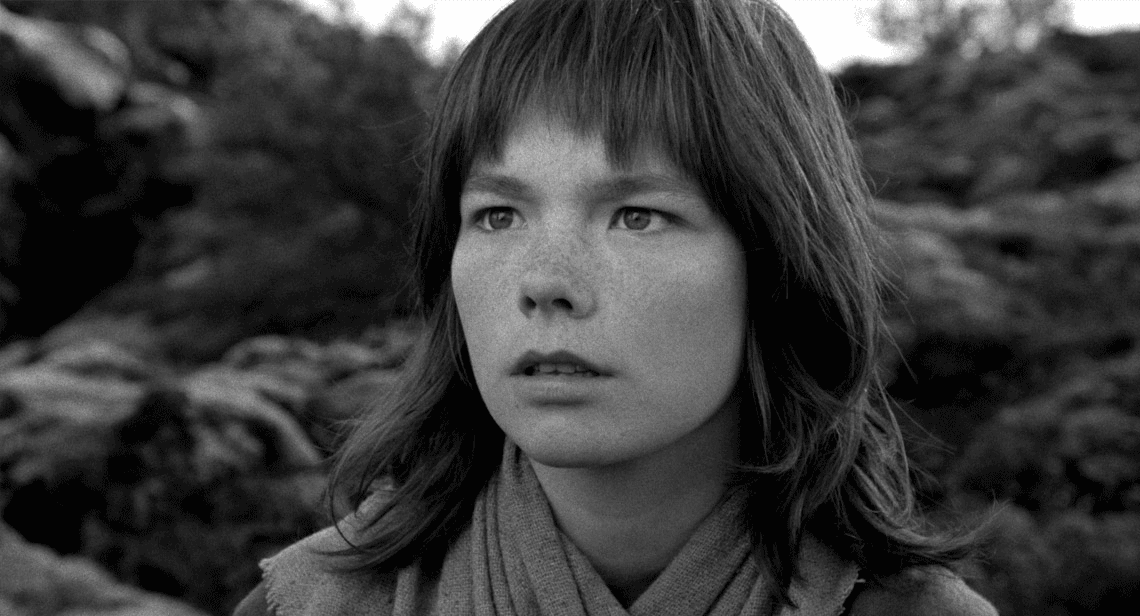
Image context: the lead image is an official black-and-white film still published by Arbelos Films, the distributor of the restoration.[1] It belongs here because Margit's position in the open landscape is not decorative. Keene repeatedly places her outside the farmhouse when the dead become perceptible and family can be imagined without possession.
A house entered under conditions
Katla's decision to marry is not introduced as romantic destiny. It is an emergency housing strategy. The sisters have no family compound to return to and no community likely to protect women associated with an executed witch. Jóhann has land, a dwelling, and the social legibility of a male-headed household. Katla has labor, sexuality, and magic. Their union is unequal before it is enchanted.
Keene makes that inequality visible in the scale of the farmhouse. Interiors were filmed in a preserved turf house, and the main room seems to gather cooking, sleeping, prayer, quarrel, and surveillance into one dim enclosure. A single cloudy window offers less a view than a reminder that the outside exists.[5] There is nowhere for a new wife to arrive gradually. Katla enters the daily life of a father and son who are still organized around the woman they lost.
Jóhann's affection can feel tender, even carnal, when the couple is alone. In front of Jónas, however, he becomes defensive and violent as the boy refuses his stepmother.[5] Katla is therefore protected by a love that cannot produce authority where she most needs it. She can bind the father and still fail to join the family. The household gives her a bed but not an uncontested role.
Jónas understands this weakness. He visits his mother's grave and treats Katla not as an addition to the household but as an attempt to overwrite it. His accusation—witch—is factually close enough to be powerful and socially lethal enough to be more than a child's insult. Katla has already watched that word authorize the killing of her own mother. Inside the farmhouse, it becomes an eviction notice that could also become a death sentence.[6]
Katla treats affection as infrastructure
The film does not separate sorcery from practical work. Katla performs rituals to bind Jóhann to her and prepares a poultice meant to help her bear him another son.[5] These acts are supernatural, but their objectives are recognizable forms of domestic security: maintain a husband's attachment, produce an heir, make oneself indispensable to the household.
That proximity between spell and chore is what makes Katla more disturbing than a simple fairy-tale villain. Her magic is coercive. It is also the tool she reaches for in a world where property, legitimacy, and protection travel through a man. Keene refuses the easy moral comfort of choosing one description. Katla is manipulating Jóhann, and Katla is trying to keep herself and Margit alive.
The film's soundscape makes such categories even less stable. Prayers, Bible passages, folk rhymes, songs, spells, and stories pass across the same rough images.[5] Christian speech does not monopolize truth, and magic does not monopolize danger. A prayer may accompany a household capable of expelling two women; a spell may be used to secure dinner; a child's accusation may be sincere grief and a repetition of collective persecution at once.
Keene's static compositions intensify the ambiguity. Cinematographer Randy Sellars often holds foreground and background together instead of cutting quickly toward the character who is supposedly in control.[1][5] Katla may occupy the front of a room while Jónas watches from its edge, or domestic action may continue while another body registers distrust. The frame behaves like the household: everyone is close, nobody shares the same account of what closeness means.
Two motherless children do not inherit equal risk
Margit and Jónas should be natural allies. Both are young, both have lost their mothers, and both believe that the dead remain active nearby. Jónas can tend a grave. Margit does not know where her mother was buried, so mourning reaches her as vision: a silent figure in the hills, a presence behind the waterfall, a body marked by an impossible dark opening.[5][6]
Their friendship is real, but it is not symmetrical. In one scene they sit outdoors over a shell game. When frustration turns to rage, Jónas pelts Margit with the pieces until she bleeds. The action miniaturizes the violence that drove the sisters into flight: a woman marked as strange is struck with stones while the person striking her experiences his fear as justification. Margit quickly forgives him.[4][7]
Her forgiveness is tender, but it is also survival knowledge. Jónas belongs to the household without having to earn his place. Margit stays because her sister has persuaded his father to keep them. The children can meet in grief, yet only one of them can turn a quarrel into a threat against the other's shelter. Keene lets companionship and hierarchy occupy the same patch of ground.
This is why Margit's visions do not function as an escape hatch from politics. She can see more than Jónas, but second sight does not grant her his material security. Her gift helps her interpret the world; it does not provide a roof. Björk plays that distinction with watchful stillness. Margit often seems to be listening past the speaker in front of her, alert to another layer of the scene, while remaining physically subject to the people who control the immediate one.
Outside, the dead are easier to meet
The farmhouse is supposed to shelter bodies from weather. Keene reverses the emotional arrangement. Indoors, affection is conditional, suspicion circulates, and the one murky window constricts sight. Outdoors, the film's rocky distances give Margit room to perceive relationships that have not been certified by marriage or property.
The locations are specific even though the story's world is deliberately unpinned. Keene filmed along Iceland's south coast, including the basalt formations at Reynisfjara and the path behind Seljalandsfoss, where Margit and her mother's apparition move behind a curtain of water.[5] Experimental filmmaker Pat O'Neill contributed to the waking-dream effects that interrupt the otherwise spare, black-and-white naturalism.[1] The result is not a fantasy world pasted over Iceland. It is a landscape whose physical surfaces—spray, volcanic rock, long grass, open sky—seem capable of holding more than one state of existence.
The distinction between inside and outside is not simply safe versus free. The land is cold, exposed, and indifferent to hunger. It cannot protect Katla from accusation or feed the sisters by itself. What it offers is a form of company without ownership. Margit's mother can appear without taking anybody's place. Birds can carry messages without demanding proof of lineage. Water can conceal and reveal in the same image.
Keene repeatedly makes spirits less frightening than people. The dead guide, warn, or remain available to grief; living characters stone, strike, bind, and accuse.[6] That reversal matters because it changes the meaning of the supernatural. Magic is not the foreign danger entering a stable household. Violence is already the social order. The uncanny images give the people damaged by that order another language in which to be present.
The spell expires, but blame does not become simple
Katla's refuge finally fails through the person it could never incorporate. She challenges Jónas to prove that his dead mother will protect him if he leaps from a cliff. He jumps and dies. Katla then repeats the Grimm tale's grotesque domestic logic: a severed finger, a mouth sewn shut, and meat placed in the family's stew turn the murdered child into food served inside his own home.[7]
The sequence destroys any reading that would convert social vulnerability into moral exemption. Katla has been persecuted, displaced, and made dependent. She also kills a child and uses domestic work to hide the killing. Keene's achievement is to keep causation from becoming acquittal. The refuge was unjustly conditional; Katla's response reproduces the same logic of expendability on someone with less power than the man whose love she enchanted.
Margit again becomes the keeper of what the household cannot admit. She recognizes what has happened and eventually connects Jónas to the bird that returns after his death. In the Grimm story, the resurrected bird brings a punitive order: the stepmother is killed and the family is restored. Keene withholds that clean repair. Katla flees, Jóhann goes after her, and Margit is left behind. The protected household dissolves because it was never held together by shared mourning in the first place.[7]
The final movement belongs to Margit's voice. She makes another bird story from abandonment, imagining children who pass into the land of birds and retain knowledge their human father cannot recognize.[7] Storytelling does not rebuild the farmhouse. It does something smaller and more durable: it gives loss a form that cannot be revoked when somebody withdraws shelter.
The film found shelter in an archive
There is a final, material echo outside the fiction. Keene shot The Juniper Tree in Iceland in 1986, largely financed it herself, and struggled to complete and circulate it. By the time the Wisconsin Center for Film & Theater Research began the restoration, distribution depended on a single 35mm print and poor video copies, even though the original black-and-white negative and sound elements survived.[2]
The 4K restoration returned the film to view through an alliance among an archive, preservation specialists, a foundation, and a distributor.[1][2][3] That history does not prove the movie's themes, but it gives them an apt afterimage. A work about women whose survival depends on being received into somebody else's structure nearly disappeared when the structures around its filmmaker failed to hold it.
Preservation provided a better kind of shelter: not possession disguised as rescue, but stewardship designed to let the work leave again. The restored film can travel, be argued with, and find viewers who encounter Keene as more than the director of Björk's first feature role. Like Margit's bird story, it survives because custody is not the same as control.
That is the quiet force of The Juniper Tree. Every enclosed refuge in the film asks for obedience, usefulness, silence, or love in return. The open forms—memory, landscape, story, archive—cannot guarantee safety, but they can carry a life or a work beyond the household that failed it. Keene does not pretend that freedom is a roof. She shows why a borrowed roof is never enough.
Sources
- Arbelos Films, “The Juniper Tree” — official restoration-release page with credits, synopsis, production stills, location photography, Pat O'Neill's effects credit, and restoration partners.
- Wisconsin Center for Film & Theater Research, “The Juniper Tree (1990) to Be Restored thanks to a Grant from the Film Foundation” (January 8, 2018) — Keene's background, the 1986 production, surviving film elements, and restoration plan.
- The Film Foundation, “Restoration Gives New Life to Lost, Forgotten, or Dismissed Films” — discovery, preservation partnership, restoration history, and Keene's post-restoration critical recovery.
- BFI Player, “The Juniper Tree” — institutional film record with synopsis, runtime, cast, and discussion of the film's literary and landscape textures.
- Mark Asch, “Review: The Juniper Tree.” Film Comment, March–April 2019 — adaptation context, farmhouse and south-Iceland locations, soundscape, visions, and formal close observation.
- Robert Abele, “Björk stars in Nietzchka Keene's rarely seen film The Juniper Tree.” Los Angeles Times, April 16, 2019 — opening violence, maternal grief, Katla's survival logic, Margit's visions, and landscape imagery.
- Pauline Greenhill and Sidney Eve Matrix, eds., Fairy Tale Films: Visions of Ambiguity, Utah State University Press, 2010 — scholarly account of Keene's revision of the Grimm tale, including Jónas's death, the stew, the bird, and the unresolved ending; Library of Congress copy.