A film projector asks one strip of material to obey two incompatible commands. Between the reels, film must keep traveling. At the aperture, each frame must become absolutely still long enough for light to throw a sharp image onto the screen. Then it must jump forward and stop again, many times a second. If the whole roll absorbs every start and stop, inertia pulls at the perforations until the strip slips, shudders, or tears.
The Latham loop was an elegantly modest answer, but it entered cinema in stages. Dan Streible's broad workshop history groups cameras and projectors together as beneficiaries of the loop.[2] Deac Rossell's apparatus chronology makes a finer distinction: an extra slack loop in the Latham camera of 1895 reduced tension on a long band of film, while the first Eidoloscope projector did not yet use intermittent movement. In May 1896, the projector acquired an intermittent transport; Woodville Latham's patent, filed the following month, specified two controlled slack sections around the exposure window.[1][3]
The distinction matters. The 1895 loop helped the camera carry more time into a film, while the mature 1896 projector design isolated a stop-start gate from the weight of long reels. These were related transport solutions, not one unchanged mechanism hiding inside every version of the Eidoloscope. Together they loosened an early ceiling on duration: a camera could record more film, a projector could handle more film, and a moving picture could become an event with enough time for anticipation, development, and an ending.
A boxing round exposed the short-film ceiling
In the mid-1890s, motion pictures were not yet organized around feature-length stories. Edison Kinetoscopes offered brief subjects to one viewer at a time, while competitors explored how moving pictures might be projected for a group. Film historian Deac Rossell places the Latham family's Eidoloscope among the early machines that challenged the peep-show model, with a public press presentation in April 1895 and development help from former Edison mechanic Eugene Lauste and W. K. L. Dickson.[3]
The Lathams' pressure test was not a landscape or a dancer but a boxing round. That choice was commercial as much as visual. Film historian Dan Streible shows how prizefighting, theater promotion, and early motion-picture business occupied the same network of performers, agents, sporting papers, and showmen. A recognizable boxer brought an audience, while a round supplied contained action with a built-in clock. It also lasted longer than the earliest systems could comfortably manage.[2]
For the Eidoloscope debut, Young Griffo and “Battling” Charlie Barnett replayed part of a recent match on the roof of Madison Square Garden. When the film opened to paying customers in a Broadway storefront on May 20, 1895, it delivered something earlier filmed rounds had not: a complete unit of action rather than a reel that stopped in mid-contest. Streible reconstructs a film of roughly four minutes, enough for a three-minute round plus action around it; a later BFI account gives twelve minutes. The surviving accounts therefore disagree on total duration, but agree on the industrial point: the Latham system could carry a boxing attraction well beyond the brief Kinetoscope glimpse.[2][4]
Claims about cinema's single “first” public show are notoriously sensitive to definitions: invited demonstration or commercial admission, projection or individual viewing, one apparatus or another. Rossell records the Lathams' April press preview, while BFI Sight and Sound contrasts their May paid projection with the Lumière Cinématographe's celebrated Paris launch on December 28, 1895.[3][4] The useful point is not to award one birthday. It is to see that capture duration, projection, and audience scale were being solved together—even when they depended on different mechanisms.
The loop was a buffer, not a spectacle
The 1896 patent explains the mature projector problem with unusual physical clarity. Film has to advance one frame, stop at the optical axis, receive light without vibrating, then advance again. Latham's design used a light intermittent feed for that violent little cycle. The heavy supply and receiving reels did not join each stop-start movement; they carried the bulk of the strip while other drums managed the short section near the gate.[1]
Slack made the boundary work. As the intermittent drum stopped a frame for projection, continuously driven parts took up one loop and restored the other. On the next advance, the local reserve reversed roles. The apparatus therefore did not have to accelerate and arrest an entire long roll for every image. Only a small, low-inertia section answered the gate's rhythm.[1]
This is why describing the loop as “extra loose film” understates it. Loose film without controlled transport can wander. The patent couples slack with sprocket engagement, rollers, a shutter, an intermittent drum, and positive drive. Perforations keep the image registered; the loops keep the registration mechanism from bearing the weight of the reels. What appears to be empty space is really a buffer between two motion regimes.
That buffer carries an aesthetic consequence. In an intermittent projector, the image feels continuous because the machine is carefully discontinuous. The audience does not see a strip lunging, pausing, and being hidden by a shutter. It sees motion. Mechanical slack is converted into temporal confidence.
Longer film changed the product
The first Latham-loop benefit arrived at capture. Rossell describes the 1895 camera's extra loop as relief from tension on long celluloid bands.[3] A larger load could therefore record sustained action without making the film path absorb the full pull of that added length. The loop was already separating local film movement from bulk, even though the debut projector used a different, non-intermittent transport.
The 1896 patent carried that boundary into intermittent projection. It describes a strip whose length can increase without changing the work of the lightweight stop-start parts; the larger reels hold the added bulk outside the delicate gate cycle.[1] In business terms, the system could handle more saleable time without asking each perforation to survive the inertia of the whole product.
The Eidoloscope's films began to travel. Streible traces exhibitions through New York and Coney Island, then to cities including Chicago, Philadelphia, Rochester, Detroit, and Boston during 1895 and 1896. A touring stage production of Carmen even incorporated a ten-minute bullfight film shot in Mexico. The projector itself was imperfect and the company remained too weak in manufacturing, capital, and film supply to dominate the market, but the shows proved that a projected moving picture could be programmed as more than a fleeting novelty.[2]
This is the industrial hinge. A few extra minutes do not automatically produce a feature film, but they change what producers can promise and what exhibitors can sell. Duration permits a complete contest rather than a fragment, a traveling attraction rather than one cabinet view, and eventually a program whose parts can be sequenced for a seated crowd. As the slack-buffer principle moved from camera transport into intermittent projection, it supported the move from image as glimpse toward film as scheduled time.
It also altered production ambition. A longer load makes it possible to wait for action, cover intervals, and preserve an event's internal continuity. The camera no longer has to treat every subject as if the stock will expire before the subject does. Later narrative cinema would use that freedom differently, but the engineering condition came first: the strip had to survive being long.
The famous name hides a workshop
“Latham loop” sounds like a clean lone-inventor label. The record is messier and more interesting. Streible describes Woodville Latham and technician Eugene Lauste developing the loop within the Lathams' Lambda Company, with occasional expertise from Dickson.[2] Rossell likewise identifies help from Lauste and Dickson while placing Woodville and his sons Gray and Otway at the center of the film enterprise.[3] The device emerged from a workshop crossing entrepreneurship, engineering, Edison experience, and the practical demands of filming fights.
The patent timeline complicates the legend further. Woodville Latham filed his projecting-kinetoscope application on June 1, 1896, after the first Eidoloscope demonstrations and commercial screenings and just after Rossell dates the addition of intermittent movement to the projector. The patent was not granted until August 26, 1902.[1][3] The legal document is invaluable because it shows the mature system in detail, but its date should not be mistaken for the instant one isolated genius conceived every version of the loop.
This distinction matters because film technology is full of famous component names that conceal teams and transfers. A mechanism can be developed collaboratively, patented under one name, manufactured elsewhere, refined by competitors, and normalized until operators stop thinking of it as an invention at all. The Latham name endured because it gave the component a portable identity. The working principle endured because other cameras and projectors needed the same separation of reel weight from intermittent motion.[2]
The machine lost; the interface survived
The Eidoloscope did not win the projector market. The Lumière Cinématographe combined camera, printer, and projector functions in a compact hand-cranked apparatus; its manufacture and distribution turned technical elegance into a repeatable system.[3][4] Edison entered projection by marketing the Vitascope. By Streible's account, the Eidoloscope company lacked the production resources and catalog needed to turn its early lead into durable scale; by 1898 it was in receivership.[2]
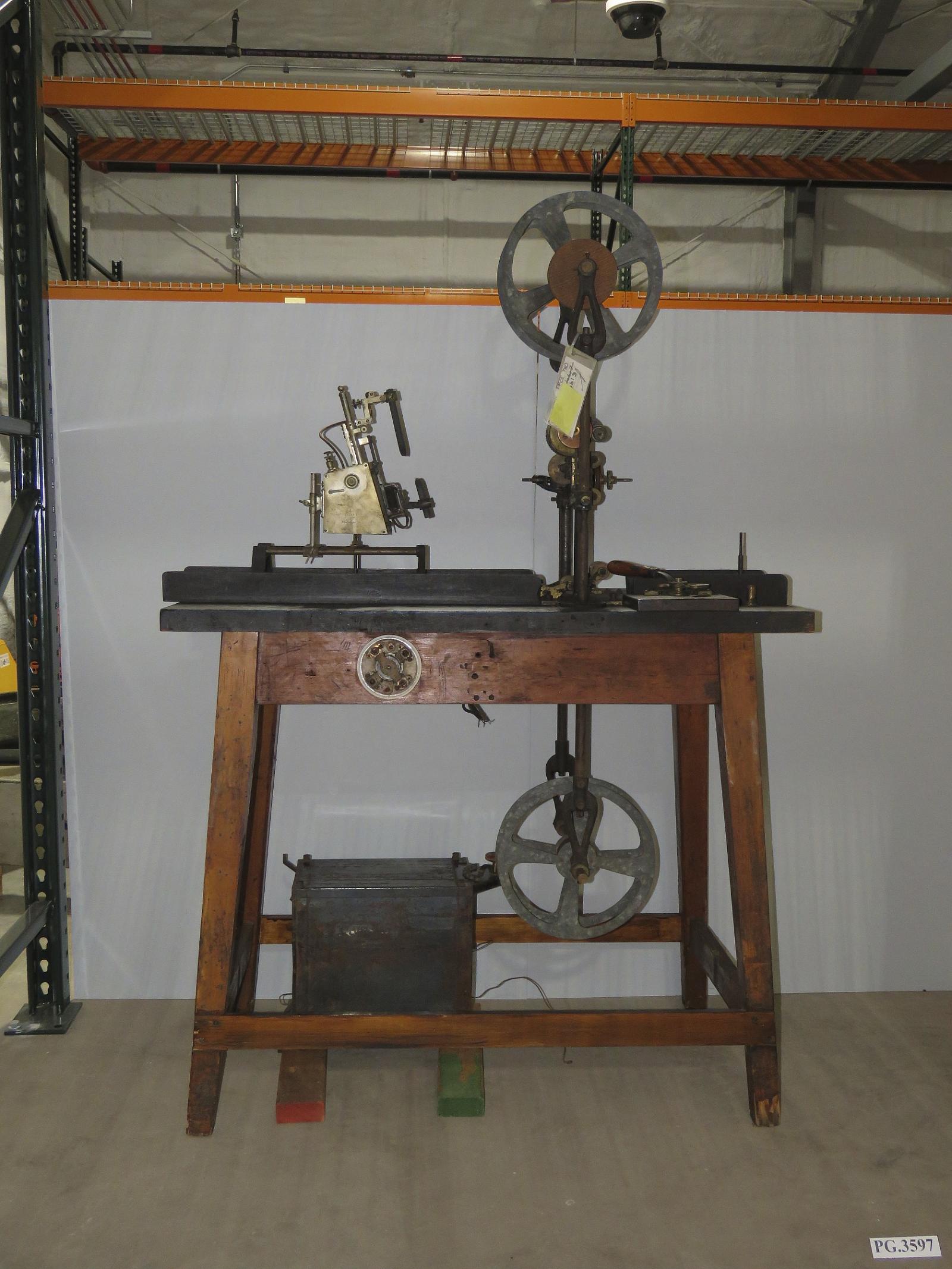
Yet the most consequential part of a system is not always the system that survives. The Smithsonian's preserved Eidoloscope is now a large, handmade museum object: cast and machined metal on a wooden table, with the visible weight of experimental apparatus.[5] The slack-buffer idea migrated beyond that body. Cameras and intermittent projectors of many later designs preserved a controlled pocket of film because the transport problem had not gone away: bulk film had to travel through a machine without forcing each local acceleration, pause, or pull onto the whole roll.[2][3]
The loop therefore belongs to a class of inventions that become nearly invisible when they succeed. It does not supply the image, perform for the camera, or command attention in the theater. It protects the conditions under which all three can continue. Its achievement is measured in what does not happen: torn perforations, unstable frames, aborted reels, an ending lost because the machine could not carry enough time.
Cinema often celebrates the frame as its smallest meaningful unit. The Latham loop suggests another candidate: the slack between frames and reels, deliberately preserved so incompatible motions can coexist. Early film became longer not only because inventors added capacity, but because they gave the strip somewhere to breathe.
Sources
- Woodville Latham, “Projecting-Kinetoscope,” U.S. Patent 707,934—application filed June 1, 1896 and granted August 26, 1902, with the film path, intermittent feed, slack sections, sprocket drums, and reel-isolation logic described in the specification.
- Dan Streible, Fight Pictures: A History of Boxing and Early Cinema, chapter 1 sample, University of California Press (2008)—the Lambda workshop, Latham loop, Griffo–Barnett film, Eidoloscope debut, touring exhibitions, and the company's commercial limits.
- Deac Rossell, “The Public Exhibition of Moving Pictures Before 1896,” pre-publication text for KINtop 14/15 (2006), hosted by Goldsmiths Research Online—the 1895 camera loop, the projector's 1896 intermittent movement, Eidoloscope workshop and exhibitions, and comparison with contemporary apparatus.
- Peter Domankiewicz, “In the beginning: cinema's murky origin story,” BFI Sight and Sound (February 27, 2021)—an alternative early-cinema chronology covering Kinetoscope viewing, the Latham paid projection, disputed Eidoloscope duration, and the Lumière system.
- Smithsonian National Museum of American History, “Latham Eidoloscope,” IIIF manifest for object PG.3597—catalogue metadata and photographic source for the surviving New York-made projector used as this article's cover image.