Late on December 4, 1957, a screen in a Paris radio studio became part of the rhythm section. Louis Malle had chosen a handful of sequences from his first feature, Elevator to the Gallows, and arranged for them to be projected in loops. Miles Davis watched. Barney Wilen, René Urtreger, Pierre Michelot, and Kenny Clarke watched with him. Then the five musicians played while the images came around again.[2][3]
The famous shorthand is that Davis improvised the score in one night. True, but incomplete. The session worked because improvisation did not mean the absence of a plan. The plan had migrated. Instead of a fully notated score dictating each bar, there were selected scenes, repeated durations, a plot briefing, a few harmonic materials, a bandleader's ear, and the visible behavior of faces and streets. The film became a moving lead sheet: specific enough to establish a field, open enough to leave the phrases undecided.
That distinction explains why the music still feels attached to the film without behaving like conventional suspense scoring. It does not underline every action, announce every danger, or strike each cut on cue. It gives uncertainty room to accumulate. The craft is not simply Davis's ability to invent beautiful lines at speed. It is the design of a situation in which five musicians could discover what the images needed before repetition turned discovery into routine.
Spoiler note: this essay discusses the film's central crime, the stalled elevator, and the mechanism that eventually exposes the plot.
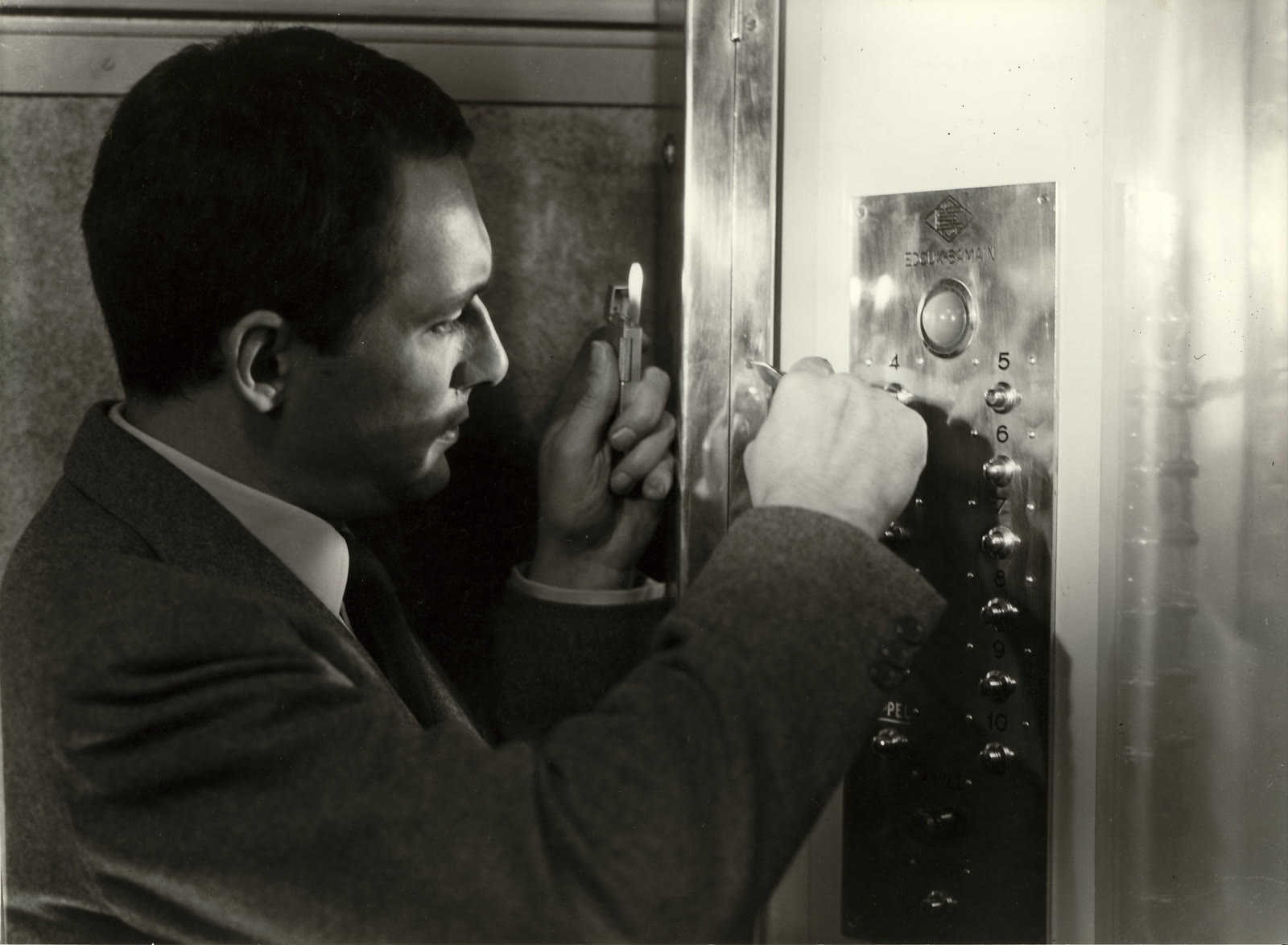
Image context: the lead image is an official production still from Gaumont's film gallery, credited to Nouvelles Éditions de Films.[1] Maurice Ronet's Julien holds a lighter beside the controls of the stalled elevator. The image belongs here because the score's achievement is not to make the box exciting; it is to let confinement remain suspended, physical, and unresolved.
The image supplied a moving form
Malle did not ask the musicians to fill all ninety-three minutes. He selected a handful of passages for music and looped them during the overnight session.[1][3] That choice created a useful middle ground between synchronization and freedom. A scene supplied length, visual density, and emotional temperature, but it did not prescribe a musical event for every gesture. When the loop restarted, the players could retain a contour, abandon an idea, or hear a new opening in a familiar shot.
Davis was not arriving cold. Producer and tour organizer Marcel Romano later recalled that Davis watched the film, took notes, and tried fragments of themes on a hotel piano before the recording date. Yet the band itself entered without a conventional rehearsal or finished score. Bassist Pierre Michelot remembered two chords and broken pieces of structure rather than a defined theme.[4] Preparation established the edges; performance determined what could happen inside them.
This is why “spontaneous” is both accurate and misleading. Davis had already made compositional decisions about scarcity. Few chords would keep the players from spending the scene negotiating a dense progression. Fragmentary material would allow an entrance to feel responsive rather than preordained. Repeated images would replace bar lines as the shared external reference. What was withheld from paper was not withheld from the process.
The loop also changed the musicians' relationship to cinematic time. A linear screening asks a first-time viewer what happens next. A loop asks a scorer what remains when surprise is removed. On the second or third return, plot information matters less than duration, movement, and pressure: how long Florence's walk can bear a sustained note, how Julien's immobility changes the weight of a pulse, how a car's forward motion differs from genuine escape. Repetition converted narrative into playable structure.
Five players made one temporary clock
The official Miles Davis account identifies the session ensemble precisely: Davis on trumpet, Wilen on tenor saxophone, Urtreger on piano, Michelot on bass, and Clarke on drums. Recording began late on December 4 and continued into the next day.[2] Calling the result “the Miles Davis trumpet score” captures its most recognizable voice while obscuring the mechanism that lets that voice sound free.
The rhythm section makes space measurable. Michelot can hold a pitch long enough for Davis's entrance to feel like a change in air rather than a melodic announcement. Urtreger's compact figures establish harmonic color without building a busy route through chord changes. Clarke can imply forward motion while refusing the emphatic punctuation that a crime thriller seems to invite. Wilen's tenor broadens the ensemble beyond a lone voice wandering above accompaniment. Improvisation here is collective timing: every player decides not only what to add, but how much room another player and the projected scene require.
Leonardo Camacho Bernal's harmonic study places several cues firmly on Davis's road toward modal jazz. In “Générique” and “L'Assassinat de Carala,” repeated piano-and-bass material supports long trumpet tones colored by modal relationships rather than rapid chord changes.[5] The technical consequence is audible even without naming a mode. Harmony stops behaving like a sequence of doors the soloist must pass through. It becomes a room in which a line can turn, pause, and change its emotional weight while the underlying space remains recognizable.
The released session material also preserves the sense that one scene could produce more than one valid musical answer. That matters to the film-scoring method. The projected image was a constraint, not a solution key. Malle and Davis could listen for the performance whose internal pace best joined the cut, while the alternate attempts retained value as music beyond the finished film.[4] Improvisation generated options; selection made one of those options cinematic.
The score refuses to solve the plot
Elevator to the Gallows is built from mechanisms that fail to deliver the certainty promised by their design. Julien stages the murder of his employer, then becomes trapped in the building's elevator when the power is shut off. A young couple steals his car and creates a second trail of violence under his identity. Florence, seeing the car but not understanding who is inside it, spends the night searching Paris for a lover she believes may have abandoned her. Photographs made by an automatic booth eventually preserve what the characters would prefer to erase.[1]
A more directive score could sort those strands for us: menace for the murderer, acceleration for the thieves, lament for the abandoned woman, a sting when evidence appears. Davis's music does something less helpful and more interesting. Because Malle reserves it for selected passages, its absences leave dialogue, machinery, traffic, and silence to carry much of the plot. When the jazz enters, it does not certify a moral category. It creates proximity among people who possess radically different amounts of information.
Richard Brody notes that, despite the period habit of attaching jazz to screen violence, this music is not itself violent or sinister.[4] That refusal matters most around Julien. The score does not turn him into a sleek professional whose crime deserves admiration, nor does it convert the stalled lift into a carnival of suspense effects. Its sparseness lets competence and panic occupy the same body. He planned an efficient murder; he cannot command a switched-off motor.
Florence's music is similarly resistant to explanation. The trumpet can sound lonely beside her, but it never proves that her version of events is correct. We know Julien is trapped while she imagines betrayal. Music binds us to the duration of her uncertainty without endorsing its cause. The score therefore works less like narration than shared weather: it can envelop a character's experience while leaving the facts untouched.
A face and a trumpet accept the street
The best-known fusion of image and score follows Jeanne Moreau through nighttime Paris. Henri Decaë used light-sensitive black-and-white stock, worked on real streets, and photographed Moreau without the polished makeup and stable illumination associated with studio glamour.[6] Shopfronts and streetlights do not hold her face at one ideal exposure. They find it, lose it, and return it altered.
Davis's long, unhurried phrases meet that photography without trying to domesticate it. The trumpet does not march to Moreau's footsteps or flare whenever light crosses her eyes. It permits the same kind of variation Decaë permits: a strong form whose surface changes with the environment. The street supplies pools of brightness; the band supplies fields of harmony. Moreau moves through both.
This is a deeper coordination than hitting visual cues. Camera and score share an attitude toward control. Decaë does not build a soundstage where every reflection can be fixed; he chooses stock and movement capable of receiving whatever Paris offers. Davis does not prescribe every pitch; he chooses sparse materials and players capable of responding to whatever the loop discloses. Neither method is casual. Each depends on technical preparation strong enough to make contingency usable.
The result is often described as atmosphere, which is correct but underspecified. Atmosphere here is a production achievement. It comes from aligning two systems that remain partly open: location photography exposed to changing light and ensemble performance exposed to real-time choice. Moreau's walk feels inseparable from Davis's trumpet because neither has been forced into a mechanical imitation of the other.
Bounded freedom became the technique
The session's place in Davis's development can tempt a tidy origin story. Camacho Bernal treats the soundtrack as an important step toward the modal language that would become more explicit in Milestones and culminate in Kind of Blue.[5] The chronology is useful, but the film should not be reduced to a rehearsal for a later masterpiece. Its musical economy answered an immediate cinematic problem: how to give separate nocturnal strands a common emotional pressure without flattening them into one explanation.
Nor did improvisation erase authorship. Malle chose the passages, supplied the cut, and later decided where performances belonged. Davis studied the film, narrowed the harmonic field, led the ensemble, and shaped its restraint. The other musicians converted those boundaries into playable time. Editor Léonide Azar's finished structure determined how the cues lived beside dialogue and silence.[1][2] The score exists because these layers remain distinguishable and cooperate.
That is the durable craft lesson of Elevator to the Gallows. “Improvise it overnight” is an anecdote, not a method. The method is to decide what must be fixed and what gains life by remaining open. Fix the scene. Repeat the duration. Clarify the dramatic pressure. Limit the harmonic traffic. Choose players who can listen across disciplines. Then allow the answer to arrive as a performance rather than a diagram.
In that Paris studio, the screen did not merely receive music after the images were finished. It organized attention. Each loop told the band where time tightened and where it could breathe, while leaving the actual breath unnotated. The film became a lead sheet not because it was vague, but because it knew exactly how much not to say.
Sources
- Gaumont, “Elevator to the Gallows” — official film record, synopsis, technical specifications, credits, and 1958 production-still gallery.
- Miles Davis official site, “Elevator to the Gallows” — recording dates, ensemble personnel, modal and impromptu session description, and film credits.
- Tina Hassannia, “In 1956's ‘Elevator to the Gallows,’ Miles and Malle Found Their Grooves.” The Village Voice, August 3, 2016 — overnight session, selected scene loops, and production context.
- Richard Brody, “Louis Malle's Elevator to the Gallows, and Its Historic Miles Davis Soundtrack.” The New Yorker, August 11, 2016 — Romano and Michelot session recollections, harmonic constraints, alternate recordings, and Davis's musical transition.
- Leonardo Camacho Bernal, Miles Davis: The Road to Modal Jazz. University of North Texas master's thesis, 2007 — harmonic analysis of the soundtrack and its place in Davis's shift toward modal practice.
- Eye Filmmuseum, “Ascenseur pour l'échafaud” — Henri Decaë's light-sensitive stock, location shooting, Moreau's unadorned screen image, and the film's break with studio polish.