

Billy Wilder is often praised for his wit, which can make him sound lighter than he is.[1][2][3][7] The wit is real, but the official trailers for Ace in the Hole (1951), Sunset Boulevard (1950), and The Apartment (1960) point toward a harder constant in his cinema. Wilder keeps finding institutions that claim to organize modern life responsibly and then showing how quickly they begin to feed on private weakness. A newspaper wants a scoop, a studio system wants one more close-up, an insurance office wants orderly promotion. In each case, the promised structure starts behaving like a trap.
Seen together, the three videos make that design unusually clear.[1][2][3] They do not just market stars, genre, or famous lines. They keep returning to operational spaces: the cave mouth and carnival perimeter in Ace in the Hole, the gate, pool, and staircase in Sunset Boulevard, the office grid, elevator corridor, and borrowed apartment key in The Apartment.[1][2][3][4][5][6] Wilder's real subject is not simply corruption in the abstract. It is the point where a system stops processing work and starts processing human need, loneliness, or vanity as fuel.
That is why these trailers are worth curating as trailers rather than treating them as disposable promotion.[1][2][3] In compressed form, they expose Wilder's basic mechanism. He loves doors, desks, telephones, crowds, staircases, and routines because those things let him show how public structures invade private feeling. The institutions differ, but the pressure pattern does not. Advancement is offered, intimacy is rerouted, and a room that looked useful five minutes earlier suddenly feels impossible to leave.
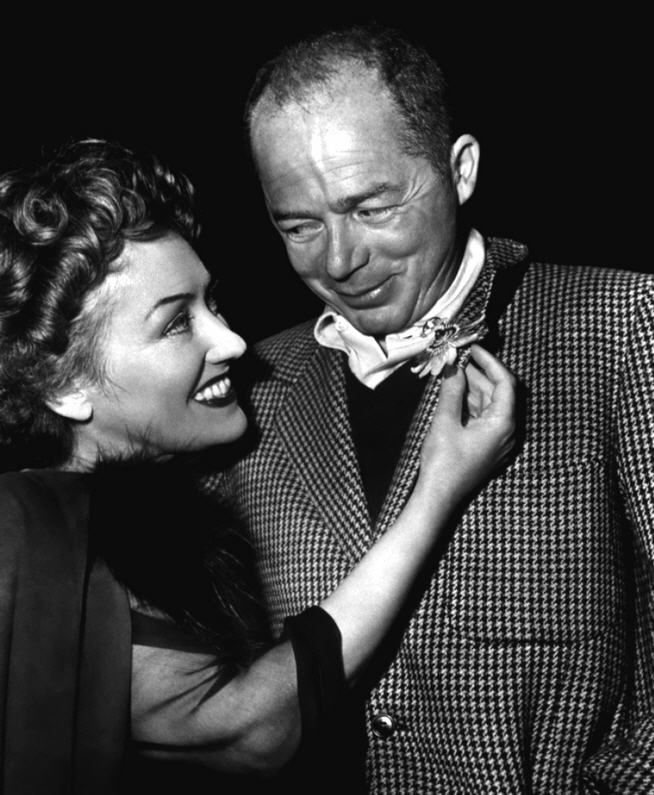
Image context: the cover uses a circa-1950 studio publicity photo of Billy Wilder and Gloria Swanson from Wikimedia Commons. It fits a Wilder-led collection because the article moves through his recurrent interest in performance systems, and this image places him directly inside the most poisonous version of manufactured fame in the set.[8]
1. Ace in the Hole: the deadline becomes a carnival
The Ace in the Hole trailer sells urgency from the first beats, but its real intelligence is that it never lets urgency stay noble.[1][4] The setup is perfect Wilder material. Chuck Tatum, a disgraced big-city reporter stranded at a New Mexico paper, discovers that a man trapped in a cave can become the story that restores his own stature.[1][4][7] The trailer pushes hard on spectacle: the cave-in, the gathering crowd, the newspaper hunger, Kirk Douglas's muscular confidence. Yet even in preview form, the movie's core idea is visible. Rescue is not the organizing principle. Deadline management is. Human danger becomes a production schedule.
What the trailer understands is that Wilder's critique works spatially as much as morally.[1][4] The cave should be the fixed center of the drama, but the frame keeps expanding outward into parking, concessions, radio chatter, and the growing fairground that feeds on delay. Molly Haskell's Library of Congress essay notes how the film turns media opportunism into a whole roadside economy rather than one villain's bad conscience, and that is exactly what the trailer advertises in miniature.[4] Tatum is monstrous, but he is also the instrument that reveals how easily a modern information system can price suffering, prolong it, and call the result public interest. Wilder does not merely condemn the reporter. He shows a profession learning to confuse access with permission.
2. Sunset Boulevard: the mansion preserves celebrity by embalming it
If Ace in the Hole turns news into an event machine, the Sunset Boulevard trailer turns Hollywood into an afterlife industry.[2][5][7] Paramount's anniversary preview is full of the expected attractions: the dead narrator in the pool, Gloria Swanson's stare, the decaying mansion, the staircase descent that has long since become part of movie folklore.[2][5] But the trailer's deeper promise is not simple noir intrigue. It is enclosure. Norma Desmond's house does not feel like a refuge from the industry that discarded her. It feels like the industry's purest surviving chamber, a place where performance continues after the market has withdrawn its official support.
That is why Wilder keeps the mansion organized around thresholds and levels.[2][5][7] The gate separates old stardom from the street, the pool announces success as a corpse image, and the staircase converts one woman's private fantasy into permanent public performance. TCM's note on the film is useful here because it emphasizes how decisively the picture entered canon status while remaining savage about the business that produced it.[5] The trailer sells the same paradox. It asks the viewer to enjoy Swanson's theatrical grandeur while slowly realizing that grandeur has become a prison technology. Joe Gillis thinks he has entered a temporary arrangement of convenience. Wilder makes the house feel, from the preview onward, like a studio set that has decided to keep its actors long after the shoot should have ended.
3. The Apartment: the office follows people home
The official trailer for The Apartment changes the register from deathly glamour to corporate comedy, but Wilder's underlying structure barely changes.[3][6][7] The movie begins with the promise that bureaucratic obedience can be exchanged for upward mobility. C. C. Baxter lends his apartment key to superiors, absorbs inconvenience as if it were part of professional discipline, and imagines that patience will eventually convert into advancement.[3][6] The trailer captures this with remarkable efficiency. It offers Jack Lemmon's frazzled decency, Shirley MacLaine's sadness, the office hierarchy, the key circulation, and the uneasy sense that private space has become just another annex of company life.
The trailer is especially sharp because it presents the apartment as both commodity and conscience.[3][6] Office routines are supposed to remain in the insurance tower, yet Wilder keeps showing how the system extends through elevators, bar stops, night schedules, and the humble mechanics of who holds a key. Turner Classic Movies' awards-season essay stresses the film's unusual mix of romantic tenderness and institutional satire, and the preview gets that balance exactly right.[6] Baxter's room is funny because it is so ordinary, but that ordinariness is what allows the office to colonize it. By the time Fran Kubelik enters the story's emotional center, the apartment is no longer a neutral private room. It has become a ledger of favors, shame, exhaustion, and one last chance to choose decency over career arithmetic.
What the three videos reveal together
Taken together, these trailers show Wilder building one of the great twentieth-century cinemas of institutional seepage.[1][2][3][7] He does not oppose public systems with some pure private sphere waiting outside them. He shows how the systems get inside first. Journalism reorganizes rescue time. Hollywood reorganizes memory and aging. Corporate life reorganizes romance and shelter. The settings are different, but the movies keep asking the same question: what happens when a structure built to distribute work, attention, or prestige discovers that private vulnerability is its most profitable raw material?
That is why Wilder's films stay so legible in short promotional form.[1][2][3] Their hooks are not arbitrary. They are architectural. A cave opening, a staircase, a key ring, a pool, a crowd line, a reception desk: each is a small machine for translating social order into emotional pressure. The three videos do more than advertise famous movies. They map Wilder's hardest insight with unusual clarity. Institutions rarely need to shout in his cinema. They only need to keep offering convenience, access, or advancement until the room quietly closes.
Sources
- Paramount Movies Digital, "Ace In The Hole - Trailer," YouTube video.
- Paramount Movies, "Sunset Boulevard (1950) Official Trailer | 75th Anniversary," YouTube video.
- Amazon MGM Studios, "The Apartment (1960) | Official Trailer," YouTube video.
- Molly Haskell, "Ace in the Hole essay," Library of Congress National Film Preservation Board PDF.
- Turner Classic Movies, "AFI's Top 100: Sunset Boulevard (1950)."
- Turner Classic Movies, "Awards Season: The Apartment (1960)."
- Encyclopaedia Britannica, "Billy Wilder."
- Wikimedia Commons, "File: Gloria Swanson & Billy Wilder - ca. 1950.JPG."