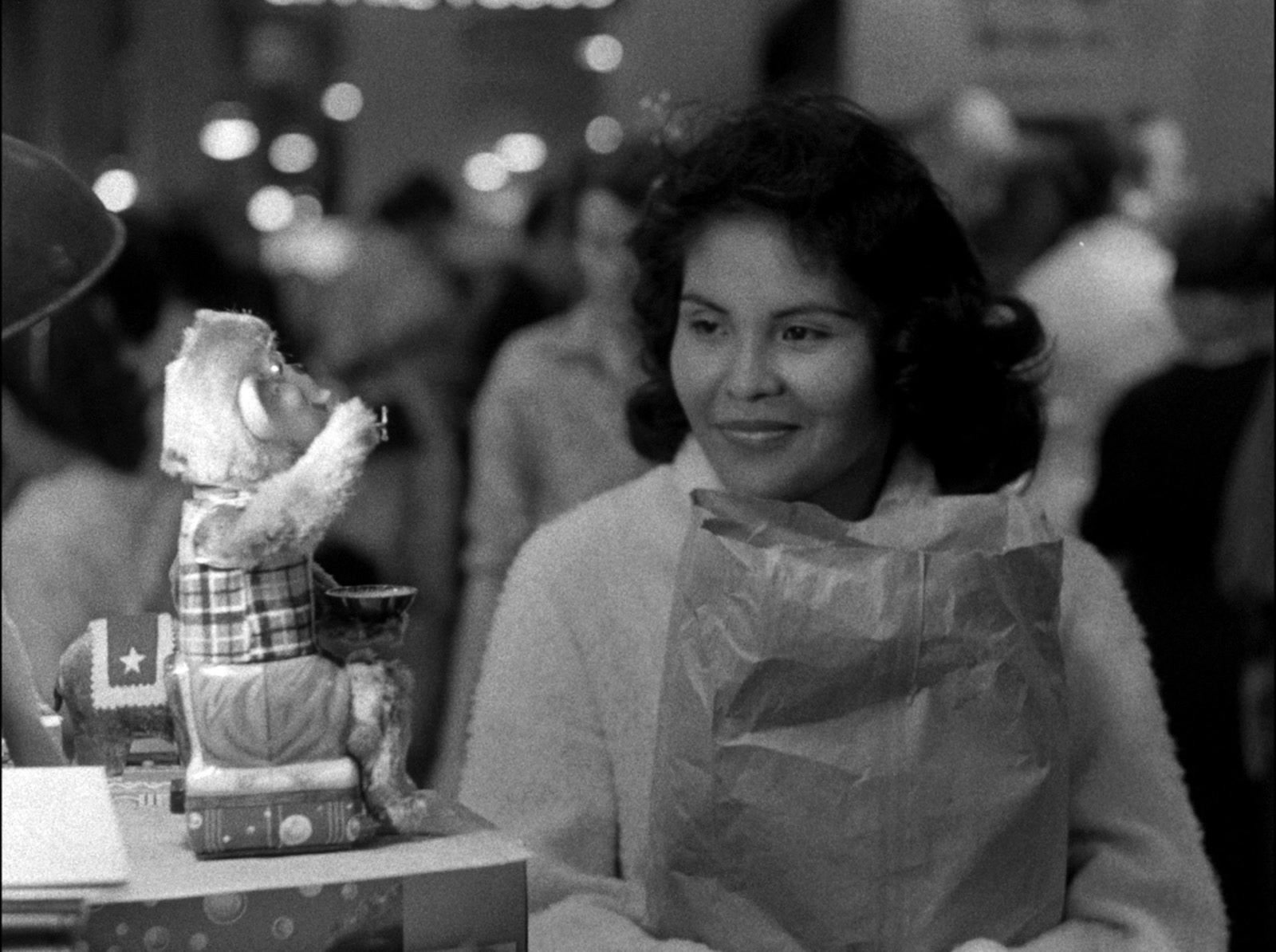
Yvonne sees the toy monkey before she sees the night go wrong. It sits on a Grand Central Market counter in a plaid vest, blowing bubbles toward the face of the pregnant woman carrying a paper grocery bag. She leans closer and smiles. Nothing is purchased; nothing is explained. For a few seconds, looking is enough.
Kent Mackenzie's The Exiles is full of images that later became historical evidence: the old Bunker Hill rooming houses, Angels Flight, Main Street bars, the Third Street Tunnel, and the land around Chavez Ravine before Dodger Stadium remade the view. But the monkey scene refuses the melancholy of a city already lost. Yvonne Williams is not walking through an archive. In the film's 1958 Los Angeles, she is simply out in her city, considering its objects and her unborn child's future.[1][4]
Completed and first shown in 1961, the 72-minute film compresses the experiences of young Native residents into one Friday night. Its Apache, Hualapai, Pueblo, and other Native participants play versions of themselves in a narrative developed from interviews and familiar routines. They shop, cook, work, flirt, gamble, fight, drive, dance, and wait. Mackenzie was a white outsider and retained the power of director and editor, so this is not unmediated testimony. Yet the film's deepest formal decision is to keep its characters in the contemporary world—to let their own clothes, voices, popular music, friendships, failures, and claims on Los Angeles displace Hollywood's timeless “Indian.”[1][2][8]
Spoiler note: this essay discusses the film's full night and its return at dawn.
The prologue points backward; the first scene moves
The Exiles begins with photographs by Edward S. Curtis: posed images that place Native people in a generalized historical past. Mackenzie added this short prologue after early festival screenings in 1961, responding to audiences who wanted orientation.[2] Its explanatory function is obvious, but so is its danger. Before the contemporary characters have appeared, the film briefly supplies the familiar museum distance through which non-Native spectators had been trained to look.
Then Yvonne enters Grand Central Market in a white coat and ribbon, carrying cash, choosing groceries, and watching the bubble machine work. The cut is more than a leap in time. It changes the terms of visibility. Curtis's subjects are held still for the historical gaze; Yvonne moves through a commercial space and directs her own gaze at the city. Store signs, paper sacks, men's shoes, dresses, movie marquees, jukeboxes, convertibles, and gas pumps insist that Native life belongs to the same midcentury present as everything around it.[1][2]
That present had been shaped by federal policy. The Bureau of Indian Affairs opened a Los Angeles placement-and-relocation office in 1951 as the federal government encouraged Native people to leave reservations for metropolitan jobs. Assistance often meant a one-way trip, while housing discrimination, low-paid work, unemployment, and separation from family made the promised urban opportunity radically uneven.[3] The film never turns Yvonne, Homer Nish, or Tommy Reynolds into illustrations for a government program, and their individual routes to Los Angeles were not identical. It records the social world that policy helped produce without pretending a policy summary could contain the people living in it.
Liza Black, a Cherokee Nation historian, offers the crucial reversal: The Exiles should be read first as a story of Native presence and survivance, and only second as an elegy for demolished Los Angeles.[1] Bunker Hill is the thing about to vanish. The people on screen are inventing urban Native lives that exceed both the reservation/city binary and the neighborhood's physical lifespan.
Yvonne gets the first walk
The film's night is divided by unequal forms of mobility. Yvonne walks. Homer and Tommy ride in cars, charge through tunnels, move between bars, and eventually climb to Hill X with a crowd. Their speed looks like freedom, but it traces a loop: drink, wager, pursue women, fight, repeat. Her slower route appears solitary, yet it gathers a future the men keep postponing.
The difference begins at home. Yvonne returns with food to an apartment already occupied by Homer and his friends. She cooks pork chops while the men lounge, eat, dress, and give little sign that they have seen the labor making their evening possible. They drop her at the Roxie Theatre and promise to collect her later. She watches a Western while they enter the bar circuit. When no one returns, she waits, gives up, and starts walking again.[1]
Mackenzie does not turn that abandonment into a chase or confrontation. Yvonne's passage is made of pauses. She studies shop windows, considers clothes and shoes, climbs the hill, and speaks on the soundtrack about marriage, prayer, disappointment, and what she wants for her child. The storefront glass offers images of a better life without granting access to it. Yet looking is not nothing. In the market and on the pavement, Yvonne occupies the foreground, sets the pace, and imagines a life beyond the apartment's current arrangement.[1]
Her visit to a female friend's room changes the emotional temperature. The two women share a bed, look at family photographs, tease an old boyfriend's thinness, and briefly laugh. The scene does not erase Yvonne's isolation; it reveals that the men's night out is not the film's only form of community. Her alternative is quieter, domestic, and built by women accustomed to being left behind. It also gives her a destination Homer did not choose.
This is why the market image is more than an attractive archival still. Yvonne's smile beside the mechanical monkey is one of the film's rare moments of unforced delight. The city is not merely the machine that displaced her or the background that will disappear. It is where she can look, desire, judge, remember, and laugh. Her claim on Los Angeles is made at walking speed.
The voices do not match the mouths
The film's celebrated realism was constructed after the images were shot. Working in 35mm without usable synchronized location dialogue, Mackenzie recorded speech later and built the soundtrack from post-synchronized exchanges, interview material, reflective monologues, traffic, bar noise, songs, and music by the Revels.[4][5] Voices often continue while the image dissolves to a street, a face, or a passing car. Inner thought occupies the same city as neon and asphalt without being pinned to a moving mouth.
The separation creates intimacy, but it should not be confused with transparency. Mackenzie chose questions, selected statements, directed later recording, and edited hours of experience into three character lines. The monologues are both collaboration and construction. Their value lies less in a claim that the camera captured untouched reality than in the room they give Yvonne, Homer, and Tommy to sound unlike the Native figures that mainstream movies manufactured for non-Native audiences.[5][8]
Laura Sachiko Fugikawa calls the result an Indigenous soundscape while keeping its contradictions audible. In the Café Ritz, Tommy's greetings move among English, Spanish, and Diné over loud rock and roll; elsewhere, teasing, laughter, jukebox music, surf-inflected songs, traffic, and the Hill X drum connect people across bars, streets, reservations, and the city. The same soundtrack also carries historical silences and stereotypes that Mackenzie's outsider framing cannot automatically solve.[8]
Visually, the film borrows the finish of Hollywood while rejecting its usual Native imagery. Cinematographers Erik Daarstad, Robert Kaufman, and John Morrill give the night deep shadows and bright pools from shop windows, headlights, gas-station lamps, and neon. Continuity cuts make crowded rooms and fast cars legible; dissolves loosen time between incidents.[2] The result resembles noir, but there is no detective arriving to interpret the streets. The people usually reduced to atmosphere become the ones with interior voices.
Two crossings of the same city
Yvonne's walk has a counterpart in Homer's. After a bar fight, he moves through downtown with a bottle and reads a letter from his parents. His voice and a brief memory of the reservation bring family into the city without turning either place into his single authentic home. He misses people elsewhere while continuing to enjoy Los Angeles with his friends. The film can hold attachment and departure together because the monologue floats across locations rather than forcing identity into a before-and-after diagram.[1]
Tommy's route is more aggressively present-tense. He performs ease—jokes, clothes, flirtation, speed—as if the night will stay open as long as the car keeps moving. At a brilliantly lit gas station, that mobility reveals its cost. The group leaves Marilyn behind after she goes to the restroom, converting a communal ride into another casual abandonment. The attendant watches from the station, but the film does not turn his white gaze into the scene's moral center. The harm occurs inside the group and remains theirs to confront.[1][2]
Cars therefore do not simply oppose Yvonne's confinement. They enlarge the men's range while making their irresponsibility portable. Yvonne is the person most visibly left waiting, but the night repeatedly shows women supplying food, money, attention, and exits for men who mistake circulation for freedom. By cross-cutting these routes, The Exiles makes gender a question of who gets to move without arranging the return.
Hill X is a claim, not a cure
The men's route culminates above the city at Hill X, in the Chavez Ravine area. Cars arrive, an intertribal crowd forms, and a “49” gathering of drumming, singing, dancing, drinking, and joking carries the night toward dawn. Rock and roll has not been exchanged for a purified tradition. Both belong to the same people and the same evening. The songs and movement remake a Los Angeles hill as Native social space without asking the city for a monument or permission.[1][8]
The sequence is exhilarating because it expands the frame from small rooms and bar tables to bodies moving together against open darkness. It is also brutal. Tommy tries to force himself on Claudine; she fights him off. Other aggression and fighting continue around the gathering. The film neither supplies a clean condemnation nor allows celebration to wash the violence away. Community, cultural continuity, misogyny, pleasure, and danger occupy the same hill.[1][2]
That collision prevents an easy redemptive reading. Hill X is not a return to an intact past, and urban life is not a fall from it. The gathering is a contemporary intertribal practice made by people whose routes and affiliations already cross. It restores energy and belonging for the men while exposing how readily they reproduce domination against women. The claim to space is real; so is the question of who can feel safe inside it.
Yvonne is absent from the hill, but her walk remains its formal counterweight. Both sequences turn movement into a claim on Los Angeles. Only one is built around a pregnant woman's need to find shelter after the person responsible for her fails to return.
At dawn, what has vanished?
Morning does not solve the night. The group descends, Homer returns, and the crowded apartment resumes its claim on Yvonne's attention. The circular structure denies the satisfying conversion that a social-problem film might impose. We have learned how the arrangement works; the characters still have to live in it.
The material film nearly disappeared too. It had festival and university screenings but no normal theatrical life, then circulated in poor versions until its recovery and restoration. UCLA Film & Television Archive restored it with National Film Preservation Foundation support, and Milestone brought it back to audiences in 2008.[6][7] Preservation made Bunker Hill visible again, but the movie's value is larger than a record of vanished buildings.
To treat the people as ghosts of “old Los Angeles” would repeat the prologue's backward pull. The film instead preserves the force of their present: Yvonne smiling at a toy, Homer stopping over a letter, Tommy switching languages in a bar, friends turning a hill into a dance floor, and women measuring the price of the men's freedom. These moments do not make Mackenzie's authorship innocent or the community ideal. They make the characters contemporaries rather than relics.
The title The Exiles tempts us to ask where these people truly belong. The film's form gives a better question: who gets to behave as if the city belongs to them? Its answer changes from scene to scene and remains unequal. Yet the strongest reversal holds. The supposedly permanent city is demolished, rebuilt, and forgotten. The Native lives moving through it stay in the present tense.
Sources
- Liza Black, “The Exiles: Native Survivance and Urban Space in Downtown Los Angeles,” American Indian Culture and Research Journal 42, no. 3 (2018) — Yvonne's market and walking sequences, Native self-representation, survivance, Hill X, gender, and urban space.
- Catherine Russell, “The Exiles,” Library of Congress National Film Registry essay — 35mm cinematography, the Curtis prologue, editing, voice-over, contemporary popular culture, the gas station, Hill X, and gender inequity.
- U.S. National Archives and Records Administration, “Bureau of Indian Affairs Records: Urban Relocation” — termination-era policy, the 1951 Los Angeles relocation office, employment figures, one-way travel, discrimination, and urban adjustment.
- American Film Institute Catalog, “The Exiles” — production chronology, Bunker Hill and downtown locations, nonprofessional cast, 35mm short ends, budget, equipment, festival history, and release record.
- Harvard Film Archive, “The Exiles by Kent Mackenzie,” January 25, 2016 — one-Friday-night structure, collaborative reenactment, 35mm production, post-synchronized dialogue, and voice-over method.
- Milestone Films, “Exiles, The” — official distributor page, interview-built narrative, cast participation, rediscovery, UCLA restoration, and 35mm availability.
- UCLA Film & Television Archive, “The Exiles / The Savage Eye,” January 23, 2020 — 1961 film record, runtime, format, credits, restoration provenance, and source of the archival film still.
- Laura Sachiko Fugikawa, “Sonic Connections: Listening for Indigenous Landscapes in Kent Mackenzie's The Exiles,” Sounding Out!, June 15, 2015 — asynchronous recording, multilingual speech, popular music, the 49 gathering, Native urban sound, and the film's historical silences.