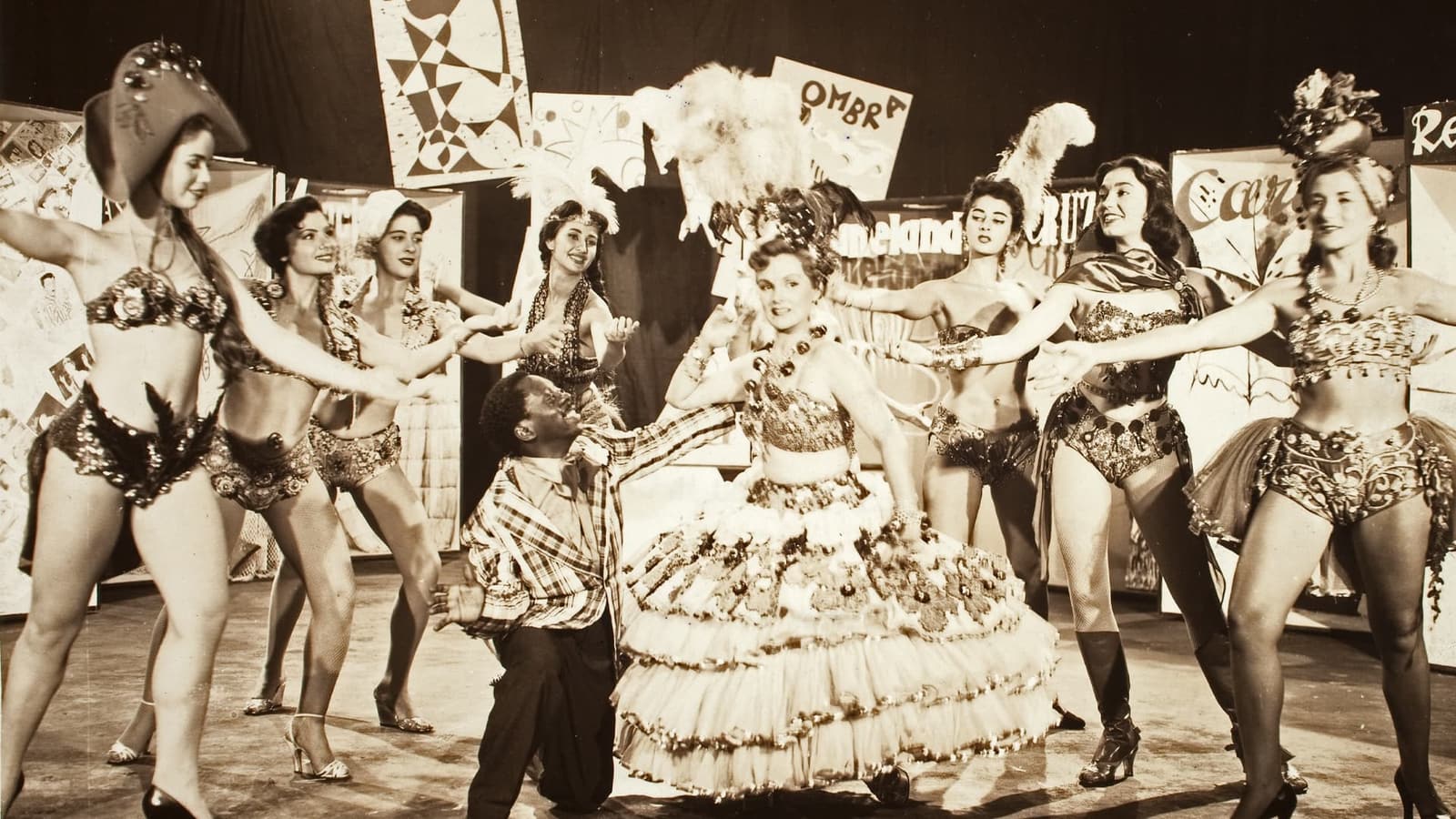
In Carnaval Atlântida (1952), a movie producer wants to make Helen of Troy. Two employees at his studio want to make a carnival comedy. The solemn project gradually loses the argument, and the supposedly lesser film takes possession of the screen. By the end, Brazilian popular entertainment has not defeated Hollywood from outside. It has invaded the studio wearing Hollywood's costume.[1]
That is the cleanest way into the chanchada, the cycle of musical comedies that connected Brazilian cinema to carnival, radio, records, theatrical revue, and circus performance from the 1930s through the 1950s. Calling these movies low-budget imitations is factually tempting and historically inadequate. They borrowed plots, genres, stars, and poses that audiences already recognized, then made the borrowed material answer to Rio's rhythms, class types, political jokes, working conditions, and appetite for live performance.[2][3]
The visible mismatch was not an embarrassment that the best chanchadas managed to hide. It was often where the comedy began. A biblical epic could be governed by a barber. A western sheriff could move like a clown. A studio unable to manufacture ancient Greece could make that inability the subject of a musical. Chanchada did not prove that Brazilian cinema could reproduce Hollywood perfectly. It asked why perfection should be the only measure of a national popular cinema.
A genre timed to February
The chanchada was less a sealed film genre than a switching station. Performers arrived with established personae from radio auditoriums, casinos, circus rings, and the theatre of revue. Songs circulated through records, broadcasts, illustrated magazines, and stages before or alongside their screen appearances. Carnival supplied not only imagery but a deadline: producers tried to identify likely seasonal hits, assemble scripts, shoot quickly, and release while the songs still belonged to the approaching festivities.[2]
That schedule explains a feature contemporary critics treated as evidence of bad construction: the story may pause so a singer can deliver an entire number almost straight to the audience. Measured against the integrated Hollywood musical, the interruption can look static. Measured as the screen extension of a radio auditorium or revue stage, it keeps a different promise. The spectator has come to see a familiar performer complete the song, not merely advance a fictional plot.[2]
Flávia Cesarino Costa's study of musical numbers shows how many cultural economies meet inside that pause. Samba and the brisk carnival marchinha share space with the northeastern baião, Mexican bolero, jazz, rock, and later bossa nova. Famous singers sometimes appear as versions of themselves; revue performers bring presentational gestures and direct looks toward the camera. The film records a number, advertises a record, recalls a stage attraction, and invites a cinema audience to behave like a radio crowd at once.[2]
The seams therefore carry historical information. They reveal who already had drawing power, which songs could travel, which stages trained the performers, and how rapidly a film had to join the circuit. What looks like cinema failing to become self-contained is also cinema succeeding as part of a larger popular culture.
Atlântida turns the circuit into a studio system
Chanchadas were made by many companies, but Atlântida Cinematográfica became their most durable emblem. Founded in Rio in 1941, Atlântida gathered filmmakers including José Carlos Burle, Watson Macedo, and Carlos Manga. In 1947, exhibitor Luiz Severiano Ribeiro acquired most of its shares, tightening the relation between production and the theatres in which the films met their mass audience.[2][3]
The scale of that audience matters because critical memory once made the genre look more marginal than it was. Maia and Azevedo count 206 comedies among 387 Brazilian fiction features produced during the first three decades of sound—about 53 percent—and recall reports of long queues and packed family screenings. The put-down embedded in the word chanchada came from critical discourse; the public did not need the insult converted into approval before buying a ticket.[3]
Carnaval Atlântida makes the hierarchy literal. The producer Cecílio B. de Milho hires a professor as consultant for a prestigious classical epic, while workers in the studio argue for the comedy that the actual company knows how to make. Musical numbers, disguises, romance, and backstage confusion dismantle the division between elevated antiquity and supposedly vulgar carnival. Cinemateca Brasileira describes the result as social criticism, comedy of manners, Hollywood parody, and self-irony about the material limits of Brazilian production.[1]
The joke lands because Atlântida is not pretending that resources are equal. Its fictional studio cannot conjure DeMille-sized antiquity. But scarcity does not lead only to apology. It lets the film reverse the terms of prestige: the Greek epic is the impractical fantasy, while popular comedy is the form that understands the workers, performers, and audience already in the building.
Hollywood supplies the costume, not the verdict
Carlos Manga's two 1954 parodies make this conversion especially sharp. Nem Sansão nem Dalila begins from Cecil B. DeMille's Samson and Delilah but replaces monumental heroism with Horácio, a frightened, physically slight barber played by Oscarito. A time machine carries him to Gaza; an encounter with Samson lets him trade a cigarette lighter for the miraculous wig that contains the strongman's power. The exchange shrinks divine epic into streetwise barter.[3][4]
Once strong, Horácio does not become noble. He becomes a genial-looking autocrat. He creates departments and taxes, proposes a meter for camels, and opens a speech with an unmistakable variation on Getúlio Vargas's address to the “workers of Brazil”: Horácio speaks instead to the “workers of Gaza.” The parody does two jobs at once. DeMille's biblical spectacle is brought down to human scale, and the borrowed authority of the epic is redirected toward contemporary Brazilian government.[3][4]
Matar ou Correr starts with Fred Zinnemann's High Noon, released in Brazil as Matar ou Morrer—“Kill or Die.” Changing “die” to “run” replaces the western hero's moral stand with the antihero's sensible exit. The credits use western typography and announce that the film occurs somewhere in the West at some unspecified time, but that everyone speaks “Portuguese, certainly” for the convenience of cast and audience. Even the exposition admits that this West is a set being performed.[3]
The film's exaggerated saloon, costumes, and gunplay do not merely fail to match their American models. They keep pointing at the act of matching. Oscarito and Grande Otelo play two swindlers who accidentally acquire badges and become the law in City Down. The conventional romantic hero is pushed toward the edge; the figures who would ordinarily provide comic relief become the narrative motor. Authority survives as hat, holster, posture, and collective belief—exactly the things physical comedy can knock out of alignment.[3]
Borrowing, in these films, is neither cultural surrender nor an innocent claim to purity. The audience must know the imported form for the joke to work. But recognition is only the first beat. The second is reassignment: Samson's strength goes to a barber, the sheriff's badge goes to a pair of hustlers, and Hollywood grandeur becomes raw material for thinking about who gets to look powerful.
Oscarito and Grande Otelo move the center
The genre's argument lives in bodies as much as plots. Oscarito brought circus timing, revue experience, a pliable face, and a walk capable of puncturing ceremony before dialogue arrived. Grande Otelo moved among theatre, radio, music, cinema, and later television; Brazil's National Library records his path from the Companhia Negra de Revista through major radio stations and into Atlântida's most popular films.[5]
Together, they could make hierarchy look temporary. One body stretches a dignified pose past its breaking point; the other watches, answers, redirects the rhythm. In Matar ou Correr, their importance is structural, not decorative. Maia and Azevedo note that the upright western lead and romance receive little narrative weight beside the comic pair. Drama becomes an interruption inside the comedy, a reversal of the usual arrangement in which a clown briefly relieves heroic tension.[3]
Yet moving Grande Otelo to the center did not make the frame equal. A 2026 exhibition catalogue from Fundação Clóvis Salgado places his chanchada work inside a longer career of negotiating roles constrained by racist stereotypes. It argues that Atlântida's pairing of a Black actor and a white actor could perform an easy interracial friendship—a screen version of “racial democracy”—while letting underlying conflicts remain visible but unresolved.[6]
That boundary changes how the partnership should be admired. Grande Otelo's precision and range cannot be reduced to a symbol of harmonious national mixture, and the genre's carnival inversions did not automatically survive the end of the number. Chanchada could lower the pompous intellectual, the studio boss, the dictator, or the western lawman while still relying on racial caricature and revue conventions that turned women into display. Popular irreverence is a tool, not a guarantee of liberation.[2][3][6]
The seams become the style
Critics saw haste, repetition, crude sets, disconnected songs, and vulgar humor. Those features were sometimes present; recovering the chanchada does not require declaring every shortcut secretly radical. The larger error was to use classical narrative integration and Hollywood finish as neutral standards, then call a form built from carnival timing, radio address, revue spectacle, and conspicuous parody defective whenever those other practices remained visible.[2][3]
From the 1980s onward, scholarship increasingly treated the cycle as a major Brazilian genre rather than a shameful prehistory. That reversal recovered its political satire and cultural hybridity, but it also made a formal discovery: chanchada's exaggeration and exposed construction can be reflexive. Costa argues that the mixture of performance strategies repeatedly calls attention to the production process. Maia and Azevedo go further, finding in its caricature and self-conscious imitation qualities later prized as modernist.[2][3]
The cycle thinned as its surrounding circuit changed. By the end of the 1950s, theatrical revue was declining, radio's live-auditorium culture was giving way, and television was absorbing performers and audiences; Costa dates the chanchada model's loss of dominance to the early 1960s.[2] Its disappearance confirms how deeply the form depended on more than cinema alone.
That dependence is its legacy. The chanchada proposes that a national cinema need not begin with purity, technical equivalence, or withdrawal from imported culture. It can begin with traffic: a Hollywood plot, a carnival deadline, a radio voice, a revue gesture, a studio shortfall, a crowd that already knows the setup. What makes the result Brazilian is not that nothing foreign enters. It is that everything entering has to survive the joke.
Sources
- Cinemateca Brasileira, “Carnaval Atlântida” — official 1952 film record, credits, synopsis, archival still, and account of the film's musical, social-critical, parodic, and self-reflexive form.
- Flávia Cesarino Costa, “Building an Integrated History of Musical Numbers in Brazilian Chanchadas,” Alphaville: Journal of Film and Screen Media 19 (2020) — carnival production cycles, radio and revue networks, Atlântida history, musical staging, critical reception, and television-era decline.
- Guilherme Maia and Euro Prédes de Azevedo, “Quanto vale uma Chanchada? Disputas conceituais e valorativas em torno das comédias cinematográficas brasileiras (1940–50),” Brasiliana 6, no. 1 (2017) — genre scale, critical history, audience reception, and close analyses of Nem Sansão nem Dalila and Matar ou Correr.
- Cinemateca Brasileira Filmography, “Nem Sansão, Nem Dalila” — official production record, synopsis, cast and crew, exhibition circuit, and identification of the film's DeMille parody.
- Biblioteca Nacional Digital, “Artes | Grande Otelo, o Sebastião Bernardes de Souza Prata” (2021) — Grande Otelo's revue, radio, music, and film career and his partnership with Oscarito.
- Fundação Clóvis Salgado, Grande Otelo: múltiplo exhibition catalogue (2026), pp. 82–85 — Grande Otelo's performance history, Atlântida roles, racial stereotyping, and the contradictions of interracial friendship in the chanchadas.