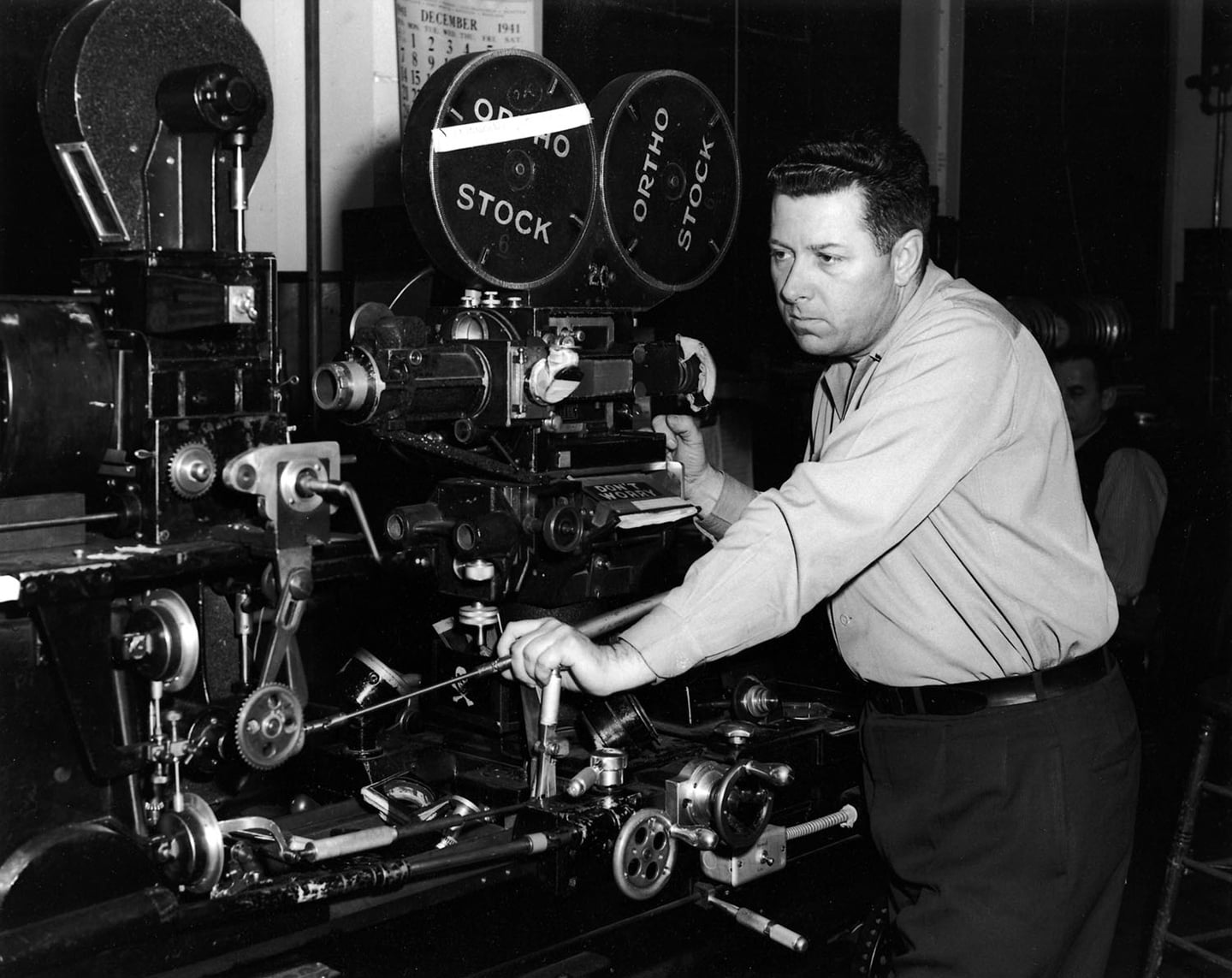
The most revealing photograph of an optical printer does not look futuristic. Linwood G. Dunn sits beside a tall assembly of reels, sprockets, lenses, cranks, and cast metal. There is no set in front of him and no audience behind him. One strip of film supplies an image; another receives it. Between them, Dunn operates what is effectively a camera department built inside a laboratory.[1]
That plain arrangement carried an extraordinary idea: a finished piece of photography could become the subject of another photograph. Once a frame could be projected, enlarged, masked, moved, softened, or combined with a second frame and then recorded onto fresh stock, the laboratory no longer had to reproduce only what production had delivered. It could reshape time and space after the actors had gone home.
The optical printer became the working grammar behind dissolves, wipes, blowups, titles, speed changes, split screens, traveling mattes, and effects composites. Its achievement was not that every trick became easy. It was that an effect became a repeatable sequence of photographic decisions. The price of that freedom was equally photographic: every copy could change grain, contrast, color, sharpness, and alignment. For decades, visual-effects craft lived inside that bargain.
A camera photographs another camera's past
At its simplest, an optical printer aligns a projector with a motion-picture camera. The projector advances developed film, often one frame at a time. A lens forms that frame as an image, and the camera exposes it onto new raw stock. Because the two transports are coordinated, an operator can photograph the source repeatedly and with far more control than an ordinary projection would allow.[2]
This is different from contact printing, where source film and raw stock meet emulsion-to-emulsion as light passes through them. The optical path creates room to intervene. Change the distance or lens position and the image can grow or shrink. Move the source within the gate and the composition shifts. Alter exposure across successive frames and a fade appears. Hold a frame, skip it, reverse the transport, defocus the image, or photograph separate elements in successive passes, and copying begins to behave like shooting.
The word generation mattered because film copies had a family tree. The U.S. National Archives distinguishes preservation elements, reproduction masters, and distribution copies, with access material derived from a higher-quality master rather than repeatedly exposing the best surviving source to use.[6] An optical effect could create characteristics absent from the original negative, but it could not pretend the new negative had never been copied. The operator was photographing both an image and everything the earlier film stock had already done to it.
That is why “postproduction” is too bloodless a word for the process. The printer had a camera, a lens, a light source, a film movement, focus, exposure, and a human making judgments through them. It did not merely repair photography. It photographed photography.
Dunn designs the operator into the machine
Optical printers existed before the Acme-Dunn machine. Dunn's important claim was narrower and more consequential: the devices had not been standardized. In his 1944 account for American Cinematographer, he complained that studio printers were custom-built around individual setups and too often designed by machine shops without enough influence from the people expected to operate them. Moving between machines could mean relearning the work.[2]
Dunn drew on fifteen years in RKO's effects department and collaborated with engineer Cecil Love and the Acme Tool & Manufacturing Company. The resulting printer integrated its camera into a rigid cast-iron body and placed adjustments within reach from one side. It coordinated camera and projector clutches, counted frames, and offered mechanical control over moves that otherwise depended on improvised rigs and an operator's ability to repeat a delicate action by hand.[2]
The feature list reveals how broad “effects” already was. Dunn described lap dissolves, directional wipes, slide-offs, mechanically focused zooms, out-of-focus transitions, frame repetition, skip-frame work, 16 mm-to-35 mm blowups, and the insertion of paintings, mattes, or animation as aerial images. Register pins supported precise lineup work; dial indicators measured lens movement to one-thousandth of an inch. A moving wipe could even be timed to follow an object inside the photographed scene.[2]
What the machine standardized, then, was not one illusion but a way of working: set values, count frames, expose, return, and repeat. Its first completed unit went to the U.S. Naval Photographic Science Laboratory during the Second World War, while other machines were prepared for military and government film facilities. Studio technique and wartime training-film demand met inside the same apparatus.[2]
The Academy now preserves more than 400 items in Dunn's collection, including effects shots, title sequences, and elements from 16 mm through 70 mm productions.[3] Calling Dunn the “father of the optical printer,” as the Academy does, should not erase earlier printers or his collaborators. It identifies the scale of his contribution: he helped turn an adaptable workshop contraption into durable production infrastructure.
A composite is choreography with absence
The optical composite is easiest to understand as an exercise in withholding light. Imagine a photographed spacecraft that must cross a separately photographed star field. Simply exposing both images onto the same negative would make the stars shine through the ship. The compositor therefore creates a matte: an opaque silhouette that prevents the background exposure from reaching the area the ship will occupy. A complementary matte then protects the already exposed background while the ship is printed into the reserved space.
Nothing has been “cut out” in the modern drag-and-drop sense. One piece of film blocks light while another supplies it. The final negative accumulates exposures in an exact order, and the untouched areas are as important as the exposed ones. A complex shot is therefore planned less like a collage than like choreography: which element enters first, which region waits in darkness, which pass reveals it, and which matte protects everything already placed.
The boundaries are unforgiving. If the foreground and its matte do not register frame for frame, a bright or dark outline appears. Dust becomes part of the shot. Film-base shrinkage, gate weave, a change in density, or a fractional focus error can make separately convincing elements refuse to share one image. Repeatability is not a convenience under those conditions; it is the foundation of the illusion.
Industrial Light & Magic's work on The Empire Strikes Back shows how far the system could be pushed. Richard Edlund's team built a computer-controlled, four-headed beam-splitter printer that combined large, horizontal VistaVision elements and reduced them to the anamorphic format of the live-action feature. One shot incorporated twenty separately photographed bluescreen elements. The crew used dimensionally stable polyester-base stocks for effects material because many pieces had to keep their shape through repeated handling and alignment.[4]
Large-format elements provided a quality reserve. A VistaVision frame used more negative area than the final four-perforation image, so reduction could surrender some detail without making the composite immediately look like a degraded copy. Better optics, steadier film, cleaner rooms, carefully made mattes, and fewer duplicate generations all served the same goal: make the effect shot belong beside the camera-original footage rather than announce its route through the laboratory.
Every copy leaves fingerprints
The paradox of optical printing is that control arrives through duplication, and duplication changes the thing being controlled. Rephotographed grain can become coarser. Contrast can build. Color can drift. Fine edges may soften, while a matte made on different stock may draw an unnaturally hard boundary. Even an ordinary dissolve can briefly reveal its status as duplicate footage if the surrounding shots come directly from the original negative.
Effects cinematographers learned to budget those changes. They could start with a larger negative, choose fine-grain intermediate stock, combine several elements in one final pass, or deliberately alter a source so the completed shot matched its neighbors. On Empire, Edlund reported that the new printer sometimes produced composites so crisp that the team degraded them to feel credible inside the movie. Photographic perfection was not the target; continuity was.[4]
The machine itself also evolved around the edge. Edlund later traced persistent matte-line problems to distortion introduced by an aerial-image printer's field lens. For a new ILM quad printer, he and optical designer David Grafton developed a telecentric relay system that kept light rays nearly parallel, sharply reducing geometric change as an element moved through focus. That refinement mattered because a beautiful foreground and a beautiful background still fail if the border between them will not stay put.[5]
This is where the printer most clearly resists the myth of a solitary effects magician. A successful composite depended on camera crews, model makers, matte painters, animation, processing, optical photography, editorial, and machinery agreeing about scale, exposure, movement, and order. The printer was the final meeting place, but it could not rescue a plate that had never supplied the information the composite required.
The laboratory logic survives the machine
Digital compositing eventually removed the need to rephotograph every layer onto film in order to combine it. That change relieved artists of photochemical generation loss and made revision less physically punishing, although it introduced new limits of sampling, bit depth, color management, storage, and computation. Edlund's account of the transition is telling: digital systems expanded what could be manipulated, but their early hardware was expensive and became obsolete with startling speed.[5]
The optical printer nevertheless remains legible inside the software that replaced it. Digital artists still speak of plates, mattes, masks, layers, registration, tracking, grain matching, and compositing. They still decide what an element reveals, what it holds out, how edges behave, and in what order operations occur. The physical pass has become an editable instruction, but the underlying question is unchanged: how can images made at different times occupy one convincing exposure?
That is the optical printer's deeper legacy. It made the copy creative without making it free. It moved cinematic decisions beyond the set while keeping them accountable to lenses, light, stock, and sequence. The machine in Dunn's laboratory did not abolish the camera moment. It created another one—quieter, slower, and capable of photographing a world that had never stood whole in front of any lens.
Sources
- Michael Goldman, “Visions of Wonder — ASC Visual Effects Experts.” American Cinematographer, April 30, 2019 — Dunn's account of the shift from in-camera effects to controlled laboratory work and the archival photograph used for this article.
- Linwood Dunn, “The New Acme-Dunn Optical Printer.” American Cinematographer 25, January 1944, pp. 11, 29 — primary description of the machine's design, controls, effects functions, registration features, and first installations.
- Academy Film Archive, “Linwood Dunn Collection” — collection scope, formats, and the Academy's account of Dunn's optical-printing legacy.
- Richard Edlund, “Special Visual Effects for The Empire Strikes Back.” American Cinematographer, originally June 1980 — ILM's four-headed optical printer, VistaVision reduction, matte workflow, dimensional stability, and multi-element compositing.
- Joe Fordham, “An Eye for the Cameras: Richard Edlund, ASC.” American Cinematographer, August 7, 2023 — telecentric printer optics, matte-line control, optical-effects practice, and the costly transition to digital systems.
- U.S. National Archives and Records Administration, “Film Output from Motion Picture Film Source” — the hierarchy and purposes of preservation masters, reproduction masters, and distribution copies.