
Kino Lorber's 4K re-release trailer for Bernardo Bertolucci's The Conformist is useful because it does not sell the film as a simple anti-fascist period thriller.[1] It sells an atmosphere of compliance. In a little over a minute, the trailer moves through polished interiors, snowbound roads, theatrical shadows, dance-floor motion, official rooms, and faces that seem composed before they seem honest. That compression matters because The Conformist is a film about a man who wants political belonging less as conviction than as camouflage. Marcello Clerici does not only join a violent system; he tries to disappear inside its idea of respectable adulthood.[2][3]
The plot is direct enough to summarize. Minerva Pictures identifies Marcello as a spy for the fascist political police who goes to Paris under cover of a honeymoon while secretly preparing to eliminate his former professor, now an anti-fascist dissident.[2] Senses of Cinema's Bertolucci profile puts the deeper structure in formal terms: The Conformist avoids the usual signals that would cleanly mark flashback and makes style itself part of the film's account of fascist order and collapse.[3] Another Senses essay on Storaro helps explain why the images feel so agile rather than merely polished, noting the film's debt to New Wave camera mobility and discontinuity.[4]
That is why this trailer works as an annotated-viewing object. The film's central question is not merely "will Marcello commit the crime?" It is "what visual form does self-erasure take?" Vittorio Storaro's photography and Bertolucci's staging do not decorate Marcello's world; they make his appetite for order dangerously legible.[3][4] The trailer lets us watch that appetite in miniature. Light is never just light. Walls are never just walls. Every elegant surface seems to ask whether beauty can become a hiding place.
Light behaves like a loyalty test
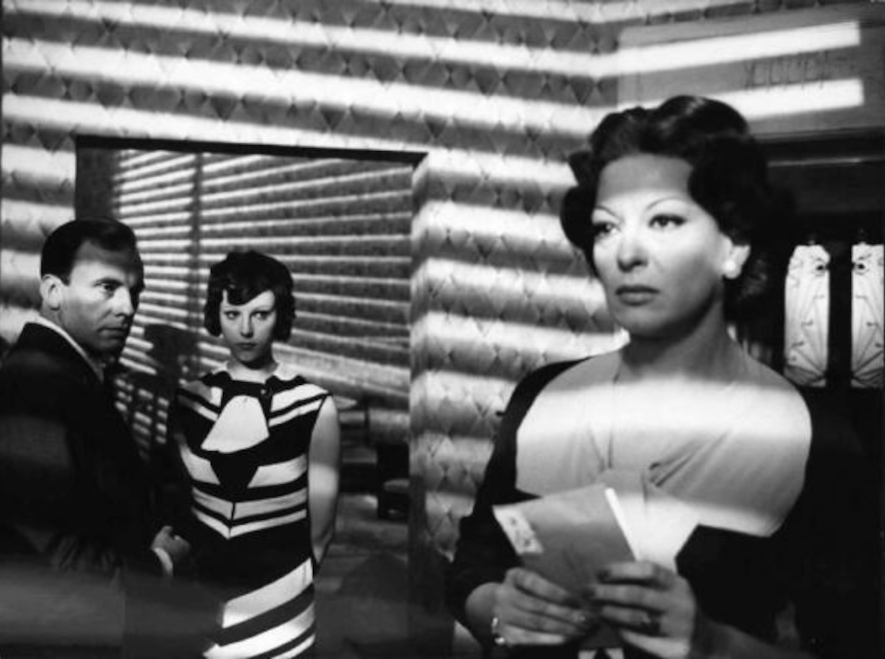
The first thing to watch in the trailer is how often light arrives as a system of stripes, shafts, partitions, and blocked apertures.[1] In a less exact movie, light would simply beautify the frame. Here it behaves like a social filter. It falls across bodies in segments. It makes rooms look organized before they look habitable. It turns Marcello into a man trying to occupy a pattern that already existed before he entered it.
The Senses of Cinema profile is helpful because it treats the film's movement and design as symbolic of authoritarian regimentation and psychic breakdown, not as prestige surfaces added after the politics are already settled.[3] The trailer condenses that idea into motion. Marcello keeps appearing in spaces that promise control: offices, corridors, cars, formal rooms, architectural grids. Yet the control is always slightly too visible. It feels staged, as if normality itself had become a set.
That is the film's coldest insight. Fascist conformity does not appear only as rally spectacle or blunt coercion. It can also appear as taste, marriage, career, tailoring, and a well-lit room where every object knows where it belongs. Marcello's longing is frightening because it is not chaotic. It is orderly. The trailer's patterned light turns that order into pressure, making the viewer feel how badly he wants to be arranged by something stronger than his own unstable self.
The honeymoon cover makes marriage part of the machinery
The trailer's flashes of Giulia matter because the honeymoon is not a romantic detour from the political plot.[1][2] It is part of the cover story and part of Marcello's performance of conventional life. Minerva's synopsis makes that double use explicit: the trip to Paris is a honeymoon, but it is also a disguise for murder.[2] The marriage therefore becomes a political prop before it becomes an emotional relationship.
That does not make Giulia irrelevant. It makes her crucial to the appearance Marcello is trying to build. The still used for this article shows Trintignant, Sandrelli, and Yvonne Sanson inside a heavily patterned interior, and it catches the film's social grammar well.[6] Bodies are placed, watched, and framed by decor. The room seems to have more confidence than the people inside it. Everyone looks visible, but no one looks free.
That vacancy is not emptiness in a plain room. It is emptiness inside style. Marcello can put on the costume of a husband, citizen, and operative, but the more successfully he dresses the part, the more hollow the part becomes. The trailer's elegance is therefore not a contradiction of the film's politics. It is the politics in visual form.[3][4]
The camera keeps refusing psychological comfort
One reason the trailer remains unsettling is that it does not let Marcello become a stable case study.[1] The Senses profile emphasizes Bertolucci's refusal of conventional flashback grammar, and the trailer cannot reproduce that whole structure, but it suggests the same instability through abrupt changes of setting and temperature: Rome to Paris, social dance to road, intimacy to surveillance, warm interior to hard winter exterior.[3]
That movement matters because Marcello's politics are not presented as one clean ideological conversion. The film is interested in the machinery by which fear, shame, desire, class aspiration, and state violence can be made to look like adulthood. Britannica's overview places The Conformist among the films through which Bertolucci reached full maturity as a director, and the trailer makes the reason easy to feel: the form is not illustrating a thesis from outside. It is carrying the thesis in its camera movement, color logic, and spatial rhythm.[5]
Watch the trailer's transitions closely and the film's moral argument sharpens. Marcello is often framed as though the world has already judged him into place, but he is also choosing that placement. The film refuses the comfort of treating him only as a victim of history or only as a monster. Its terror lies in the middle condition: a man damaged enough to crave submission, privileged enough to choose collaboration, and polished enough to call the arrangement normal.
Restoration makes the danger newly legible
The video is specifically a 4K re-release trailer, and that technical context is more than packaging.[1] Minerva notes that the film was restored in 4K at L'Immagine Ritrovata by Cineteca di Bologna in collaboration with Minerva Pictures, with support from the Bernardo Bertolucci Foundation, starting from the original camera negative.[2] For a film built from light, shade, color temperature, fabric, glass, and architectural depth, restoration changes what can be read.
This is not only a question of sharper beauty. In The Conformist, beauty is evidence. If the image is muddy, the patterned light becomes mood. If the image is clear, the pattern becomes structure. If the colors flatten, the film can look like tasteful retro design. If the restoration lets the surfaces breathe, the viewer can see the more disturbing proposition: fascist normality is not ugly at every point of contact. Sometimes it arrives with seductive polish, and the polish is part of the trap.
The trailer should therefore be watched less as a plot preview than as a short lesson in moral mise-en-scene.[1][3][4] Look at how Marcello is placed in rooms, how windows divide bodies, how official space dwarfs private uncertainty, how the honeymoon cover contaminates romance, and how snow and road imagery drain the glamour from movement. The result is a film whose images remain beautiful because they are unsafe, not despite being unsafe. The Conformist endures because it understands that the wish to belong can be filmed as architecture, and that architecture can become a crime scene before the crime is complete.
Sources
- Kino Lorber, "The Conformist - 4K Re-Release Trailer - Bernardo Bertolucci, Jean-Louis Trintignant," YouTube video.
- Minerva Pictures, "The Conformist" film page - synopsis, awards notes, restoration details, and cast.
- Richard Suchenski, "Bertolucci, Bernardo," Senses of Cinema - director profile discussing The Conformist's flashback grammar, movement, design, and political symbolism.
- Ara Osterweil, "Chiaroscuro: Caravaggio, Bazin, Storaro," Senses of Cinema - discussion of Storaro, Bertolucci, and the camera style of The Conformist.
- Encyclopaedia Britannica, "The Conformist" film by Bertolucci overview.
- Wikimedia Commons, "File:Jean-Louis Trintignant, Stefania Sandrelli e Yvonne Sanson, 'Il Conformista', 1970.jpg" - archival film still source and metadata.