Manhatta is only about ten minutes long, but it changes the scale of movie looking. Charles Sheeler and Paul Strand do not tell a story about a person who enters Manhattan. They make Manhattan itself enter the frame as a set of pressures: ferry decks, harbor water, facades, bridges, steam, rooftops, crowds, and the repeated upward pull of buildings still learning how to dominate the camera.[1]
That is why the film remains more than an early city portrait. MoMA describes it as a filmed portrait of Manhattan, a series of vignettes rather than a linear narrative, and a work often cited as the first American avant-garde film.[1] The label matters, but the experience is more specific. Manhatta discovers that documentary footage can become modernist form without ceasing to document. Its city is real, photographed, and recognizably Lower Manhattan. It is also cut into a grammar of verticals, diagonals, masses, and flows.
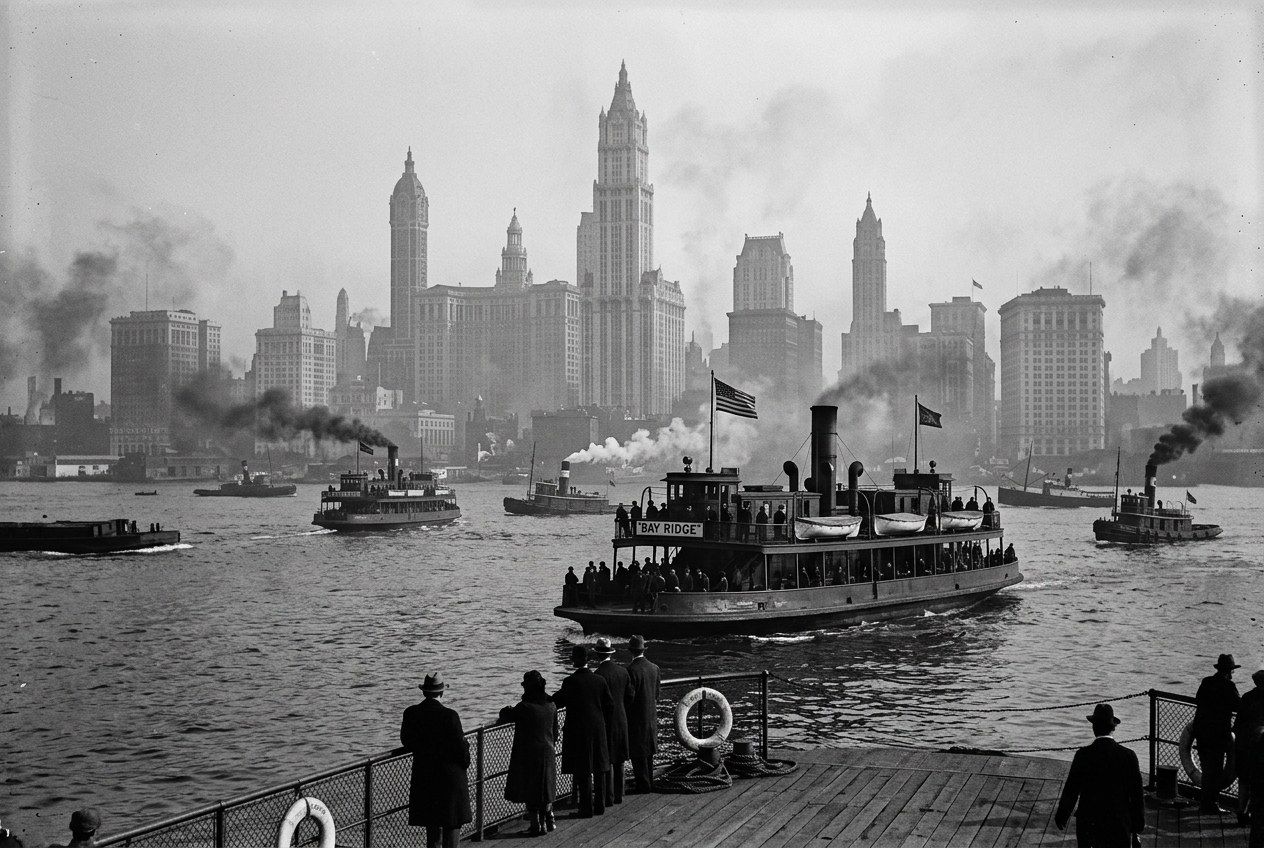
The ferry makes the city collective before it is scenic
The opening movement is crucial. Manhatta does not begin with a skyline postcard held at a comfortable distance. It approaches from the harbor and then returns to the ferry terminal, where commuters gather and spill toward the city.[1] The Staten Island Ferry is not incidental atmosphere. It gives the film a social rhythm before the skyscrapers fully take over.
That choice keeps the picture from becoming a pure architecture study. The city is first a machine of arrival. People are not yet characters in a plot, but they are not decorative dots either. They arrive in batches, move through terminals, cross thresholds, and become part of a daily mechanism that the film respects without sentimentalizing. The ferry says: this modern city is not just built upward; it is fed from the water, on schedule, by bodies moving into work.
MoMA's collection text notes that the film carries viewers through a day in Lower Manhattan, from early ferry approach to a sunset view from a skyscraper.[1] That day structure is simple, but it is not casual. Morning arrival lets the film build Manhattan as process, not monument. Before we admire the towers, we have to watch the city absorb people.
Whitman is not decoration
The intertitles are easy to misread as antique flourish. Silent films commonly used titles for dialogue or plot explanation; Manhatta uses lines from Walt Whitman's "Mannahatta."[1] MoMA's audio guide adds that Strand remembered both artists admiring Whitman's poem and that the title was taken from the Lenape-derived name for Manhattan.[2]
This pairing is stranger than it first looks. Whitman's verse brings civic exaltation, crowds, races, facades, and a democratic scale of address. Sheeler and Strand's images bring a cooler modernist eye: buildings as planes, smoke as motion, workers as units of flow, streets as vectors. The poem does not soften the images. It gives them a voice big enough to match their ambition, then lets the camera test whether that old lyric confidence can survive steel, commerce, and vertical density.
The result is not simple celebration. The Whitman lines lift the city into song, but the images keep placing people under the geometry. In one sense, Manhatta inherits the poet's pleasure in crowds and facades. In another, it exposes how small human figures can look once the new metropolis is composed from high angles and hard edges.[1][3]
The camera thinks like a photographer
Sheeler and Strand came to the film with strong photographic and painterly commitments. The Whitney identifies Sheeler with Precisionist painting, photography, and Manhatta, and describes his art through industrial forms, geometry, and clear surfaces.[6] MoMA's audio page similarly frames the film through the artists' shared interest in urban and industrial America, buildings, smokestacks, machines, and abstract movement.[2]
You can feel that background in the shots. Many frames look less like action waiting to happen than like still photographs that have been asked to breathe for a few seconds. The motion is real: water moves, smoke rises, people cross streets, traffic circulates. But the compositions often hold movement inside a rigid structure. A bridge is not only infrastructure; it is a dark line organizing space. A rooftop is not only a vantage; it is a grid from which the city can be sorted.
This is why the film's modernism still feels calm rather than frantic. Later city symphony films would push urban speed harder. Manhatta is interested in rhythm, but it is also interested in weight. It makes Manhattan feel newly kinetic and newly static at once: a city rushing through a form that seems already monumental.
Height changes the ethics of looking
The most important formal shift is vertical distance. MoMA's gallery label stresses the film's extreme camera angles and its sixty-five nonnarrative shots, moving from ferry approach to sunset from a skyscraper.[1] Once the camera climbs, the city changes. Streets become channels. Crowds become texture. Rooftops become a second ground plane. The viewer is given power, but also estrangement.
That estrangement is the film's most modern feeling. The camera can now see patterns no pedestrian could see from the sidewalk. It can make labor, traffic, harbor, and architecture legible as one system. But the price of that legibility is distance from individual experience. Manhatta does not solve that tension; it makes it beautiful enough that viewers have to stay with it.
MoMA curator Dave Kehr's skyline essay is useful here because it places Manhatta inside a broader moment when cinema and steel-framed skyscrapers developed in parallel, and notes how the film's geometry can create a foreboding feeling.[3] That word matters. The towers are splendid, but they are not innocent. The city looks powerful partly because it dwarfs the people who animate it.
Documentary becomes form
The film's place on the Library of Congress National Film Registry, added in 1995, confirms its preservation status inside American film history.[4] Yet the reason to keep returning to Manhatta is not only that it arrived early. It shows a durable way for nonfiction cinema to think. It does not merely record what Manhattan looked like in 1921. It asks what kind of image a modern city requires.
The answer is neither travelogue nor pure abstraction. The harbor must remain water. The ferry must remain ferry. The buildings must remain buildings. But once edited together and set against Whitman's titles, they begin to operate as relations: approach and height, crowd and facade, motion and grid, civic lyric and industrial fact.[1][2][5]
That balance is why Manhatta still feels alive. It refuses the familiar split between documentary evidence and visual art. The same shot can be a historical record of the waterfront and a composition about horizontal drag against vertical ambition. The same ferry crowd can be a morning commute and a modernist pattern. The same skyline can be both place and proposition.
By the sunset ending, Manhattan has been built twice: once by steel, stone, docks, ferries, and labor; once by camera placement, cutting, intertitles, and duration. The film's achievement is to make those two constructions feel inseparable. It teaches viewers to see a city as documented fact and as a machine for producing new kinds of vision.
Sources
- The Museum of Modern Art, "Paul Strand, Charles Sheeler, Manhatta, 1921" collection record, including structure, opening sequence, intertitles, and gallery label.
- The Museum of Modern Art, "Paul Strand, Charles Sheeler. Manhatta. 1921" audio guide, including Strand's recollection of the camera, collaboration, abstract movement, and Whitman title.
- Sean Yetter and Dave Kehr, "The City Stars: Skyline," MoMA Magazine, July 26, 2019, on Manhatta, skyscraper cinema, geometry, and early American experimental film.
- Library of Congress, "Complete National Film Registry Listing," showing Manhatta as a 1921 film added to the registry in 1995.
- Wikimedia Commons, "File:Lower Manhattan by Brown Bros. circa 1920.jpg," public-domain harbor photograph used as a period reference for Lower Manhattan seen from the water.
- Whitney Museum of American Art, "Charles Sheeler," artist page noting Sheeler's Precisionist painting, photography, industrial forms, and collaboration with Paul Strand on Manhatta.