Spoiler note: this essay discusses the film's central disappearance, the passengers' denials, and the late spy-thriller turn.
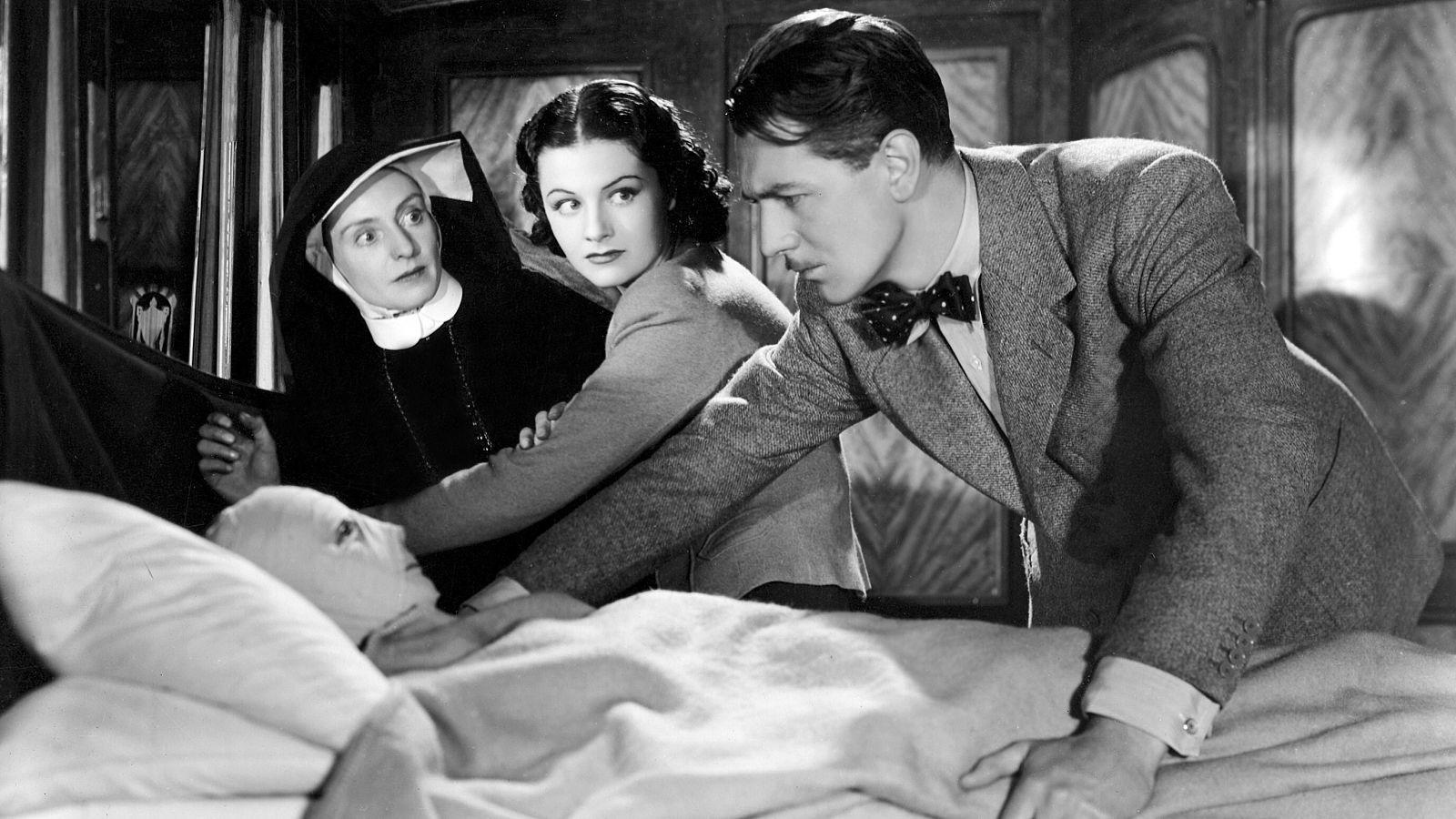
Alfred Hitchcock's The Lady Vanishes begins with a joke of inconvenience and turns it into a study of collective refusal. A group of travelers is delayed in a fictional European country, squeezed into a hotel, then released onto a train where Iris Henderson, played by Margaret Lockwood, discovers that Miss Froy, the elderly woman she just befriended, has apparently disappeared.[1][2] The mystery is simple enough to state in one line. The craft is stranger: Hitchcock makes the train itself into a pressure system where every compartment, corridor, dining table, and polite lie helps reality become negotiable.
That is why the film remains more than a brisk pre-Hollywood thriller. AFI records the picture as a 1938 Gainsborough and Gaumont-British production directed by Hitchcock, written by Sidney Gilliat and Frank Launder, photographed by Jack Cox, and based on Ethel Lina White's 1936 novel The Wheel Spins.[1] BFI calls it a comic thriller that helped pave Hitchcock's way to Hollywood, while also noting its satire of British insularity during a period of rising international tension.[2] Those two descriptions belong together. The film is funny because people keep protecting their little arrangements. It is suspenseful because those little arrangements become a conspiracy of convenience.
A train is not a setting here
The train in The Lady Vanishes is often remembered as a perfect Hitchcock location, but it is more active than that. It is an editing device. It divides people into little social chambers, then forces them into brief collisions. A compartment can isolate Iris with people who deny her memory. A corridor can become a narrow lane of pursuit. A dining car can make disappearance look absurd because tea, seating, and table service continue as if nothing has broken.
That division matters because the plot depends less on hiding Miss Froy than on making Iris' testimony socially expensive. AFI's synopsis reduces the premise cleanly: after Miss Froy disappears, the other passengers insist she was never on the train.[1] The force of the film lies in how many motives can support that falsehood. Some people are directly dangerous. Others are merely selfish, embarrassed, frightened, or eager not to be delayed. Hitchcock does not need every denier to be part of the spy plot. He only needs each of them to prefer a comfortable lie to an inconvenient truth.
The moving train sharpens that preference. There is no town square where Iris can step outside the system and appeal to neutral space. The rails keep carrying everyone forward. Rooms are connected but not open. Evidence can be shifted, hidden, or reinterpreted before Iris reaches the next person. The result is a mystery built from circulation: who saw whom, who passed through which door, who occupies which berth, who can plausibly say that memory has been scrambled by a blow to the head.
Comedy slows the proof
One reason the film still feels nimble is that Hitchcock does not separate comedy from suspense. Criterion describes the movie as one of Hitchcock's most quick-witted comic thrillers, and that quickness is not decoration.[3] The jokes regulate the speed at which proof can arrive. Charters and Caldicott, the cricket-obsessed Englishmen, are funny because their priorities are so narrow. They are also structurally useful because narrow priorities make them bad witnesses. They are not villains in the melodramatic sense. They are citizens of their own comfort.
This is where The Lady Vanishes becomes sharper than a puzzle about a missing passenger. The film keeps asking how much evidence people need before they will interrupt their own plans. A couple traveling under a social fiction has reasons to avoid attention. A doctor has reasons to sound reasonable while misdirecting suspicion. Other travelers have reasons to accept the explanation that makes the least demand on them. Comedy becomes the medium of evasion. Laughter keeps the train civilized while the truth is being smothered.
The Lockwood-Redgrave pairing works because Gilbert begins inside that comic economy and then crosses out of it. At first he is noise, irritation, flirtation, and performance. He looks like another obstacle in Iris' way. Gradually he becomes the one person willing to treat her memory as actionable. That shift is central to the film's craft. The romance is not a detachable reward after the mystery. It is the process by which private perception becomes shared investigation.
Objects turn memory into evidence
Because the passengers deny Miss Froy's existence, Iris needs material signs. Hitchcock therefore makes small objects carry disproportionate force: a name on a window, a tea packet, a piece of music, a nun's shoes, a gesture noticed and later reweighed. The film's suspense comes from watching fragile traces survive inside a social world determined to mislabel them.
Britannica's summary emphasizes the combination of taut suspense and dry humor that marks the film as one of Hitchcock's early classics.[4] The tautness comes from compression. The dry humor comes from the way compression exposes manners as tactics. People can lie politely. They can obstruct by sounding sensible. They can make Iris appear hysterical simply by remaining calm. In that context, an object does not merely prove a fact. It lets Iris resist a whole performance of normality.
This is also why the famous vanishing premise has had such a long afterlife. BFI notes that the missing-person-who-may-not-exist setup echoes through later thrillers.[2] The device lasts because it does not depend on trains alone. It depends on a more durable fear: that a group can make one person's accurate perception look like instability. Hitchcock gives that fear mechanical form. He puts it on rails, seats it among classes and compartments, and lets etiquette become a weapon.
The spy story widens the social joke
The late movement into espionage can seem like a genre escalation, but it also completes the film's social design. Miss Froy is not only a kindly governess who has vanished from Iris' side. She is carrying information, and the cheerful bustle of travel has been sitting on top of political danger all along.[1][2] The film's fictional geography gives Hitchcock room to avoid direct naming while still making 1938 Europe feel unstable.
That historical pressure is why the British comedy matters. Charters and Caldicott may begin as a running gag about cricket, but their unwillingness to be bothered becomes part of the film's argument about attention. The danger outside Britain cannot be treated forever as someone else's disruption. The train, for all its comic population, is moving through a world where neutrality and noninvolvement have consequences.
The final armed confrontation is less elegant than the earlier compartment games, but it pays off the film's moral conversion. People who avoided involvement must decide whether to act. Gilbert and Iris, who began as bickering strangers, have already learned the harder discipline: noticing, checking, and refusing the version of events that powerful or comfortable people prefer.
The vanishing is really a test of form
The craft triumph of The Lady Vanishes is that its central trick is not just narrative. It is spatial, comic, and social. Hitchcock takes a train set and makes it do several jobs at once: it restricts movement, sorts passengers by motive, controls the rhythm of encounters, and turns every corridor into a contested line between fact and denial. The film's speed comes from its construction. Its charm comes from how lightly that construction moves.
That lightness is easy to underestimate. A heavier version of the story would make Iris' problem solemn from the start. Hitchcock lets the film sparkle because sparkle is part of the trap. The more amusing the passengers are, the more plausible it becomes that they will protect their own amusement, reputations, appointments, affairs, or habits before they protect a stranger's truth.
By the end, the missing woman has been found, the spy mechanism has been exposed, and the train has delivered its passengers into a clearer moral landscape. But the lasting unease is not only about kidnapping or espionage. It is about how quickly a shared space can become a machine for denial when enough people decide that accuracy is less convenient than peace and quiet. That is the film's modern sting. The lady vanishes once. The willingness to make her vanish again, by consensus, is what Hitchcock makes unforgettable.
Sources
- AFI Catalog, "The Lady Vanishes (1938)" - credits, production companies, literary source, release data, and synopsis.
- BFI, "The Lady Vanishes (1938)" - film note on the train-journey premise, comic-thriller construction, political satire, and Hitchcock's move toward Hollywood.
- The Criterion Collection, "The Lady Vanishes (1938)" - edition page and critical framing of the film as a quick-witted Hitchcock comic thriller.
- Encyclopaedia Britannica, "The Lady Vanishes" - overview of the film's suspense, humor, premise, cast, and place among Hitchcock's early classics.
- Wikimedia Commons, "File:The Lady Vanishes 2.jpg" - 1938 United Artists promotional still from The Lady Vanishes, published in National Board of Review Magazine.