Spoiler note: this essay discusses the film's ending, the Chinatown newsreel sequence, and the monkey-footage payoff.
Buster Keaton's The Cameraman is usually introduced as a romantic farce about a street photographer trying to impress a studio secretary.[1][3][4] That description is correct and still too small. The movie's real subject is the period in which a man falls in love with a machine before he learns how to use it well. The title announces that priority from the start. Sally matters, and the love plot gives the comedy direction, but the deepest attachment in the film is between Keaton and the heavy, temperamental newsreel camera he buys in order to enter a profession he barely understands.[1][2]
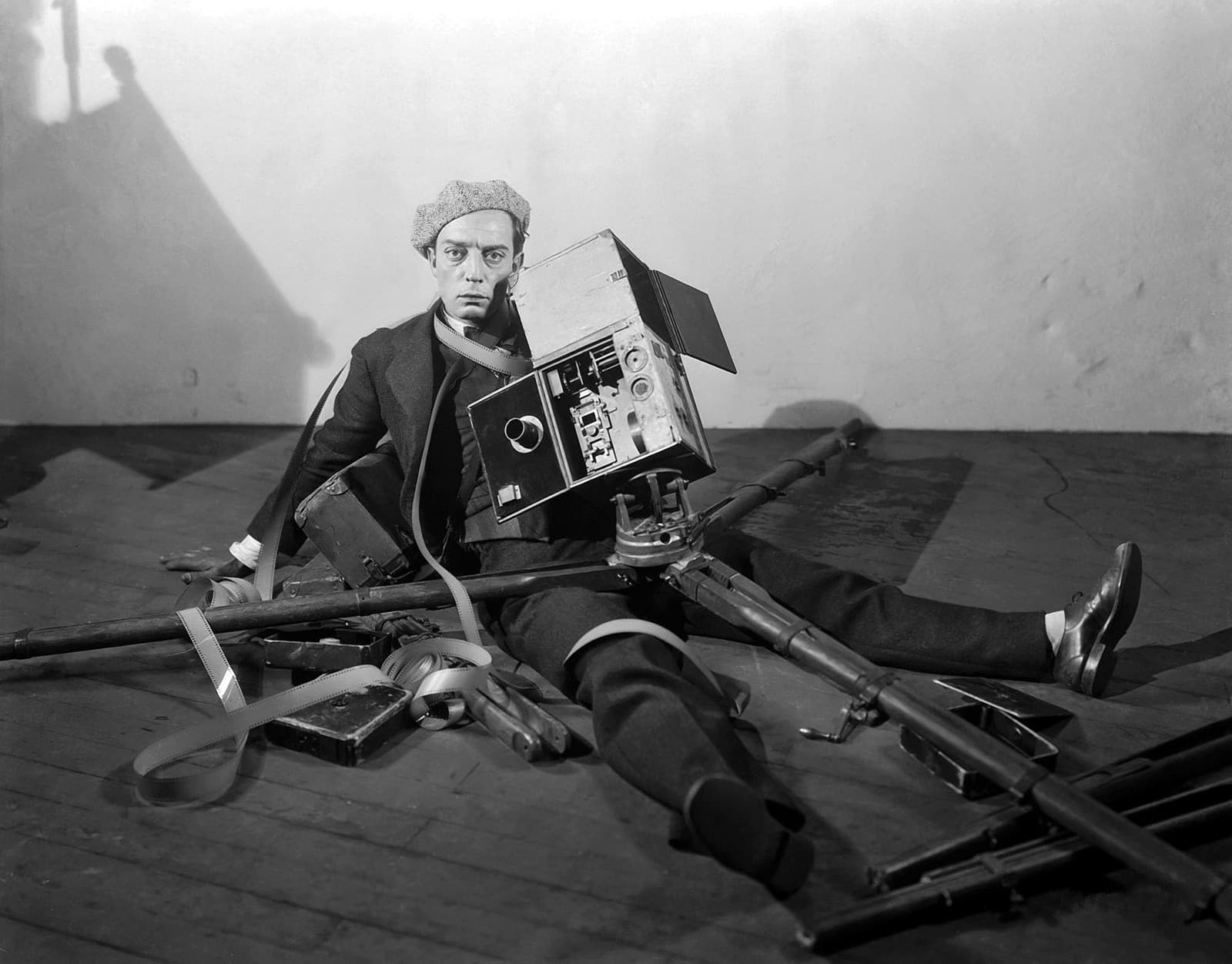
The lead image makes that argument before the story does. Keaton sits on the floor amid tripod legs, loose film, and a boxy camera body, looking less like a triumphant professional than like a mechanic who has been defeated by his own equipment.[6] That is exactly where the film wants him. A polished hero would kill the premise. The Cameraman becomes great because it turns beginner's awkwardness into a craft problem: how does someone who loves motion pictures learn the difference between touching the apparatus, hauling it through the street, pointing it in time, and actually coming back with usable images?[2][4][5]
The camera arrives as a costar, not a prop
Criterion's edition describes The Cameraman as Keaton's first MGM film and the last one over which he kept real creative control, while Imogen Sara Smith's essay goes further and calls the camera his true costar.[1][2] That feels exactly right. When Buster follows Sally into the MGM newsreel office, the scene does not play like ordinary romantic pursuit. He inspects the machine with tactile hunger. He tests the crank, studies the body, and behaves like a person trying to read a new animal by hand.[2] The comedy does not come from ignorance alone. It comes from the speed with which fascination outruns competence.
That distinction matters because Keaton never films cameras as neutral tools. In Sherlock Jr. the apparatus opened a path into dream space. Here the apparatus is heavier, more practical, and more humiliating.[2] Buster trades his tintype setup for an old hand-cranked Pathe and discovers that the purchase does not grant membership in the profession.[2][4] The tripod has to be carried, the frame has to be found, the reel has to keep running, and the event has to happen in front of the lens instead of three seconds before or after it. The movie keeps returning to the same small cruelty: wanting to make pictures and being able to make them are two separate talents.
Keaton authors incompetence with impossible precision
One of the film's most durable pleasures is that Buster's bad footage looks so specifically bad.[2][4][5] Smith notes the double exposures, tilted views, and shots that run backward; James Steffen at TCM ties those mishaps to Keaton's delight in cinematic devices such as reverse motion and other medium-specific tricks.[2][4] The joke is not that an amateur fails in a vague way. The joke is that every failure has form. The mistakes reveal which variables the medium can punish: orientation, timing, continuity, even the operator's assumption about where action will begin and end.
That is why the film works as a craft study rather than a general underdog story. Keaton stages incompetence so carefully that the viewer begins to understand newsreel practice through negative examples. Buster is always a fraction late, slightly off-center, distracted by the wrong attraction, or overwhelmed by the urban field he is trying to record. Each comic error translates the abstract problem of "coverage" into bodily terms. A tripod snags. A crowd closes. A reel jams. A subject escapes the frame. The movie keeps insisting that camera work is not pure looking. It is logistics under pressure.
The National Film Registry description is especially sharp on this point when it calls the picture one of Keaton's best treatises on the techniques and psychology of shooting motion pictures.[5] "Psychology" is the key word. The film is not satisfied with showing the machinery. It studies the operator's desire to be in the right place when the world becomes worth filming. Buster wants the scoop, but more than that he wants the feeling of being adequate to the event. Keaton understands that this is both a professional ambition and a private fantasy.
Manhattan is the film's real training ground
AFI's catalog is useful here because it restores the geography. John Bengtson's location work, cited there, traces the picture through Yankee Stadium, Fifth Avenue in midtown Manhattan, and several California stand-ins used after New York crowds became unmanageable.[3] Smith adds that Keaton had to return to Los Angeles to finish location work because his celebrity turned the city into an obstacle course.[2] That production history belongs inside the reading of the film because The Cameraman is fundamentally about a camera operator being bullied by public space.
The city moves faster than Buster's developing technique. Crowds gather before he is ready. Traffic redirects his path. Spectacle erupts at the wrong distance. Even an empty setting such as Yankee Stadium becomes a problem of scale rather than relief.[2][3] Keaton's gift is that he never turns these pressures into abstraction. He makes them tactile. You feel the weight of the tripod on the shoulder, the effort of pivoting the camera before the moment is gone, the indignity of hauling delicate equipment through streets that do not care about your artistic plan.
This is also where the film's comedy becomes quietly modern. Newsreel work ought to promise mastery over the visible world: be there, record it, return with proof. The Cameraman strips that fantasy down to its moving parts. Being there is hard. Recording is contingent. Proof depends on whether the machine, the operator, and the event briefly line up. Keaton's stone face helps because it refuses grand self-expression. His body does the thinking instead, adjusting to corners, stairways, curbs, surf, and crowds with the concentration of a person solving equations through balance.
The monkey's second take rewrites authorship
The film's ending is famous for its monkey payoff, and it deserves to be read as more than a cute comic flourish.[1][4][5] TCM's synopsis notes the rough sequence clearly: Buster's brave effort is miscredited, and the monkey's hidden camera work supplies the evidence that restores him.[4] The gag lands because it humiliates and vindicates him at the same time. He really did act. He really did risk himself. Yet the image that proves his worth comes from an operator who is not an operator at all.
That reversal is the film's most elegant craft joke. After so much anxiety over learning to see professionally, the decisive footage arrives by accident, imitation, and animal mischief. The result does not cheapen Buster's effort. It clarifies the medium's boundary. Motion pictures reward skill, but they also depend on contingency. The right image may come from preparation, luck, a witness you did not plan for, or a machine running in the hands of someone who barely understands the stakes.[4][5]
There is an ethical boundary here as well. The climactic Chinatown material is inseparable from period yellow-peril caricature, and modern admiration should not glide past that damage.[2][4] Yet even there the film's craft logic stays legible. Keaton distinguishes between courage, performance, and successful recording. A person can do the hard part and still fail to secure the image. Another image can appear from somewhere lower, stranger, and less prestigious. The monkey does not simply save the romance. It punctures professional vanity.
A last great silent film about the cost of control
Every account of The Cameraman circles back to its historical position, and for good reason.[1][2][3][4][5] Criterion calls it Keaton's last great masterpiece and the last work over which he maintained creative control.[1] AFI repeats Bengtson's description of it as Keaton's last great silent feature.[3] TCM frames it as the product of Keaton's troubled first MGM period, while Smith details how he fought the studio, discarded an overcomplicated script, and salvaged room to improvise several of the film's best scenes.[2][4]
That off-screen context matters because the movie's whole emotional structure is about partial control. Buster does not dominate the camera; he negotiates with it. He does not dominate the city; he chases openings in it. He does not dominate the studio system; he wins a few battles inside it. The form and the production history therefore rhyme. Keaton made a film about the impossibility of mastering the image at exactly the moment when his own industrial freedom was narrowing.[1][2][4]
This is why the picture still feels alive rather than merely charming. Its sentiment is earned through technical frustration. Its comedy keeps discovering that modern image-making is a collaboration among bodies, machines, crowds, luck, and bureaucracy.[2][5] Buster's busted Pathe teaches him how to see by refusing to flatter him. It makes him carry weight, miss moments, process embarrassment, and accept that the world will sometimes hand the best shot to somebody else.
That is the movie's deepest lesson. The camera in The Cameraman is never just a badge that turns an amateur into a professional.[1][2] It is a discipline in humility. Keaton understands that cinema begins in desire, but it survives through timing, repetition, accidents, and the stubborn willingness to try again after returning with the wrong reel. The film remains funny because every disaster has shape. It remains moving because the shape of those disasters slowly becomes a way of learning.
Sources
- The Criterion Collection, "The Cameraman" film page, with production context, credits, restoration notes, and summary of Keaton's first MGM feature and its film-within-a-film setup.
- Imogen Sara Smith, "The Cameraman: Man with a Movie Camera." The Criterion Collection, June 16, 2020, on Keaton's fascination with camera mechanics, MGM transition, ad-libbed scenes, and the film's argument about moviemaking.
- AFI Catalog, "The Cameraman (1928)," with production history, credits, release details, and John Bengtson's location notes for Manhattan, Yankee Stadium, and California stand-ins.
- James Steffen, "The Cameraman." TCM, December 17, 2002, on Keaton's MGM move, the newsreel premise, cinematic device gags, and the monkey-footage ending.
- Library of Congress National Film Preservation Board, "Brief Descriptions and Expanded Essays of National Film Registry Titles," entry on The Cameraman as a study in the techniques and psychology of shooting motion pictures.
- Wikimedia Commons, "File: Publicity still for The Cameraman (1928) 01.jpg," MGM publicity still used for the article image.