Spoiler note: this essay discusses Chuck Tatum's rescue strategy, the carnival atmosphere around Leo Minosa's entrapment, and the film's ending.
Billy Wilder's Ace in the Hole (1951) is usually remembered as a savage media satire about a reporter who exploits a trapped man for personal gain.[1][3][4] That description is accurate and still too narrow. Wilder's deeper achievement is that he does not treat exploitation as a matter of private vice alone. He builds a whole temporary economy around disaster. Ladders, drilling plans, loudspeakers, concession stands, parking flow, and sheriff's access control all become part of the same system, until suffering is no longer simply reported. It is administered, scheduled, and sold.[1][2][3]
Criterion's film page calls the picture one of the most scathing indictments of American culture made by a Hollywood filmmaker, while Molly Haskell's essay memorably describes it as noir in broad daylight, with moral rot taking place under pitiless desert sun rather than in rain and neon.[1][2] TCM's long retrospective on the film adds the crucial plot mechanism: rescuers could free Leo Minosa quickly by clearing the rocks at the entrance, but Chuck Tatum persuades them to use a supposedly safer route from above, stretching the operation from hours into days so he can keep the story alive.[3] Once that delay is in place, Ace in the Hole becomes less about one man writing bad copy and more about how quickly a public emergency can be converted into a venue.
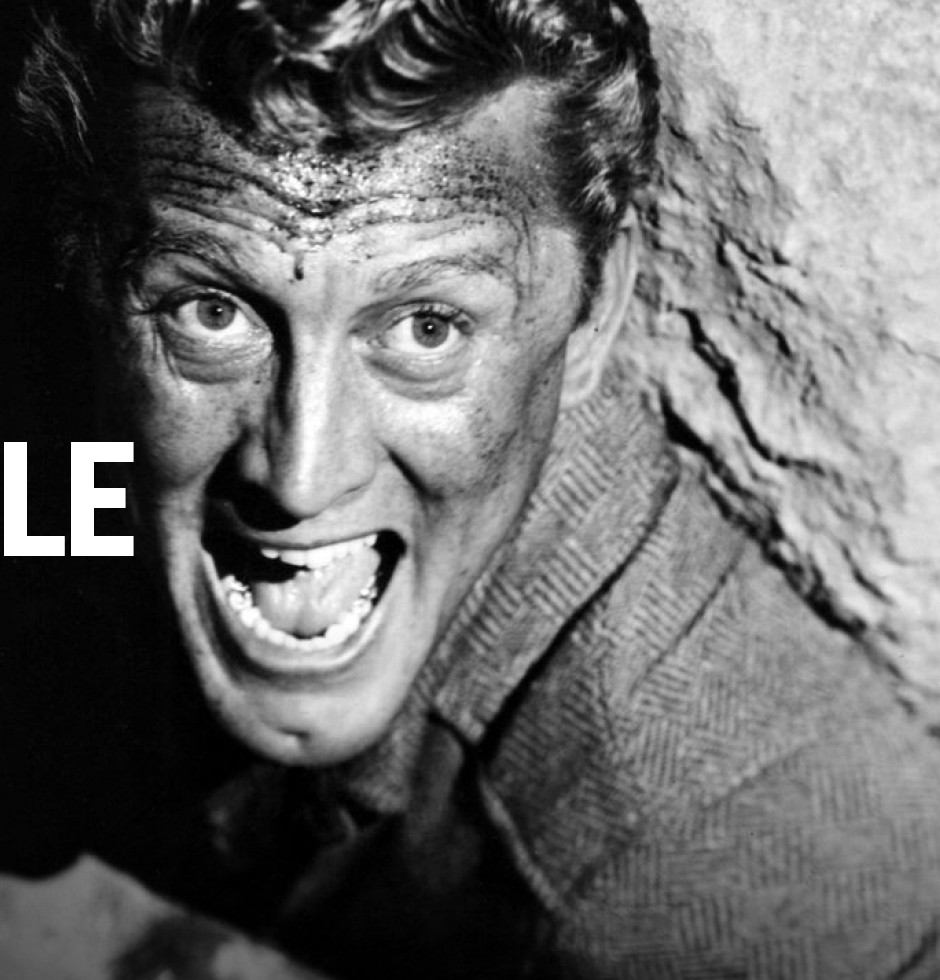
Image context: the cover uses a real still from the film rather than poster art because this essay is about contact between ambition and material reality. Cave wall, lantern light, and Chuck Tatum's ecstatic face make clear that Wilder's critique is not abstract. It is built from rock, machinery, and a man who can already see a headline forming before anyone has been saved.[1][3]
1. Tatum's real crime is not just lying. It is redesigning the timetable.
Chuck Tatum arrives in New Mexico as a washed-up big-city reporter looking for a way back to prominence.[1][3] When he finds Leo trapped in a cave, the first temptation is journalistic: a live, emotional story with human stakes. But Tatum's decisive move is logistical rather than literary. TCM's account lays it out plainly. A quicker rescue path exists. Tatum helps redirect the operation toward a slower drilling plan that gives him days of headlines instead of a few hours of duty.[3] That is why the film feels more poisonous than a simple portrait of bad ethics. The reporting does not merely feed on the event after the fact. It helps engineer the event's duration.
This change in tempo matters because time is the movie's most valuable commodity. The longer Leo remains underground, the larger the audience can grow and the more money, influence, and emotional theater can collect around the hole.[2][3] Tatum understands this immediately. He does not need to invent a fake story. He only needs to control the pace at which reality is allowed to resolve. Wilder thereby turns journalism into event management. The scoop is no longer information alone. It is custody over the clock.
That is why the ladders and access routes matter so much in the film's imagery. They are not neutral pieces of rescue infrastructure. They are choke points in an improvised economy. Whoever controls entry, delay, and visibility controls the value of the story. Tatum's brilliance is monstrous because he sees administration as narrative. If the rescue can be slowed, the public can be fed in stages, and the story can be widened from local emergency to national spectacle.[1][3][4]
2. Wilder turns the desert rescue site into a midway
The TCM essay notes that Tatum's stories attract multitudes, transforming the accident scene into a morbid spectacle.[3] That sentence gets at the film's harshest joke: once enough people arrive, the tragedy begins to resemble a county fair. Traffic accumulates, attractions sprout, food moves in, and what should have remained a site of pressure and fear becomes a place where people stroll, watch, and spend. Wilder is not satisfied with condemning sensational journalism at the level of newspaper language. He shows how easily spectatorship grows physical habits of its own. A crowd needs routes, snacks, noise, souvenirs, and things to do while it waits.
Haskell's "noir in broad daylight" formulation is crucial here.[2] Darkness in Ace in the Hole does not hide in alleys. It unfolds in full sun, before families, vendors, officials, and gawkers. The openness of the image makes the moral situation worse, not better. Everybody can see what is happening, yet visibility does nothing to purify the scene. Wilder uses bright air and public bustle to show how quickly cruelty becomes ordinary when it is distributed across enough participants.[2][3]
This is where the movie's title change to The Big Carnival feels less like a studio footnote than an x-ray of the film's structure.[3] The rescue site becomes a carnival not because anyone announces one, but because opportunism keeps filling every available gap. One man is trapped underground; above ground, a whole service sector materializes. Wilder's satire therefore reaches beyond media criticism into something uglier and more durable. Disaster does not just attract attention. It invites entrepreneurship.
3. The film keeps proving that no one wants to be merely adjacent to the story
One reason Ace in the Hole remains so nasty is that almost everybody near the cave wants a cut, whether financial, electoral, emotional, or symbolic.[1][3][4] Tatum is the sharpest predator, but Wilder makes sure the system does not begin and end with him. TCM's summary already names two key accomplices: the dishonest sheriff and Leo's unloving wife.[3] Each person sees the event as an opening. Power can be consolidated, boredom escaped, money extracted, status increased, old resentments answered. Leo's entrapment becomes the central resource around which smaller ambitions orbit.
That is why the loudspeakers matter as much as the headlines. Public-address systems turn the rescue into programming. They organize waiting, amplify urgency, and keep the crowd emotionally enrolled. The event must be narrated continuously so that the audience never drops back into ordinary moral scale. Once disaster becomes scheduled sound, it can be managed like entertainment. Wilder understands this with frightening precision. The crowd does not need to be told explicitly that it is participating in something ugly. It only needs enough cues to keep participating.[2][3]
AFI's Movie Club note usefully reminds readers that the story draws inspiration from the real Floyd Collins tragedy and frames the film as an unflinching account of a journalist orchestrating a media circus for personal gain.[4] The word "orchestrating" matters. Orchestration implies multiple parts, timed entrances, and practical coordination. That is exactly the movie's social texture. Ace in the Hole is about corruption, but it is even more about arrangement.
4. Why the ending hurts so much
Because Wilder has built such a complete system around Leo's suffering, the ending does not land as a simple moral correction.[1][2][3] Tatum is punished, yes, but punishment alone cannot undo the structure the film has exposed. Haskell's essay is merciless on this point: the noir is interior, lodged in Chuck's moral decomposition, but also in the public culture that proves ready to meet him halfway.[2] By the time the spectacle collapses, the audience has already seen how many people were prepared to treat delay as value and pain as programming.
This is why the movie feels more radical than later "bad media" stories that isolate one villain and restore innocence to the surrounding public. Ace in the Hole does not offer that comfort.[1][3][4] It shows a society that can assemble a temporary industry around a hole in the ground with terrifying speed. Tatum may be the mastermind, but the crowd, the vendors, the officials, and the institutions of distribution all help make the thing legible as normal life. Wilder is not merely asking what sort of reporter would do this. He is asking what sort of country makes his logic workable.
That question is what keeps the film current. Long before round-the-clock cable or algorithmic feeds, Wilder understood that catastrophe can become an event product once access, delay, and emotional framing are under somebody's control.[1][2][3] The ladders are part of it. The loudspeakers are part of it. The fairground drift is part of it. By the end, Ace in the Hole has shown that the true obscenity is not just exploitation in the abstract. It is the speed with which exploitation learns to look organized, festive, and commercially reasonable.[2][3][4]
Sources
- The Criterion Collection, "Ace in the Hole" film page with synopsis, credits, and restoration context.
- Molly Haskell, "Ace in the Hole: Noir in Broad Daylight." The Criterion Collection.
- Mikita Brottman and David Sterritt, "The Big Carnival (Ace in the Hole)." TCM.
- American Film Institute, "AFI Movie Club: ACE IN THE HOLE."