Most MGM musical trailers promise a single mood and stay there. They promise buoyancy, glamour, and a reliable stream of applause cues. Warner Bros. Rewind's theatrical trailer for The Band Wagon is more interesting because it keeps changing its own terms.[1] It begins with an invitation to get aboard, then spends the next three minutes showing that the ride will not be smooth, singular, or even tonally polite. The preview sells a Broadway comeback story, a rehearsal comedy, a public-floor dance release, a grotesque novelty number, and finally a stylized detective ballet. The film looks entertaining because it never settles for one register of entertainment.
That restlessness fits what Vincente Minnelli made in 1953. BFI's guide to MGM musicals calls The Band Wagon a wry homage to Broadway musical comedy that also brought new psychological depth to the genre.[2][3] TCM's production account makes the structure even clearer: Fred Astaire's Tony Hunter is an aging star trying to convert Broadway return into professional rescue, only to watch the show get inflated by Jeffrey Cordova's prestige-heavy ambitions before it can be rebuilt into something that actually works.[3] Roger Ebert's essay catches the extra note that keeps the film from floating away on charm alone. Beneath the smiles sits show-business melancholy: fatigue, professional doubt, and the knowledge that every triumph must still pass through failure, rehearsal, and embarrassment.[4]
That is why the trailer deserves an annotated viewing of its own. It does not hide the film's tonal swings as a marketing inconvenience.[1][3] It advertises them as the point. Each section of the preview revises what the previous section seemed to promise, and that pattern becomes the best short explanation of why The Band Wagon still feels fresher than a generic backstage-musical plot summary. The movie is not about preserving one perfect show-business image. It is about watching performance survive a chain of misdirections until the right form finally appears.
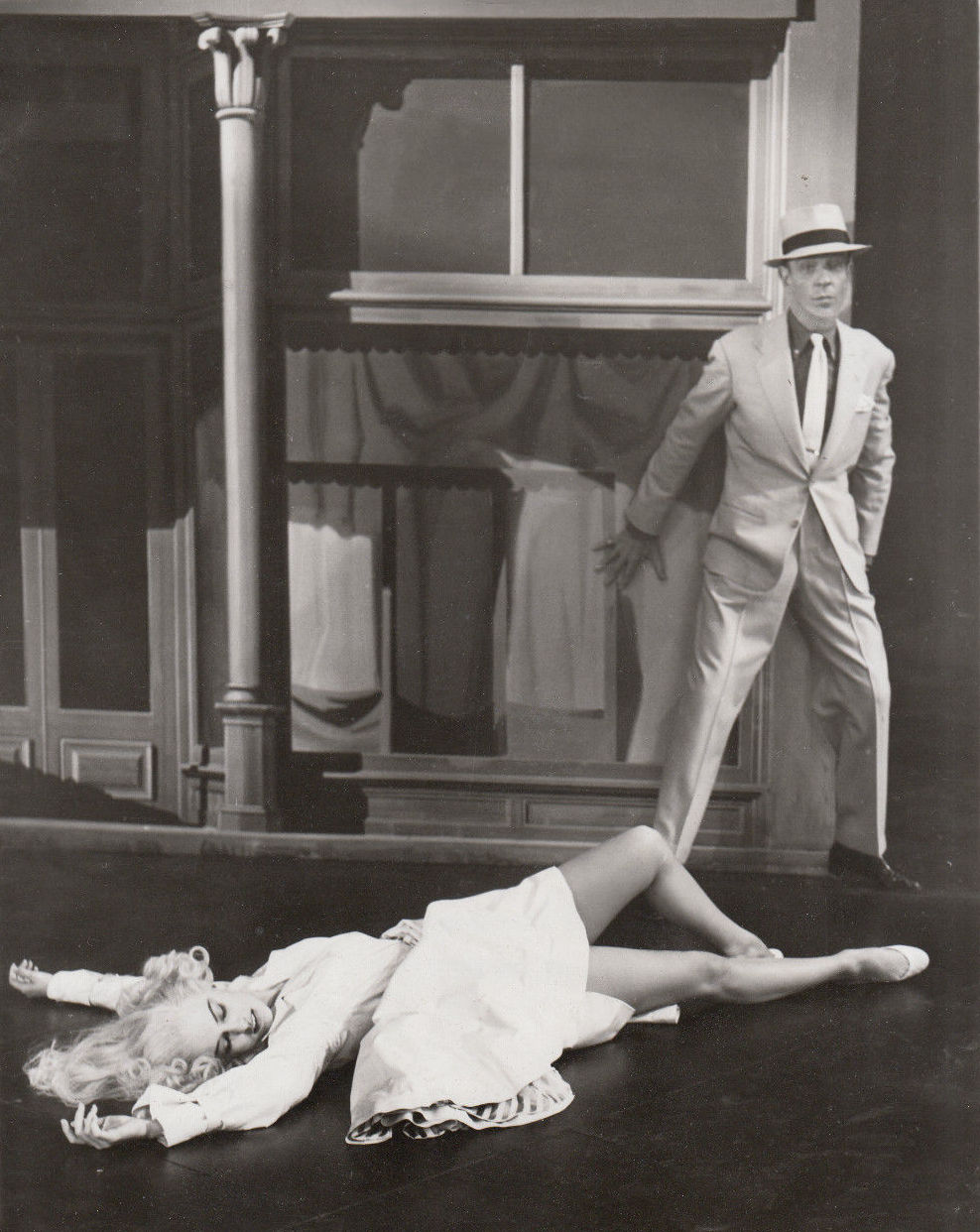
Image context: the cover uses a black-and-white publicity still from the "Girl Hunt" ballet, with Fred Astaire looming in white over Cyd Charisse on the floor. It is the right image for this article because the trailer's last and strongest move is to reveal that the film's backstage wit can suddenly harden into stylized danger without losing rhythmic control.[6]
At 0:00, the trailer invites you aboard and then immediately makes the comeback look uneasy
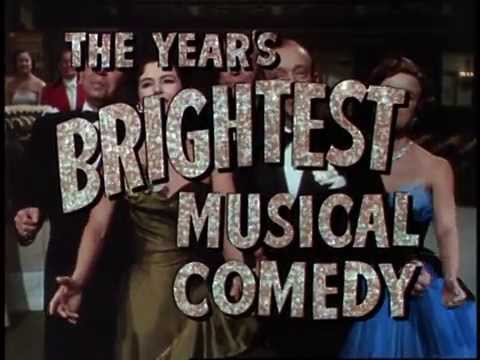
The first title card is broad and cheerful, but the trailer does not keep that simplicity for long.[1] Almost as soon as the invitation lands, the movie starts presenting Tony Hunter as a star who has to be reassembled in public. He is not introduced as an untouchable legend descending to bless the frame. He is folded into group entrances, rehearsal logistics, and a comeback structure that depends on collaborators, not aura alone.[1][3] That choice matters because The Band Wagon is built around professional vulnerability. TCM notes that Comden and Green wrote Tony close to Astaire's own position: a performer with immense prestige who is still exposed to the possibility of decline.[3]
The trailer understands that exposure and keeps it visible. Even the glamorous groupings feel slightly diagnostic. People enter in evening clothes, smile on cue, and move with polish, yet the preview never lets those images become self-sufficient.[1] Instead it keeps nudging the audience toward the fact that this production is a problem to be solved. In that sense the opening already announces the film's intelligence. The trailer is not saying, "Here is effortless greatness." It is saying, "Here is a great performer who will have to survive an apparatus of rehearsal, taste, and misjudgment before the evening belongs to him again."
Around 0:40, the backstage spaces turn performance into labor rather than glow
Once the preview starts moving through staircases, crowded tables, rehearsal rooms, and overdesigned stage environments, the film's backstage premise sharpens.[1] BFI's overview of Minnelli is useful here because it stresses his command of physical space and his ability to give emotional pressure architectural form.[5] The trailer treats that ability as a selling point. Sets are not neutral containers waiting for songs. They are pressure chambers in which style can go wrong.
This is where Jeffrey Cordova's overreach becomes central. TCM describes him as the prestige-minded director whose grandiose ideas push the comeback vehicle toward an artsy flop before the show is rebuilt.[3] The trailer does not stop to explain all of that in dialogue, but it keeps hinting at the same drama in visual terms. Too many bodies are clustered around concept, authority, and correction.[1] The movie's world is full of talent, yet talent is not enough. Someone has to decide what kind of show this is, and the wrong answer produces stiffness where lightness should be.
That is why the trailer never behaves like a simple parade of numbers. It wants the audience to feel that entertainment here is contested. Performance has to be rescued from self-importance. The atmosphere of bustle, consultation, and backstage friction prepares the later musical breakthroughs by making them look earned rather than automatic.[1][3]
Around 1:10, "Shine on Your Shoes" blows the room open and changes the social scale
The preview's smartest tonal correction comes with the shift into "Shine on Your Shoes."[1] Suddenly the movie is no longer trapped inside taste disputes and theatrical planning. Astaire is up on the shoeshine stand, the setting turns public, and the whole film seems to remember that musical pleasure can begin with contact, rhythm, and amused human traffic rather than with high-cultural prestige.[1][4] Ebert singles out the number's street-level energy by recalling Astaire alongside the shoeshine boy Leroy Daniels; the effect is playful without becoming trivial.[4]
This matters because The Band Wagon is not anti-art. It is anti-deadness. BFI's MGM-musical survey places the film within a run of studio musicals that kept expanding what screen dance could do while still respecting the crowd-pleasing force of a well-sold number.[2] The trailer makes that principle visible. "Shine on Your Shoes" is not presented as filler between plot beats. It is a correction in philosophy. After all the anxious shaping of the comeback project, the movie briefly demonstrates that entertainment regains force when it rediscovers open movement, visible delight, and a world larger than the rehearsal room.[1][2]
The trailer needs this release because it prevents the film from sounding like a lecture about Broadway difficulty. It reminds the viewer that Tony's value is not abstraction or legacy by themselves. His value is rhythmic intelligence in motion. Once the preview gives him public floor again, the whole movie starts breathing differently.
In the last minute, "Triplets" and "Girl Hunt" prove the film can survive weirdness and come out stronger
Many trailers would stop after the crowd-pleasing number and leave the viewer with a single clean promise. The Band Wagon's trailer does something riskier and better. It swerves into "Triplets," a number TCM describes as physically punishing to perform and comic in a deliberately unnerving register, with Astaire, Nanette Fabray, and Jack Buchanan dancing on their knees in infant costume.[3] In the preview, the effect is a jolt. Entertainment here is not limited to polish. It can become absurd, strained, and faintly menacing without collapsing.[1][3]
Then comes the decisive turn into the "Girl Hunt" material, and the trailer suddenly shows what the whole movie has been preparing for.[1] The image system hardens. Charisse appears inside a noir-inflected world of pursuit, poses, and danger; Astaire's elegance is retained, but it now operates inside a detective-fantasy frame rather than a cheerful backstage revue.[1][6] The publicity still used as this article's lead image captures that shift exactly: white suit, dark floor, sprawled body, and a composition that looks almost too severe for a musical until the choreography makes the severity dance.[6]
This final movement is the preview's real argument. The Band Wagon is not great because it contains several good numbers that happen to share a cast.[1][2][3] It is great because it can move from brittle comeback anxiety to public swing, from grotesque comedy to stylized noir ballet, and make each shift feel like an expansion of the same performance intelligence. The trailer keeps changing its tune because the film's deepest pleasure lies in watching one entertainment machine prove how many forms it can metabolize without losing grace.
What the trailer teaches before the film even starts
Seen this way, the preview is unusually faithful to the movie it sells. It does not flatten The Band Wagon into nostalgia, nor does it pretend that "That's Entertainment" means one texture only.[1][2][3] The trailer teaches something more exact: entertainment in this film is a process of revision. Bad ideas, swollen egos, tonal detours, comic grotesquerie, and stylized fantasy all have to pass through the same system before the movie arrives at ease. What looks effortless at the end has survived a great deal of testing.
That is why the trailer still works. It advertises not just songs and stars, but elasticity.[1][4] By the time the Technicolor flourish lands, the viewer has already been shown a musical willing to look anxious, silly, streetwise, and dangerous in one continuous promotional breath.[1] The ride is worth taking because it keeps changing shape, and because Astaire and Minnelli know that show-business confidence is most convincing when the film lets you see how much instability it had to absorb on the way there.
Sources
- Warner Bros. Rewind, "The Band Wagon - Theatrical Trailer," YouTube video.
- David Parkinson, "Where to begin with MGM musicals," BFI.
- Brian Cady and Frank Miller, "The Essentials - The Band Wagon," TCM.
- Roger Ebert, "Singin' through the pain," review of The Band Wagon.
- Christina Newland, "Where to begin with Vincente Minnelli," BFI.
- Wikimedia Commons, "File:Band Wagon still.JPG."