Discusses the shipwreck, island scenes, and the film's later racing setting without revealing the race's outcome.
A boy holds out seaweed. A horse considers the distance between them. In Carroll Ballard's The Black Stallion (1979), a shared shot against the surf gives their approaches and retreats time to register. Kelly Reno's Alec has something to offer, but no certainty that the animal will accept it. Watching the sequence with the Directors Guild of America, Spike Jonze singled out its patient choreography.[1]
The interval is the drama. A cut could take us straight from the offer to the horse eating, making friendship a completed transaction. Keeping both bodies available to the eye lets us read each adjustment. The empty space has a changing meaning: first a barrier, then a distance that might be crossed.
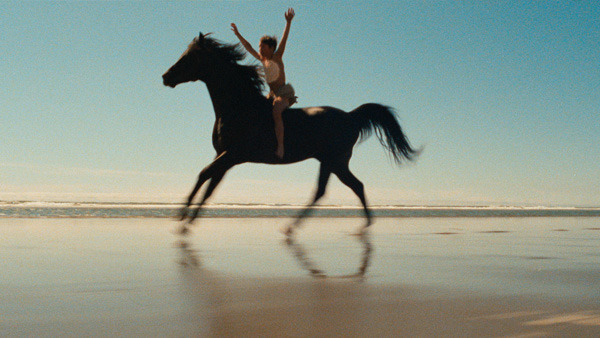
The trainer outside the frame
The encounter's apparent delicacy rested on practical preparation. A production account from Arabian Horse World, preserved on Tim Farley's official Black Stallion site, describes four horses trained for different demands. Cass Ole was the principal star; Fae-Jur supplied a more spirited presence, while others handled specialized action. Reno joined the training before filming. The animal we recognize as one character was already a collaboration.[2]
That division of labor changes how a performance can be understood. An actor may carry a character's changing temperament through successive scenes. Here, selection and editing also connect different animals into a continuous personality. The audience remembers a particular relationship, even when the production has distributed its physical expression among several performers.
Cinematographer Caleb Deschanel later explained that trainer Corky Randall stood outside the seaweed scene's frame, signaling the horse. A costume continuity problem meant the filmmakers repeated the encounter the next day. Its convincing uncertainty survived a carefully organized retake.[3]
The frame therefore contains two kinds of knowledge. Alec's offered hand belongs to the story; the unseen trainer's instructions belong to the making of the shot. Knowing about the second need not diminish the first. It helps explain why the scene can remain legible while leaving room for hesitation. Direction has established a situation in which small variations matter.
A child's height, an animal's timing
Deschanel identified the boy's eye level as a guiding principle. But he also recalled filming the island much like a documentary: when the horses disappeared, the crew could turn to Alec examining a sea urchin. They kept filming through long waits for the desired behavior. Asked about the beautiful late light, he joked that getting the horses into position could take all day.[3]
These recollections suggest a flexible hierarchy. The perspective stays consistent while the immediate subject can change. A production delay becomes an opportunity to discover what else the child might notice. On screen, such attention gives the island a life beyond the central friendship; the place can hold Alec's curiosity even when the horse is elsewhere.
The distinction matters for visual storytelling. A low camera position establishes a bodily relationship with the world. It does not dictate every object that must enter the frame. Ballard and Deschanel could preserve the scale of a child's encounter while adapting its particulars to what was available.
They also worked with carefully chosen photographic materials. Deschanel described using Eastman 5247 stock and combinations of warming filters.[3] The glowing result should not be mistaken for an untouched record of whatever happened to pass before a lens. Exposure, color, position, and the decision to keep rolling all shape what spontaneity looks like.
Let the audience discover the action
The first ride extends this approach into the water. In the sequence discussed by Jonze, the camera shows legs and hooves beneath the surface as Alec leads the horse deeper. The purpose becomes clear gradually, as the boy swims and gets onto the animal's back.[1]
That delayed understanding gives the viewer a small task. We assemble an intention from bodily evidence instead of receiving an explanation beforehand. Water changes what movement is possible, and the changing depth becomes part of the action's logic. The environment helps the scene advance.
Once the pair return to civilization, the film must carry their bond into homes, a barn, and racetracks. Sragow's Criterion essay emphasizes the continuing poetry of those more ordinary places.[4] The island has taught us what to attend to: proximity, responsiveness, the pleasure of moving together. Racing can place those sensations under pressure without making the earlier passages disposable scenery.
Time belongs in the equipment budget
Speaking to David Morgan on the set of Wind in 1991, Ballard explained that the island section of The Black Stallion depended on having considerable time with a small crew. A large production could consume its days moving people and machinery, leaving less freedom to explore natural surroundings.[5]
His complaint gives the film's beauty a material basis. Time on location and time available for observation are different resources. A crew may spend hours near water while every minute is committed to delivering a predetermined action. The capacity to notice something useful requires enough flexibility to pursue it.
The seaweed scene makes that resource visible as patience. Preparation brings the boy and horse within reach of each other; framing gives their separation shape; duration lets an approach feel consequential. The audience waits because the film has made a small movement worth waiting for.
Sources
- Rob Feld, “Animal Instincts,” DGA Quarterly, Spring 2010 — a screening of The Black Stallion with Spike Jonze, including the seaweed encounter and underwater staging of the first ride.
- Black Stallion Ranch, “The First Black Stallion Movie” — reproduces an April 1978 Arabian Horse World production account detailing the horses, their training, and Kelly Reno's preparation.
- Iain Marcks, “ShotDeck Drop: The Black Stallion,” American Cinematographer, June 11, 2025 — reproduces Caleb Deschanel's AFI seminar discussion, published in January 1981, on framing, animal cues, retakes, stock, filters, and location improvisation.
- Michael Sragow, “The Black Stallion: Nirvana on Horseback,” The Criterion Collection, July 14, 2015 — the film's two settings, cast, and continuity of feeling; source of the film still reproduced above.
- David Morgan, “Interview with Director Carroll Ballard: On the Set of Wind, 1991,” Wide Angle / Closeup — Ballard on the small crew and available time behind The Black Stallion's island scenes.