Spoilers: this essay discusses the ending and the deaths that lead to it.
A boat comes home, and a boy waits for his father. By the end of The Breaking Point, we know why that father will never appear. The people around the child are occupied with someone else's emergency.[2] Michael Curtiz makes the end of a thriller feel like the beginning of an obligation: after following one man's troubles so closely, can we recognize the life his story has pushed to the edge?
Released in 1950, the film stars John Garfield as Harry Morgan, a charter-boat captain whose financial problems draw him into crime. Ranald MacDougall adapted Ernest Hemingway's To Have and Have Not; Juano Hernandez plays Harry's crewmate, Wesley Park, and Phyllis Thaxter plays his wife, Lucy.[1] The household Harry hopes to preserve commands our sympathy. The film gradually makes that sympathy answer to a second household.
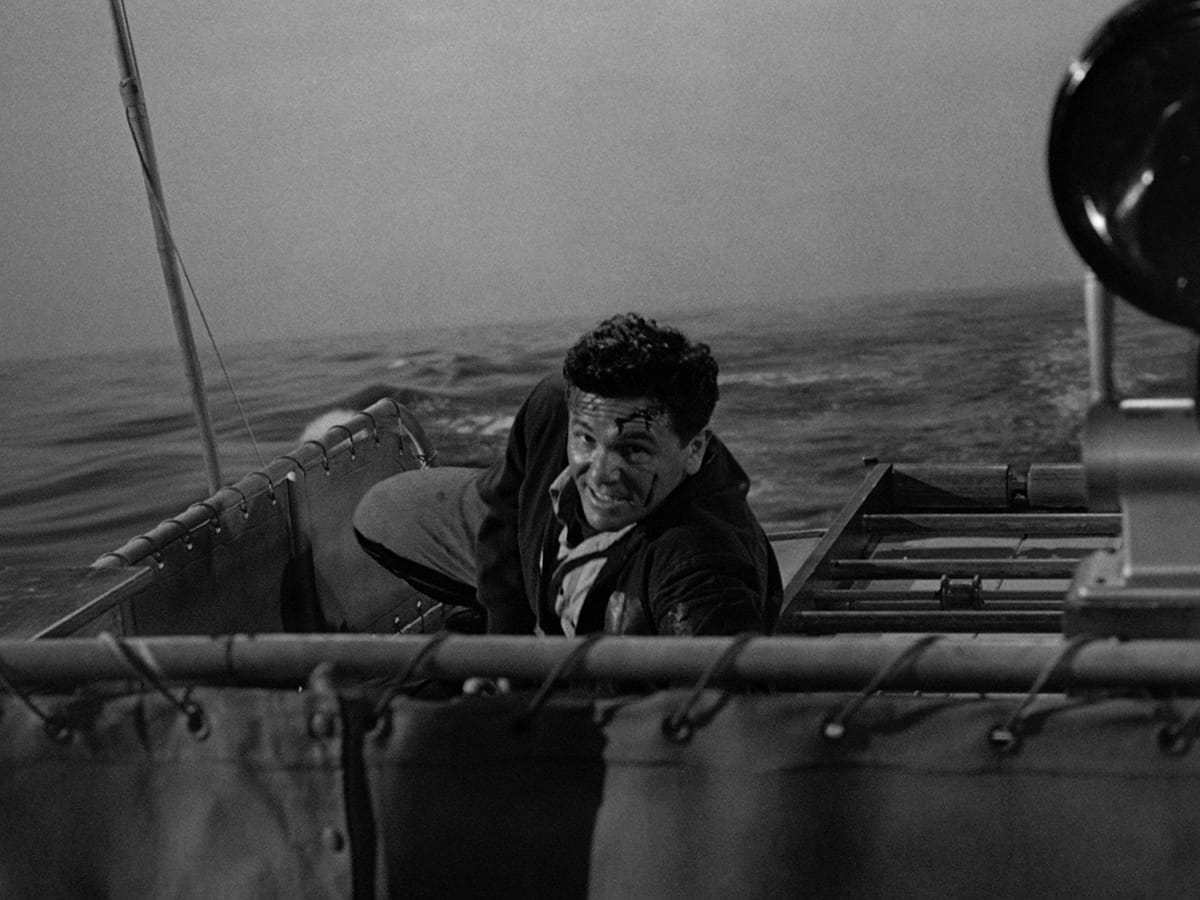
The cost of keeping the boat
Harry's trouble begins with an unpaid bill. A customer abandons him in Mexico without paying for the charter. A lawyer, Duncan, offers a way to earn money by transporting Chinese migrants into the United States illegally.[2] Work and wrongdoing become connected through the ordinary expenses of getting home.
The boat makes this connection especially painful. In Glenn Erickson's reading, Harry has invested his identity in remaining its captain; taking the farm work Lucy proposes would feel like defeat.[4] His skill is real, but so is his inability to turn it into a dependable living. The Sea Queen allows him to command a vessel while creditors and customers determine whether he can keep commanding it.
That distinction gives the criminal offers their force. Each promises to restore the independence that accepting it further compromises. Harry can calculate a fee, a debt, or a journey. He is less willing to calculate how many other people become exposed when he treats keeping the boat as the condition of keeping himself.
UCLA's archive notes that the adaptation moves Hemingway's setting from the Florida Keys to Newport Beach, California.[5] The harbor belongs to a recognizable economy of leisure: one man's fishing excursion is another man's wages. When the holidaymaker walks away, the working family absorbs the interruption. The sunshine offers no protection against that imbalance.
Two fathers, one working day
Early in the film, Harry's daughters meet Wesley's son on their way to school, and the children go off together. Stephanie Zacharek singles out this encounter in her account of the community Curtiz establishes around Harry.[3] Before crime separates the families, the film gives them a shared morning.
The scene supplies a modest but crucial measure of equality. Both men have children who expect them home. Both lives extend beyond the boat. Wesley's responsibilities do not begin when Harry needs his help, and they will not end when Harry's adventure does.
Erickson emphasizes Hernandez's thoughtful, direct performance and Wesley's own need to remain employed.[4] That emphasis matters because the role of a loyal friend can quietly reduce a character to a service: warning the hero, helping him, suffering for him. Here, the schoolday establishes another way to understand Wesley. Someone elsewhere relies on him for reasons that have nothing to do with Harry.
The opening's ease also makes the ending harder to dismiss. The families already know one another. The eventual isolation of Wesley's child cannot be explained simply by his arrival from outside the story's social world. We have seen him belong.
A rescue with someone missing
The final criminal undertaking brings Harry into contact with armed robbers. They kill Wesley; Harry fights back and is badly wounded. When the boat is recovered, Lucy persuades Harry to accept the amputation that can save him. Wesley's son, Joseph, waits on the dock.[2]
Harry's need is immediate and visible. His injury gives the people around him something to do. Lucy can speak, persuade, and accompany him. A threatened marriage acquires a possible future because its two adults are still there to negotiate one.
Joseph has no corresponding action available. Waiting is all he knows to do. The audience possesses the information that would end his wait, but knowledge cannot restore what he has lost. The difference between these two situations gives the scene its terrible imbalance: one family has a crisis that others can address; another has a loss that the gathering does not acknowledge.
Philosopher Dan Flory reads the closing image through precisely this unequal attention. Drawing on Stanley Cavell, he contrasts the concern surrounding Harry's injury with the neglect of Wesley's death and its consequences for his son.[6] The racial distinction is inseparable from the distribution of sympathy: the white protagonist remains the center of organized care, while the Black child is left waiting.
What sympathy leaves out
The ending does not require us to withdraw concern from Harry. His pain is real. Its force comes from asking whether our concern can survive a change of subject.
Zacharek stresses the film's tenderness toward Harry's marriage and the early friendship between the families.[3] Flory's reading of the final shot makes that warmth insufficient as a guarantee of equal recognition.[6] These emphases can coexist. Affection within a community does not ensure that everyone receives its attention when disaster arrives.
The last image therefore changes the scale on which Harry's choices must be judged. A man can be frightened, devoted to his children, and worth saving while still leaving damage that his own survival cannot repair. Wesley's family must remain part of that judgment after the captain's immediate danger has passed.
Curtiz leaves us on the dock because the story of the rescued man is no longer large enough to contain what happened.
Sources
- The Criterion Collection, The Breaking Point — film year, cast, screenplay credit, premise, and official gallery still reproduced above.
- American Film Institute, The Breaking Point (1950), AFI Catalog — plot synopsis, characters, criminal undertakings, and the final dockside sequence.
- Stephanie Zacharek, “The Breaking Point: All at Sea,” The Criterion Collection, August 8, 2017 — the children walking to school, the marriage, and the friendship between the families.
- Glenn Erickson, “The Breaking Point,” CineSavant / Trailers from Hell, July 22, 2017 — Harry's attachment to the boat, the alternative of farm work, and Hernandez's characterization of Wesley.
- UCLA Film & Television Archive, “The Breaking Point / Under My Skin,” April 12, 2014 — the adaptation's move from the Florida Keys to Newport Beach.
- Dan Flory, Philosophy, Black Film, Film Noir, Pennsylvania State University Press, 2008, p. 34 — reading of Wesley, Joseph, and the unequal concern in the closing shot, in dialogue with Stanley Cavell; publisher record.