Spoilers: this essay discusses the ending and the deaths that precede it.
The gunfight is over, but Howard Kemp still has work to do. His prisoner is dead, and the body must be brought ashore and loaded onto a horse before he can collect the reward.[1] In The Naked Spur, killing the villain leaves the hero with an ugly practical question: how much farther will he carry him?
Anthony Mann's 1953 western stars James Stewart as Kemp and Robert Ryan as the fugitive Ben Vandergroat.[1] Its pursuit promises a familiar destination, a wanted man delivered to justice. Yet the journey becomes increasingly concerned with another destination: the home Kemp believes the bounty will restore. Mann lets those two purposes travel together until their difference becomes unbearable.
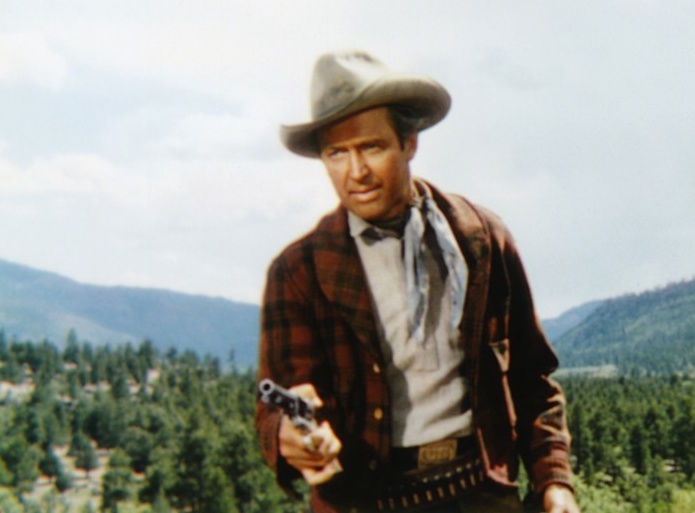
A fee becomes a share
Kemp recruits the prospector Jesse Tate for twenty dollars. Jesse assumes he is helping a sheriff. After Ben's capture, the prisoner reveals the five-thousand-dollar reward; Jesse and the third captor, Roy Anderson, demand shares. Kemp reluctantly agrees.[1]
The revelation changes the meaning of work already done. Jesse has helped locate and capture a dangerous man, but he has misunderstood the enterprise. A small payment for assisting the law becomes an insulting wage for helping someone else make a fortune. Kemp's authority weakens because his companions can now put a price on it.
Once captured, Ben's most useful weapon is information. He cannot simply command his captors, but he can make them renegotiate with one another. The men who should be watching him start watching their own interests. A three-way division also gives every participant a reason to wonder how secure the other two shares really are.
Christina Newland's account of psychological westerns emphasizes the film's stripped-down cast and its concentration on desperate motives.[3] That economy is especially effective here. There is no reassuring procession of deputies or townspeople to tell us what kind of group this is. The men have to establish their relations through each new bargain, and a bargain made under pressure is easily reopened.
The open country offers room to move without offering much room to escape the argument.
A prisoner who can still make offers
Richard Armstrong reads Kemp's pursuit as an attempt to recover the farm he lost through a former lover's betrayal. He also stresses the resentment Kemp feels toward the companions with whom he must share the reward.[2] The money is already spent in Kemp's imagination. Every claim against it threatens a return he has begun to treat as owed to him.
That makes Ben unusually powerful for a man in custody. He understands that the group's desires extend beyond the immediate journey. Armstrong describes Jesse's wandering search for gold and the unstable loyalties surrounding Lina Patch, played by Janet Leigh.[2] Ben does not need everyone to want the same thing. Different wants give him different openings.
We can read the resulting conversations as contests over the future tense. A reward, a mine, a recovered home: each imagined destination makes the present arrangement seem temporary. Ben keeps inviting his captors to picture a better outcome just beyond their current obligations. The group becomes vulnerable whenever a promise seems more substantial than the person making it.
Kemp nevertheless refuses to kill Ben in cold blood or permit Roy to do so.[1] This resistance matters. His conscience has not vanished. Mann gives us a man capable of a decent refusal while still pursuing a purpose that deforms his relations with everyone around him. The film asks us to hold both judgments at once.
The land cannot give him back his life
David Parkinson's BFI essay distinguishes Kemp's understandable wish to recover his land from the methods that test the audience's trust in Stewart.[4] That distinction prevents the film from becoming a simple warning against greed. Wanting a home is recognizable; believing one transaction can reverse a betrayal is something more dangerous.
Armstrong notes how the mountain terrain batters bodies and how Kemp's wound leaves him weakened. He also singles out the sound of rain striking metal utensils during Kemp's account of the woman he lost.[2] These details bring his ambition down to the scale of discomfort: a hurt leg, an exposed campsite, a voice trying to make the past intelligible.
For me, that modest sound is more revealing than a grand vista. Rain on a cup belongs to the immediate business of getting through the night. Kemp's dream belongs elsewhere, in a life he wants restored to its earlier shape. The distance between those scales helps explain why companionship can seem secondary to him. A person sitting nearby must compete with an imagined homecoming.
The landscape gives that mistake weight. It cannot be hurried by the size of a reward. Traversing it requires attention to bodies and hazards, while Kemp keeps measuring the journey against what awaits at its end. The practical demands of travel expose the inadequacy of his private calculation.
Putting the burden down
After Ben's death, Roy dies attempting to recover the body from the river. Kemp retrieves it and lays it across his saddle. Lina offers to accompany him; he breaks down. He ultimately buries Ben, and the two survivors leave together.[1]
The decisive change is an action performed on the same body. Across the saddle, Ben remains payable cargo. In the earth, he becomes someone Kemp has stopped transporting for money. Burial does not pronounce the outlaw innocent. It ends the claim Kemp has been making on him as the means of recovering another life.
Lina's presence makes a future possible before Kemp has secured the funds he thought it required. His tears can be read as the collapse of that requirement: the recognition that he has made a home depend on carrying this burden all the way to a cashier.
The ending leaves room for unease. A grave cannot restore the dead companions, and a new attachment cannot certify that Kemp has changed permanently. What the film gives him is a concrete first decision. He leaves the reward behind.
For a western organized around pursuit, that is a startling measure of progress. Kemp can finally go somewhere because he has stopped insisting on getting everything back.
Sources
- American Film Institute, The Naked Spur (1953), AFI Catalog — credits and synopsis, including the reward disclosure, Kemp's refusal to kill Ben in cold blood, and the river and burial sequences.
- Richard Armstrong, “The Naked Spur,” Senses of Cinema, October 2003 — Kemp's lost farm, the group's competing desires, bodily vulnerability, and the rain-on-utensils scene.
- Christina Newland, “Where to begin with psychological westerns,” British Film Institute — the film's reduced ensemble and its place within the psychological western.
- David Parkinson, “James Stewart: 10 essential films,” British Film Institute — the distinction between Kemp's motive and his methods; source of the film still reproduced above.