Ernst Lubitsch's The Shop Around the Corner is often remembered as one of cinema's gentlest romantic comedies, which is accurate and still a little misleading.[1][2][3][4] The anonymous-letter plot is famous because it is so durable: two clerks at a Budapest leather-goods shop quarrel face to face while falling in love on paper.[1][4] But the film's real hold comes from something more vulnerable than plot cleverness. Lubitsch builds a whole moral world out of one modest commercial interior, then keeps asking how much inward dignity a person can preserve when income, pride, humiliation, and longing all have to pass through the same counter.[2][3][5]
That is why the movie still feels so alive.[1][2][3] It does not flatter romance as pure escape. It places romance inside work: opening hours, sales patter, stockroom errands, a boss's moods, a customer's whim, and the tiny social theater of being watched while trying to remain polite. The letters matter because they create a second room inside this system, a room made out of language rather than furniture.[2][3] Alfred Kralik and Klara Novak are able to become legible to one another only when the shop cannot see them.
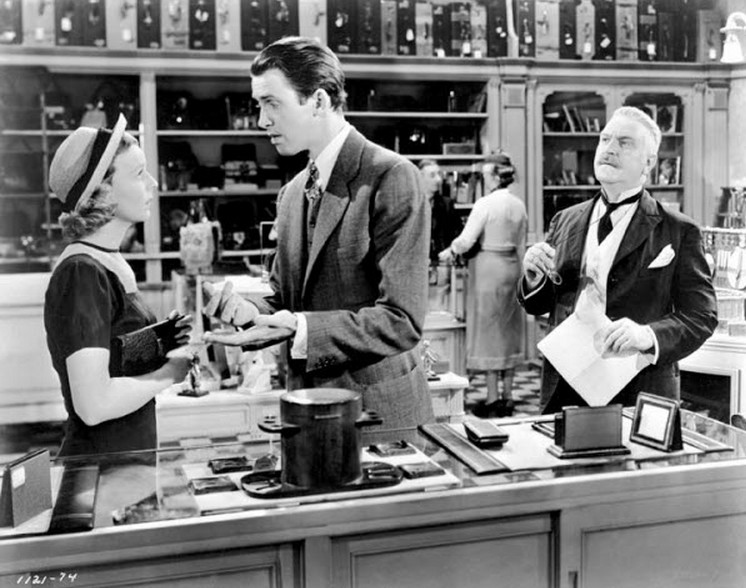
Image context: the lead image uses a real 1940 promotional still published in National Board of Review Magazine and preserved on Wikimedia Commons.[6] It is the right image for this essay because the movie's emotional system is visible in one glance: the counter as workplace front, Matuschek as pressure source, and Alfred and Klara as people whose feelings have to pass through performance before they can reach privacy.
The counter turns ordinary courtesy into public risk
Lubitsch's great trick in this film is that he makes salesmanship feel almost as consequential as confession.[2][3][4] The shop floor is not just a neutral workplace where charming people happen to banter. It is a stage on which everyone has to remain usable. David Sanjek's Senses of Cinema essay is especially sharp on the point that Lubitsch shifts from aristocratic worlds to clerks, deliveries, and customers without losing formal precision.[2] That move matters because it gives the film a stronger pressure system. A countess may lose face in a drawing room; a clerk can lose both face and livelihood before lunch.
The counter concentrates that danger.[1][2][3] Every exchange is partly commercial and partly theatrical. Alfred has to prove his value in front of Matuschek. Klara has to establish authority in a workplace already arranged before she arrived. Vadas survives by performing smoothness until smoothness itself becomes suspicious. Even small acts of competence carry status weight, because the room is narrow and everyone can hear almost everything.[2][4] The film's comedy lands so gracefully because Lubitsch never forces this pressure into melodramatic shouting. He lets the workplace remain civilized enough that humiliation arrives in a lowered tone.
That tonal control is what keeps the movie from becoming merely cozy.[3][4][5] The shop is warm, but it is never fully safe. A recommendation to a customer, an argument over a cigarette box, or a private irritation exposed at the wrong moment can alter a person's place in the room.[2][3] Courtesy in The Shop Around the Corner is therefore not surface charm. It is a labor discipline, and the audience feels the cost of maintaining it.
The letters create a private chamber the shop cannot police
The letter device is often treated as a romantic engine, and of course it is one.[1][4] Its deeper function is architectural.[2][3] Kevin Bahr's Library of Congress essay emphasizes how unusual the film is within Lubitsch's career because its characters are comparatively ordinary and its pleasures are built from modest aspiration rather than fantasy excess.[3] That modesty gives the letters their force. Alfred and Klara do not use them to become more glamorous versions of themselves. They use them to become more interior.
Inside the shop, each is trapped by tempo and role.[2][3][4] Alfred is the senior clerk who must keep order under pressure. Klara is the newcomer whose confidence reads as abrasiveness because there is so little slack in the workplace. In the letters, those roles dissolve. The pen-pal relation lets them write with patience, abstraction, and self-respect; it gives them a version of intimacy that does not have to win the room first.[3][4] Lubitsch understands that privacy is not guaranteed by walls alone. Privacy can also be a rhythm of address.
This is why the film's central irony never feels like a mechanical trick.[1][2][3] The audience is not simply waiting for two people to discover an identity mismatch. We are watching two incompatible social worlds slowly collide. On paper, Alfred and Klara meet in a register of tenderness and curiosity. At work, they meet under the compression of wages, hierarchy, timing, and ego. Romance becomes compelling because the letters prove that a richer life exists behind the shop performance, while the shop keeps showing how difficult it is to carry that richer life into daylight.
The back room is where dignity loses its protective script
The film's hardest scenes are not the flirtatious ones. They are the ones in which the shop's paternal order buckles.[2][3][4] Frank Morgan's Matuschek begins as a bustling small-business patriarch, comic in his fussiness and authoritarian habits.[1][4] Gradually, Lubitsch lets another truth surface. This little store is also a place where livelihood depends on one man's emotional weather. Once jealousy, suspicion, and loneliness invade his judgment, the workplace stops feeling like a family and starts feeling like a trap.
The back room matters because it strips away the counter's smoothing etiquette.[2][3] Out front, everyone still has lines to recite. Behind the scenes, firings, accusations, and despair arrive with much less cushioning. Sanjek writes well about the film's working-class anxiety, and Bahr notes how fully the movie understands the dread of losing one's place inside a small commercial world.[2][3] That dread is not incidental to the romance. It is the condition that gives the romance its seriousness. If Alfred can be dismissed in a burst of misjudgment, then love itself sits inside precarity.
Lubitsch is very exact here.[2][4][5] He does not turn Matuschek into a monster or the employees into saints. He shows a chain of dependencies so intimate that personal injury and business injury become hard to separate. The boss wants loyalty, the clerks need wages, Vadas wants advantage, and everyone wants to preserve face. The back room is where those desires stop sounding polite. Its emotional function is decisive: it reveals that dignity in this film is never abstract self-esteem. It is the fragile ability to keep one's inner life from being crushed by someone else's panic.
The Christmas ending works because recognition returns through work, not away from it
The film's last movement is beautiful because it does not abandon the shop's moral structure; it redeems it from within.[1][3][4][5] Alfred and Klara's eventual recognition does not arrive in some magically separate realm. It comes after dismissal, illness, embarrassment, and a day of labor closing down into evening. By the time the final scene settles into the darkened store, the room that once enforced misunderstanding has become the room in which misunderstanding can finally be relaxed.[1][4]
This matters enormously for the emotional tone. Lubitsch does not solve the movie by announcing that work was irrelevant all along.[2][3] He lets after-hours quiet transform the same commercial space that had earlier made tenderness so difficult. The shop remains a shop, but the pressure inside it changes. Alfred's knowledge, which had first given him a teasing advantage, becomes a way of protecting Klara's pride until she can bear the truth.[1][4] That small calibration of timing is the whole film in miniature. Love succeeds here not through grand declaration, but through tact finally placed in the service of care rather than survival.
That is why The Shop Around the Corner lasts.[1][2][3][5] The movie understands romance as a question of atmosphere, but it understands dignity as a question of structure. Counters expose people. Letters shelter them. The back room tests what remains once shelter fails. When the ending at last allows affection to emerge in the open, it feels earned because Lubitsch has already shown how much discipline it takes for decent feeling to stay alive inside a small economy of dependence. The result is one of the warmest films ever made about emotional risk at work.[2][3][4]
Sources
- BFI, "The Shop around the Corner (1940)" film page.
- David Sanjek, "The Shop Around The Corner," Senses of Cinema.
- Kevin Bahr, "The Shop Around the Corner," National Film Registry essay, Library of Congress PDF.
- Roger Fristoe, "The Shop Around The Corner," Turner Classic Movies.
- Hannah Strong, "Ernst Lubitsch: 10 essential films," BFI.
- Wikimedia Commons, "File:Shop-Around-the-Corner.jpg" - 1940 promotional still published in National Board of Review Magazine.