Preston Sturges's Sullivan's Travels is usually remembered for its closing defense of laughter, and that memory is accurate without being complete.[1][2][3][4] The movie does not earn its final conviction by offering a simple moral that comedy is good for suffering people. It earns it through craft. Again and again, Sturges builds a mechanism that appears ready to deliver one kind of picture, then undercuts it with another one. A Hollywood director wants to study poverty so he can make a serious social film, yet the first thing that defines his experiment is a costume from the studio wardrobe department.[5][6] He wants contact with ordinary life, yet a fully equipped land yacht keeps following him like an industrial joke.[5][6] He reaches the film's deepest region of hardship only after the talkative screwball machinery falls away and the picture starts trusting silence, physical exhaustion, and collective spectatorship.[3][4]
That is why the film remains so alive.[1][2][3] Sullivan's Travels is not just a satire of message pictures or a self-congratulatory hymn to entertainment. It is a movie about how cinema keeps contaminating every search for authenticity. Sturges does not merely tell us that Sullivan misunderstands poverty. He makes the misunderstanding visible in props, vehicles, camera rhythms, and tonal gear-shifts. The film keeps exposing the gap between experience and the apparatus built to package it.
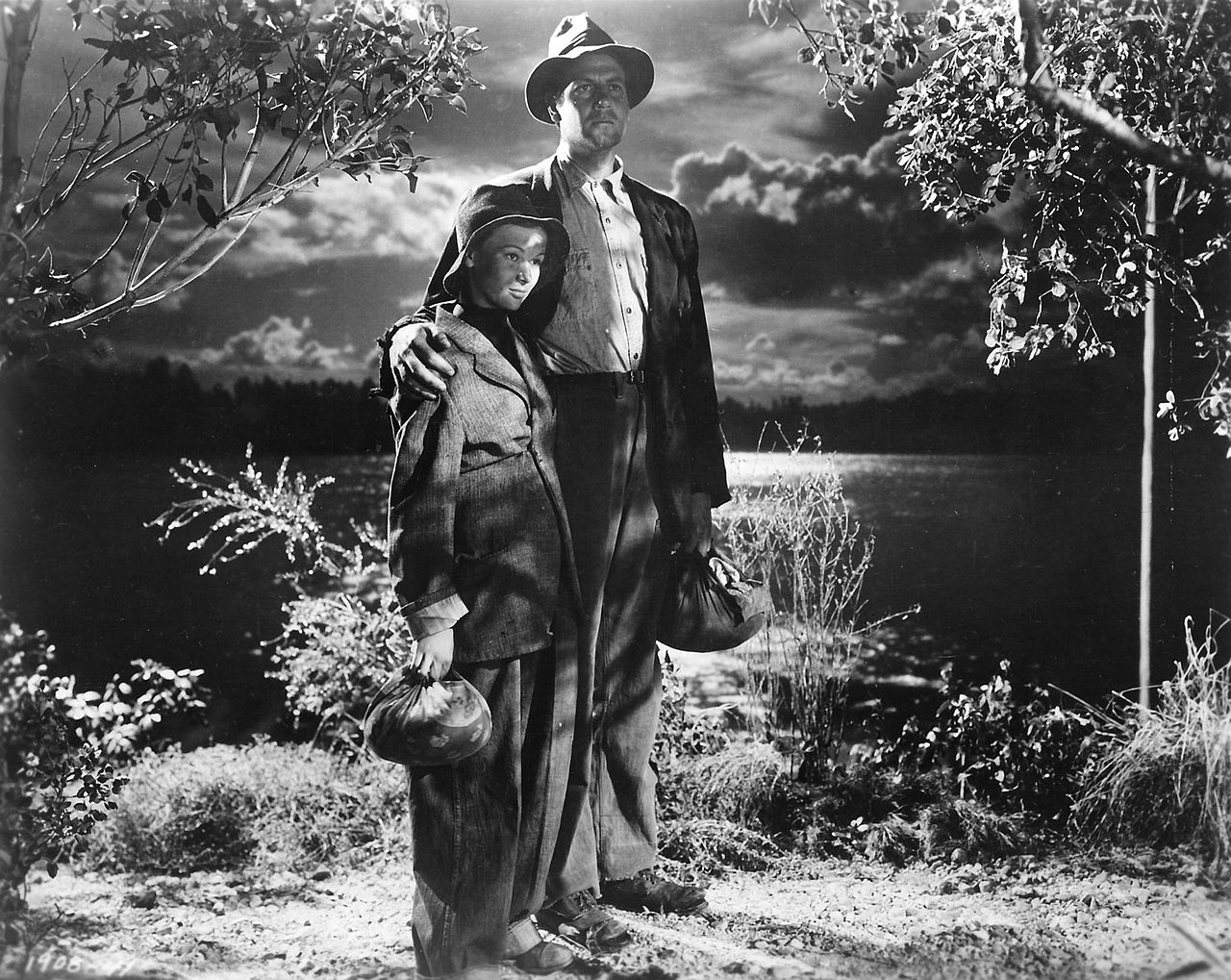
Image context: the lead image uses a 1942 Paramount promotional still, preserved on Wikimedia Commons from National Board of Review Magazine.[8] It fits this essay because the film's central problem is already visible in the pose: Joel McCrea's director and Veronica Lake's unnamed Girl look like partners in a road picture, but the movie keeps asking whether that partnership belongs to life or to performance.
The hobo costume never becomes truth; it stays costume, and that is the point
The sharpest formal joke in Sullivan's Travels arrives almost immediately.[5][6] Sullivan does not begin his research by losing status in some irreversible way. He begins by getting dressed for the role. AFI's synopsis is blunt about it: he hits the road in a hobo outfit from the studio costume department, already turning social inquiry into wardrobe selection.[6] That detail matters because Sturges wants the audience to feel the fraudulence before Sullivan fully does. The costume is not a bridge into experience. It is a reminder that Sullivan's first instinct is to approach misery as something representable.
Sturges could have played the disguise as a simple comic engine, but he keeps making it structurally important.[1][3][5] Sullivan's experiment is compromised at the exact point of origin because the film industry has supplied him with a ready-made visual code for hardship. Poverty arrives to him already stylized, already available for use. The costume looks practical enough to move the plot, yet it never stops carrying the faint absurdity of rehearsal clothes. Even when Sullivan is sincere, sincerity keeps wearing quotation marks.
This is where Sturges's writing and casting become exact.[5] TCM notes that Sturges wrote the script with Joel McCrea in mind, counting on his low-key earnestness rather than on a flamboyant comic persona.[5] McCrea's plain sincerity makes the costume funnier and sadder at once. Sullivan is not a cynic pretending to care; he is a serious man who does not understand how deeply performance has entered his own way of seeing. Because McCrea plays him straight, the costume reads less as malicious fraud than as a professional reflex. He thinks movies can help him get to reality, and Sturges keeps showing that movies are the screen through which he already perceives it.
The land yacht turns social concern into a production convoy
If the costume is the film's first formal correction, the land yacht is the second.[3][5][6] Sullivan wants to travel like a poor man, but a giant support machine follows him with a doctor, a photographer, a reporter, a secretary, and a chauffeur.[6] The image is too oversized to function merely as a gag. It is the whole studio system on wheels, a rolling proof that privilege does not disappear because its owner wants an educational weekend. The convoy makes experience impossible to separate from coverage.
This is also why so much of the opening movement feels brisk, argumentative, and unstable rather than solemn.[3][5] Stuart Klawans describes Sturges's dialogue as a kind of rapid ping-pong, and the effect matters here because the movie refuses to let Sullivan settle into the dignity of his mission.[3] Every time he imagines he is moving toward stripped-down knowledge, the apparatus swarms back in. The land yacht converts the road into a back lot extension. Escape keeps curving into publicity.
Stephen Winer's Criterion piece is useful on this point because it frames Sullivan's route as a passage through film genres rather than through untouched reality.[4] The slapstick chase with the caravan is not a detour from the movie's argument. It is the argument in comic form. Sullivan claims he is done with lightweight entertainment, yet his first research trip throws him directly into the sort of Keystone-style pursuit his own seriousness supposedly rejects.[4] Sturges does not lecture him about contradiction. He engineers the contradiction as movement.
The result is that Hollywood gravity becomes one of the film's chief techniques.[3][4] Sullivan keeps trying to go outward, downward, or deeper, and the film keeps showing how class position and movie form pull him back toward where he started. Even when he reaches more vulnerable ground, it is after failed departures, false starts, and returns. The land yacht is funny because it is ridiculous. It is memorable because it is the movie's physical diagram of privilege refusing to detach itself from conscience.
The film's middle pivot works because Sturges removes chatter before he makes his point
The movie's most impressive craft decision is tonal rather than verbal.[1][3][4] For much of its first hour, Sullivan's Travels runs on speed: smart dialogue, busy reversals, elastic side characters, and the flirtatious instability that arrives when Veronica Lake's Girl joins the picture.[1][2][5] Then Sturges starts subtracting. Winer notes that the movie eventually strips away the banter, moves through a long dialogue-light montage of poverty, and finally removes the Girl herself before pushing Sullivan into the chain-gang section.[4] That subtraction is what gives the last act force.
A lesser film would have argued for seriousness by inserting speeches earlier and more often. Sturges does something harder. He changes the pressure system.[3][4] Once the shantytowns, missions, and prison labor enter, the movie no longer depends on verbal brilliance to carry us forward. It depends on duration, fatigue, and exposure. The silent or near-silent passages matter because they show Sturges can actually stage the hardship Sullivan wants to appropriate. The film does not merely mock social realism from a safe distance. It proves it can enter that register and survive there.
That move also protects the ending from sentimentality.[3][4][6] By the time Sullivan arrives at the church screening, the movie has already passed through humiliation, bodily danger, and institutional cruelty. We do not hear the case for comedy first and then receive an illustrative example. We live through the dark material, and only then does Sturges let cinema appear as relief. The order is everything.
The church laughter sequence turns the argument about comedy into a concrete image
The church screening is the moment everybody remembers, and rightly so, but its power is technical before it is philosophical.[3][4][7] TCM identifies the cartoon as Disney's Playful Pluto (1934), the short watched by the chain gang and the Black congregation together.[7] What matters is not simply that the cartoon is funny. What matters is how Sturges stages the room. After so much wandering, beating, misrecognition, and confinement, the film narrows its attention to faces responding in time with one another. Laughter ceases to be an abstract defense of popular entertainment and becomes an event shared across exhaustion and social division.
Klawans is right that the film cannot be reduced to a neat credo about "making people laugh."[3] The ending lands because Sturges has made that laughter costly. He has taken Sullivan through a movie full of false starts, apparatus, slapstick parody, road-romance texture, social melodrama, and prison-film severity before allowing this one pocket of release. The church sequence does not erase the surrounding hardship. It suspends it just long enough to show what cinema can distribute when it is not pretending to be pure instruction.
That is why the final speech works better than it should.[1][3][4] If Sullivan's Travels were only a plea for light entertainment, it would be much thinner and much smugger. Instead Sturges spends the whole picture sabotaging Sullivan's fantasy that one can simply walk into poverty, extract truth, and carry it back to the studio untouched. The costume keeps looking like costume. The land yacht keeps dragging the industry into frame. The dark middle section refuses easy irony. By the time laughter arrives in the church, it does not feel like a slogan. It feels like the one thing in the movie that has finally stopped posing as something else.
That is the film's real technical triumph.[1][2][3][4] Sturges makes a movie that keeps puncturing its own sermon and therefore becomes more convincing, not less. He understands that comedy can only argue for itself honestly after passing through embarrassment, failed seriousness, and the visible machinery of representation. Sullivan's Travels does not choose between message and entertainment in any simple way. It shows how movies stumble between them, borrow from both, and occasionally, in one dark room full of people laughing at the same cartoon, justify themselves.
Sources
- BFI, "Sullivan's Travels (1941)."
- The Criterion Collection, "Sullivan's Travels" film page.
- Stuart Klawans, "Sullivan's Travels: Self-Portrait in a Fun-House Mirror," The Criterion Collection.
- Stephen Winer, "Laughter Behind the Screen," The Criterion Collection.
- Rob Nixon, "The Big Idea - Sullivan's Travels," Turner Classic Movies.
- AFI Catalog, "Sullivan's Travels" production and synopsis record.
- Rob Nixon, "Pop Culture 101 - Sullivan's Travels," Turner Classic Movies.
- Wikimedia Commons, "File:Sullivan's-Travels-1942.jpg" — Paramount promotional still published in National Board of Review Magazine (January 1942).