Spoiler note: this article discusses the trial strategy, the verdict, and the film's final scene.
Otto Preminger's Anatomy of a Murder is usually filed under courtroom classics, which is correct and still not quite precise enough.[1][2][3][4] The film is certainly about a murder trial: small-town Michigan lawyer Paul Biegler agrees to defend Army lieutenant Frederick Manion after Manion kills the tavern owner he says raped his wife Laura.[3][4] But what makes the picture last is not simply the case outline or the famous frankness of its language. It is the way Preminger turns legal process into an atmosphere. Facts never arrive as stable blocks. They come through blinds, hallways, bar conversations, medical testimony, improvised strategy, and bodies performing conviction in public.
That atmosphere is grounded in a very specific production logic.[1][2][3][4] Museum and archive records converge on the same basics: Otto Preminger directed the film in 1959, the setting is Michigan's Upper Peninsula, and the production was unusually committed to real locations rather than a fully abstracted courtroom set.[1][2][4] AFI's production history fills in the material side: the film shot in the Ishpeming-Marquette area where the real case had unfolded, used Voelker's actual law office for Biegler's, and filmed courtroom scenes in their real counterparts.[4] This matters because Anatomy of a Murder never looks like a sealed studio morality play. It looks worked-on, drafty, provisional. Even before the witnesses begin contradicting one another, the world itself feels built out of partial access.
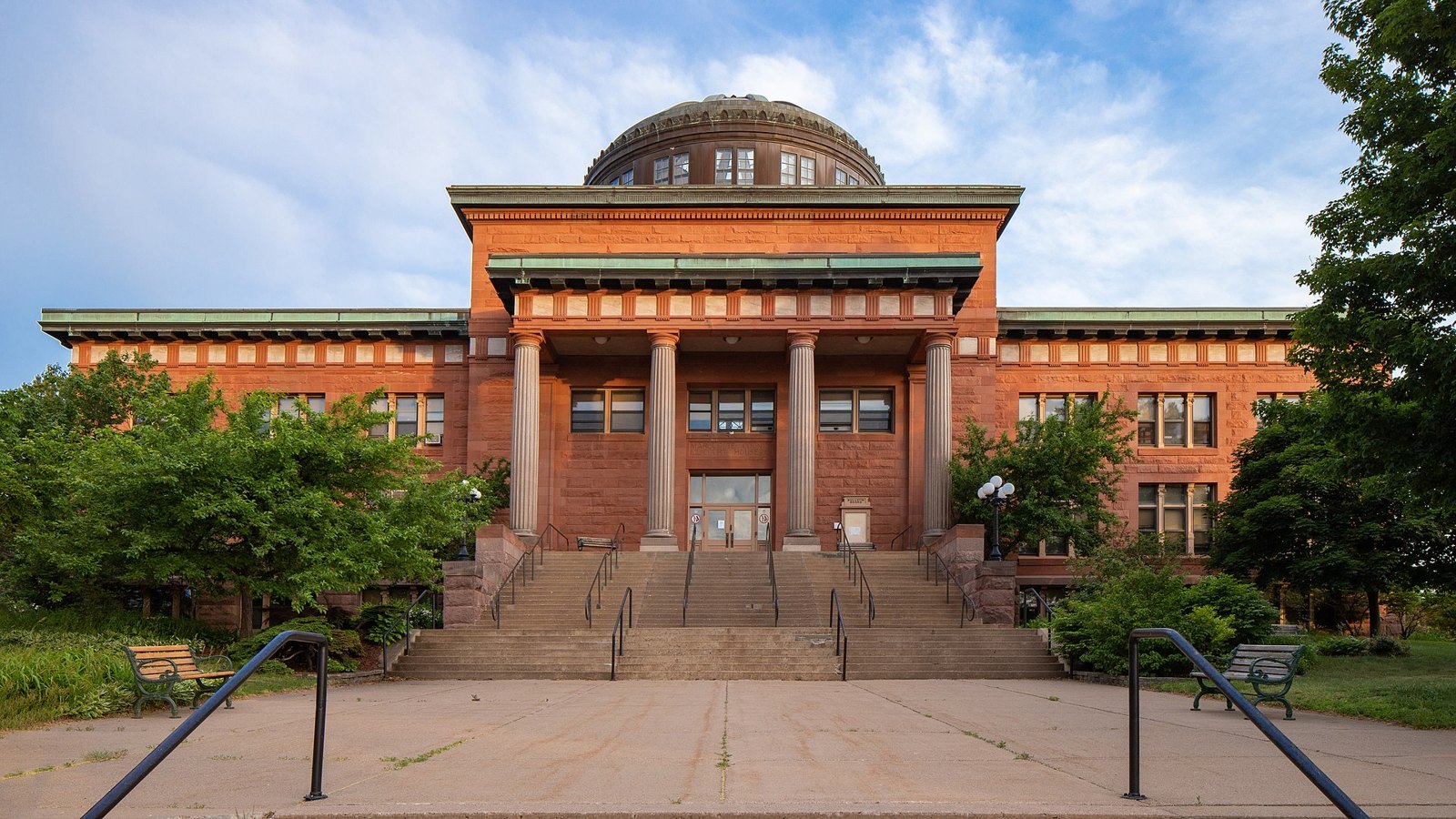
Image context: the lead image uses a Wikimedia Commons photograph of Marquette County Courthouse in Michigan.[5] It is the right image for this essay because the movie's argument about law depends on real Upper Peninsula space as much as on courtroom performance. Preminger's locations let the trial feel public, drafty, and locally inhabited before language, posture, and doubt begin to circulate.
Venetian blinds make legal knowledge look slatted and incomplete
One of the film's quiet visual ideas is that Biegler never works in clean, all-revealing light.[2][4] His office is full of practical clutter: fishing tackle, books, papers, local maps, a desk that looks used rather than ceremonial. The venetian blinds matter because they keep cutting the space into bars and strips. Information in this film rarely arrives head-on. It is filtered, segmented, and made provisional before it can ever become argument. That visual texture suits Biegler, who is less grandstanding crusader than pragmatic arranger of fragments.
The office scenes push law away from abstract certainty and toward practical arrangement.[1][4] Biegler does not discover truth in one flash. He circles it, tests phrasing, worries at boundaries, and tries to convert muddy life into something a courtroom can recognize. The blinds become a visual equivalent of that labor. They do not hide everything, but they do deny total visibility. The case keeps being seen in strips.
This is also why the film's famous attention to language matters so much.[2][4] The trial turns on what can be named, what can be smuggled into admissible speech, and what kind of mental state the defense can make the jury inhabit. AFI notes the film's conflict with censors over words that American movies had rarely spoken so directly by 1959.[4] Preminger's boldness here is not shock for its own sake. The legal system in Anatomy of a Murder depends on verbal precision, euphemism, and controlled exposure. Words, like the office light, arrive already filtered.
Duke Ellington's jazz score turns procedure into improvisation under pressure
The other great medium of uncertainty is sound.[3][4] Eye Filmmuseum's program note foregrounds two details that still matter: the film's controversy in its own day and Duke Ellington's music-and-cameo presence inside the picture.[3] AFI likewise notes that this was Ellington's first feature-length film score.[4] Ellington's music does not tell the audience what verdict to prefer. Instead it loosens the edges of the procedural world. The score swings, strolls, and lingers. It makes the film feel less like a march toward truth than like an improvisation conducted inside formal constraints.
That musical choice changes how Biegler reads.[2][3] James Stewart's lawyer is shrewd and performative, but he is never filmed as a machine of pure command. He fishes, wanders, jokes, rehearses, and listens. Ellington's cues suit a character who thinks tactically and rhythmically. A jazz solo advances by testing phrases against structure; Biegler advances by testing theories against witnesses, jurors, and the judge's tolerance. The courtroom, in that sense, is not the opposite of improvisation. It is improvisation with rules and penalties.
The score also prevents moral simplification.[3][4][6] Anatomy of a Murder is now enshrined in the National Film Registry, and part of the reason is that it refuses the false comfort many prestige legal dramas offer.[6] Ellington's music helps preserve that refusal. It gives the film urban wit, but also drift. Even when the defense appears to be consolidating, the score keeps a remainder of looseness in the air. We are not moving toward clean catharsis. We are moving through a process that may produce an outcome without resolving the people inside it.
The courtroom is a theater of posture before it is a chamber of truth
Preminger understood that trials are performances without reducing them to mere fraud.[2][4] AFI's catalog note about Joseph N. Welch is revealing: the judge is played by the lawyer whose "Have you no sense of decency?" line during the Army-McCarthy hearings had already entered public memory.[4] That casting decision gives the courtroom an extra layer of self-awareness. Authority here is not abstract. It is embodied, voiced, staged, and recognized socially. The law in Anatomy of a Murder works through ritualized public behavior.
The film keeps returning to the way bodies occupy this ritual.[2][3][4] George C. Scott's Claude Dancer does not merely offer arguments; he slices the room with polish and timing. Stewart's Biegler plays avuncular local ease against that metropolitan sharpness. Witnesses lean, evade, flirt, freeze, or overperform. Preminger's long, patient camera placements let the viewer watch these shifts without insisting on one simple reading.[2] The courtroom becomes legible as a place where persuasion depends on tempo, bearing, and the management of embarrassment as much as on factual content.
This is where the film's treatment of Laura Manion becomes especially unsettling.[2][3][4] The movie understands that the trial cannot discuss sexual violence without simultaneously converting Laura into a spectacle. Her gestures, clothes, language, and smile are all pulled into competing legal narratives. Preminger does not rescue the audience from that discomfort. He keeps showing how the system needs a body to interpret and then punishes that body for being interpretable in too many ways. The courtroom is public reason, but it is also a marketplace of performed credibility.
The acquittal lands like a transfer of uncertainty, not a clearing of it
The most modern thing in Anatomy of a Murder may be its refusal to celebrate closure.[1][3][4] Preminger elides the attorneys' closing statements and smothers the expected catharsis of the resolution. Instead of a majestic summing-up, the film gives us an acquittal that immediately starts leaking confidence. The Manions do not become vindicated citizens restored to ordinary life. They disappear, leaving Biegler with an unpaid bill, a note, and the sour knowledge that legal success has not produced moral clarity.
That ending is why the phrase "reasonable doubt" matters so much here.[2][3] In lesser courtroom dramas, reasonable doubt can sound like a heroic breakthrough, the instant when one brilliant mind shatters false certainty. In Preminger's film it feels more like an exhausted legal corridor that everyone has walked down because no cleaner route was available. Biegler wins by constructing a version of mental state the courtroom can live with. The verdict confirms that the construction held. It does not prove the world outside the courtroom has become less murky.
That is why the film still feels so bracing.[1][2][6] It is famous for frank speech, for Ellington, for James Stewart working against his own moral authority, and for Preminger's calm command of institutional space.[1][2][3][4] But its deeper achievement is tonal. Anatomy of a Murder teaches the audience to inhabit unresolvedness without mistaking it for vagueness. The blinds stay half-open. The jazz line keeps moving. The courtroom clears no one completely. What remains at the end is not truth triumphant, but the distinctly modern sensation that a system has rendered a verdict while life continues to withhold a final answer.[2][4]
Sources
- BFI, "Anatomy of a Murder (1959)" film page.
- Australian Centre for the Moving Image, "Anatomy of a murder" collection entry.
- Eye Filmmuseum, "Anatomy of a Murder" program page.
- AFI Catalog, "Anatomy of a Murder" production and release history.
- Wikimedia Commons, "File:Marquette County Courthouse Michigan 20220620-7156.jpg" — courthouse photograph file page.
- Library of Congress, "Complete National Film Registry Listing."