

Every production decision acquires a price as it moves toward the camera. A sentence can be revised in seconds. A sketch costs more, but a built set, booked location, animated crowd, or effects shot ties the same idea to crews, schedules, and money. The storyboard occupies an unusually forgiving point in that progression: concrete enough for collaborators to challenge, cheap enough to discard.
That makes the board closer to rehearsal than blueprint. It converts a proposed scene into a visible sequence that can be timed, compared, and challenged. The Fondazione Prada's survey of storyboards describes them as flexible working documents meant to circulate, be copied, consulted, and modified across production; the BFI similarly emphasizes the form's mixture of individual drawing and collective filmmaking.[3][4] The roughness is functional. Before production locks in bigger commitments, a few marks can expose a missing reaction, an impossible camera position, a dead patch of rhythm, or an idea whose cost exceeds its value.
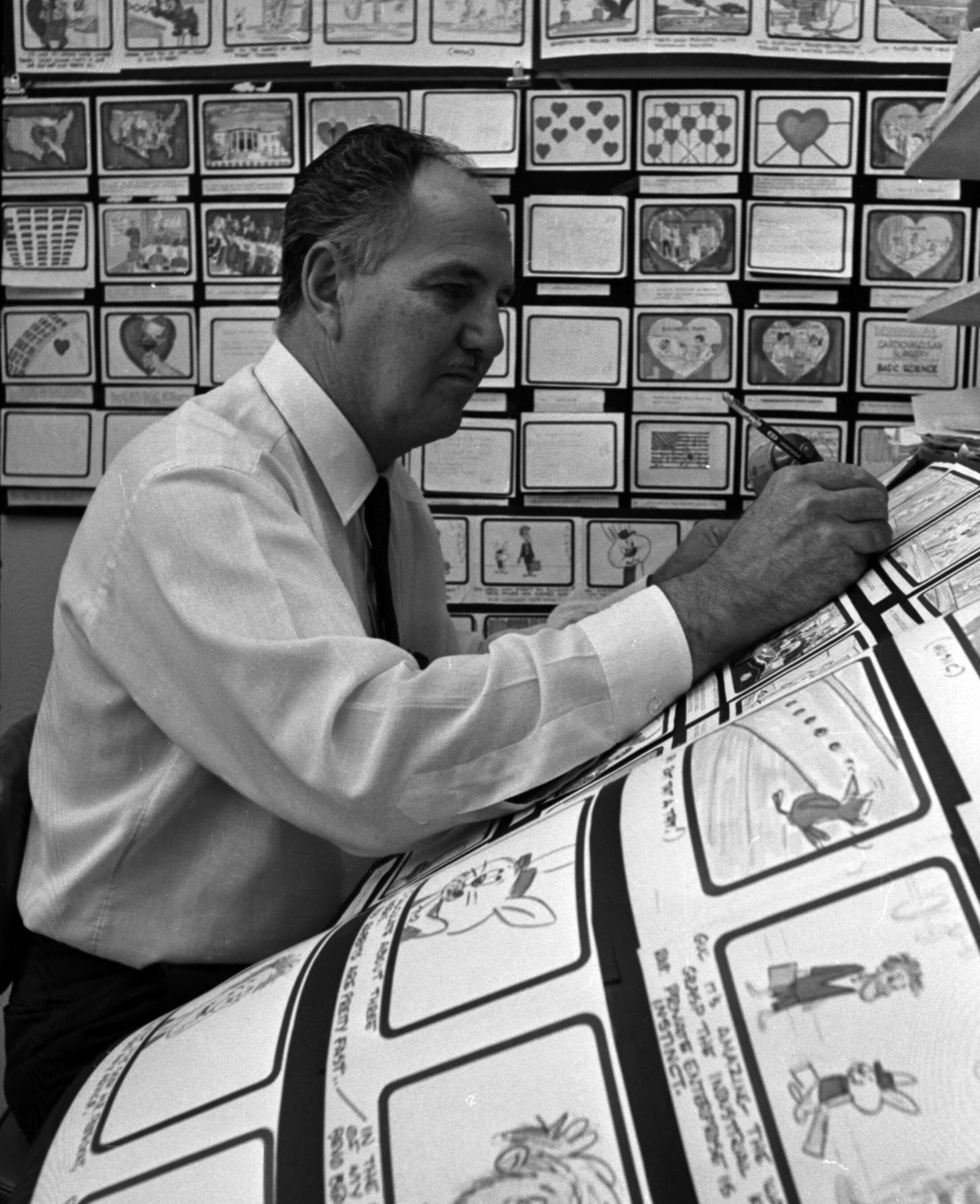
The 1967 cover photograph shows production supervisor Carl Urbano bent over just such a working surface at Hanna-Barbera, with a run of panels standing behind him.[8] Nothing about the scene suggests a sacred object. The images are arranged for use. They make duration spatial, so a filmmaker can look backward and forward at once, compare one beat with the next, and alter the movie before the movie becomes difficult to move.
The two videos below approach that freedom from opposite ends of the craft. In a 1978 American Film Institute seminar, Steven Spielberg describes crude director-drawn sketches passing to an illustrator, changing on set, and sometimes dying for budgetary reasons.[1] Sony Pictures Animation's short featurette on story artist Chase Conley makes the later chain visible: loose digital lines, clearer poses and staging, and finished images from GOAT keep answering one another.[2] One video explains why a plan must remain permeable. The other shows how much performance a rough line can already contain.
Steven Spielberg: draw the decision, not the polish
The AFI clip begins with a useful question: after storyboarding Duel, had Spielberg become more willing to deviate from his boards? His answer refuses the easy choice between rigid planning and pure spontaneity. Around 0:16, he describes making his own original sketches—stick figures with enough perspective and depth to establish the idea—then giving them to a professional illustrator. The director does not need to render a persuasive picture. He needs to identify the decision the picture must carry.[1]
At roughly 0:30, Spielberg demonstrates the information inside an apparently primitive drawing. A figure belongs in the foreground, another in the middle plane, a group or ship in the distance; arrows and color notes specify how light should behave. Composition is being separated from finish. The sketch establishes relations—near and far, movement and pause, one color meeting another—while leaving an illustrator room to make those relations legible to the crew.[1]
The most revealing passage arrives around 1:16. Spielberg recalls having time to sit with illustrator George Jensen, draw pictures, discard them, and decide that only some were worth shooting. Jensen could then continue on set, where an actor's behavior or an unexpected feature of the location might advance the concept. The storyboard therefore survives contact with reality because it is not treated as reality's replacement. It is a common surface on which the next discovery can register.[1]
Even a highly developed board remains vulnerable to economics. Near 1:38, Spielberg mentions hundreds of committed drawings for Jaws and about 1,500 for Close Encounters of the Third Kind, then describes an elaborate Close Encounters sequence discarded because the film was already too expensive. The abandoned sequence is not proof that the preparation was wasted. Drawing it made the cost and dramatic contribution comparable before production spent still more money trying to discover the same answer with physical effects.
There is also hidden authorship in this exchange. Spielberg supplies stick figures, planes, arrows, and the originating concept; Jensen translates them into images a larger production can use. The BFI notes that storyboard artists often retain a meaningful claim on a film's look while remaining less visible than directors, writers, and performers.[4] Calling the board a director's vision is only half true. The useful version of that vision is already an interpretation, sharpened by another person's hand.
Chase Conley: make the rough line act
Sony's GOAT featurette moves from explanation to demonstration. Story artist Chase Conley appears between shots of a stylus crossing a tablet, rough panels, blocked character forms, and finished arena images. The edit never presents polish as a magical leap. It keeps returning to the intermediate decisions that allow a pose, camera angle, and action beat to survive translation from drawn line to screen.[2]
Watch the first minute for economy rather than resemblance. The opening hand does not describe fur, fabric, light, or a finished arena. It searches for a body's directional force. A skeletal pose becomes a more coherent figure; the featurette then cuts into modeled and finished material where mass, texture, atmosphere, and secondary motion have arrived. Those additions are enormous, but they do not replace the first question: can the viewer immediately read what this body is doing and why the next image follows?
Around 1:30, colored strokes block a player, backboard, ball, and directional path before the featurette cuts to a completed dunk. The board's achievement is not that every contour matches. It has already solved the dramatic geometry: where attention begins, which body owns the vertical movement, how the rim supplies a target, and where the camera must sit for impact to read. Later, near 2:33, a crowded drawing organizes overlapping figures before the corresponding finished action fills the space with color and material detail.[2] The rough panel is sparse because it is ranking information.
That ranking is labor, not shorthand magic. An Animation Guild breakdown of professional board work lists background, acting, camera action, timing, staging, composition, emotional beats, continuity, and transitions among the responsibilities a panel may have to carry. It also distinguishes thumbnail, rough, and cleanup as separate passes, each resolving a different level of uncertainty.[6] The finished GOAT images make the board look simple only because modeling, layout, animation, effects, lighting, and editorial have honored and elaborated its choices.
Conley's section also corrects a common misunderstanding about drawing skill. Expressive draftsmanship matters, but virtuoso finish is not the governing test. A board must make an action pitchable. It has to let collaborators feel the pose's intention, challenge the camera, adjust the timing, or ask for a different reaction. A beautiful panel that conceals a weak transition is less useful than a rough one that makes the weakness impossible to ignore.
The gap between board and frame is evidence
Storyboarding has long offered filmmakers a place to rehearse with consequences suspended. The Deutsche Kinemathek describes a remarkable 1932 German “paper film”: 296 drawings mounted along a 75-meter strip, with separate columns for dialogue, direction, camera, and music. Its inexperienced director could test the filmmaking economically on paper.[5] The tools differ from Conley's tablet, but the operating idea is the same. Sequence turns imagination into something countable, movable, and open to response.
Nor does the board stop mattering when drawing ends. Fondazione Prada's account follows storyboards through preproduction, shooting, editing, and effects.[3] A recent Disney production history gives a concrete example: the directors of Once Upon a Studio turned their panels into a rough editorial cut while producers were already mapping live-action plate photography, staffing, and a huge returning voice cast.[7] The board was simultaneously a story test and a logistics trigger. Once images had duration and order, other departments could see when their work would be needed.
This is why differences between panel and finished frame deserve as much attention as matches. A shifted camera may record what a location offered. A changed gesture may come from a performer or animator. A simplified effect may reveal a budget judgment. A cut panel may mean the sequence found its point sooner. Fidelity can prove that an early choice endured; deviation reveals the conversation that tested it.
Seen together, Spielberg and Conley make a board's real purchase clear. It buys disagreement before disagreement becomes a reshoot. It buys specificity without demanding expensive detail. It gives director, artist, editor, performer, camera department, animation team, and producer a shared object that can be questioned without mistaking any one version for the film itself.
The archival photograph of Urbano preserves the physical labor that finished movies usually absorb: the hunched body, the drawing surface, the adjacent panels, the sequence held still long enough to think.[8] Once the movie works, that surface may vanish into a seamless scene. The storyboard's most cinematic act is often its own disappearance—but first it gives the film somewhere safe to fail.
Sources
- American Film Institute, “Steven Spielberg On Storyboarding (1978),” YouTube video — director sketches, illustrator collaboration, on-set revision, and abandoned plans.
- Sony Pictures Animation, “GOAT | The Art of Storyboarding with Story Artist Chase Conley,” YouTube video — digital drawing, action staging, and board-to-finished-shot comparisons.
- Fondazione Prada, “A Kind of Language: Storyboards and Other Renderings for Cinema,” 2024 exhibition dossier — storyboard history, circulation, revision, and uses across production stages.
- Chris Pallant, “From Star Wars to George Orwell: why storyboarding matters,” BFI, September 29, 2016 — collaborative authorship, archival evidence, and the material flexibility of boards.
- Deutsche Kinemathek, “Storyboards from Hitchcock to Spielberg” — storyboard function, early German “paper film,” camera notation, and economical rehearsal.
- Steve Hulett, “Storyboard Deadlines … Storyboard Timelines,” The Animation Guild, March 16, 2016 — a veteran artist's breakdown of staging, acting, camera, continuity, timing, drawing passes, and revision labor.
- The Walt Disney Company, “Celebrating the Artistry and Technology Behind Disney Animation's Once Upon a Studio,” October 10, 2023 — panels turned into a rough cut while production logistics took shape.
- Steve Fontanini, “Carl Urbano working on a storyboard, 1967,” Los Angeles Times Photographic Collection at UCLA Library, via Wikimedia Commons — archival photograph metadata and attribution.