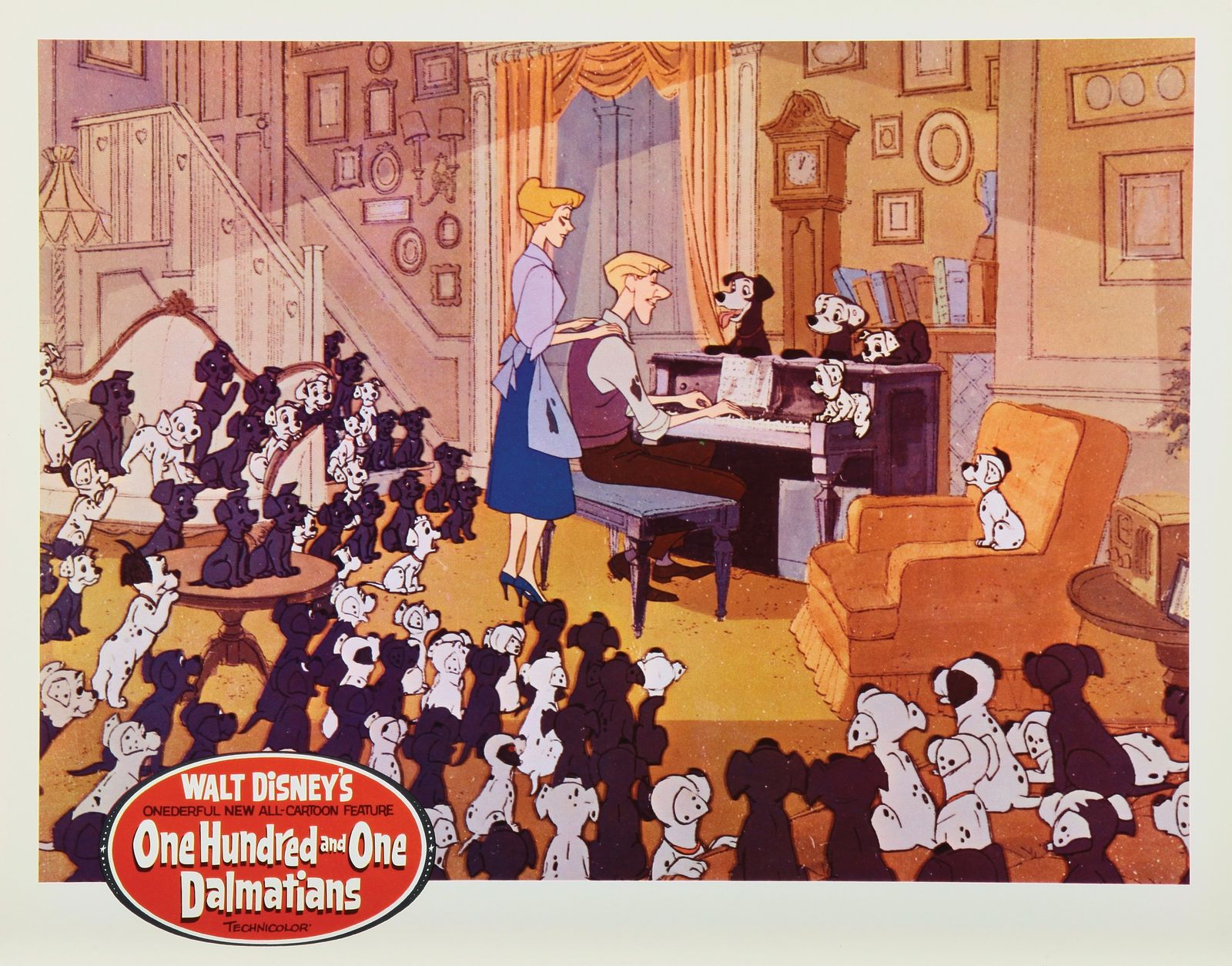
Look at the sitting room in One Hundred and One Dalmatians and the black line seems to have acquired a nervous system. It bunches around the puppies' ears, trembles along the piano, doubles back through picture frames, and refuses to disappear into the paint. Sometimes color sits neatly inside it. Sometimes the two drift just far enough apart to make the room feel drawn rather than sealed.
That visible line is the residue of an industrial decision. Disney's 1961 feature was the first to use the studio's xerographic cel process from end to end, after tests in parts of Sleeping Beauty and throughout the short Goliath II.[1][4] Xerography removed the hand-inking stage that had stood between an animator's drawing and a photographed cel. It reduced a costly production bottleneck, but it did not simply make the old process faster. It changed which hand reached the screen, which imperfections survived, and how an entire movie could be designed.
The result is best understood neither as a copier trick nor as a story in which automation magically “saved” animation. It was a new production interface. Pencil pressure became photographic information; resin powder had to adhere to acetate without ruining it; painters still supplied color; artists had to coordinate spots; and art direction had to make a dark mechanical line belong in every room. Dalmatians looks modern because its pipeline is visible.
Image context: the lead image is an archival promotional still for the 1961 film, not a later remake or fan reconstruction. Its crowded living room is especially apt here: repeated spotted bodies test the process at scale, while the room's loose black contours show how character and background linework were made to speak the same graphic language.[1][3]
The old line was a relay
Before xerography, a finished Disney line passed through several forms. An animator drew in pencil on registered paper. A skilled inker placed a clear cellulose-acetate cel over that drawing and traced it in ink. A painter then worked on the reverse, filling the outlined shapes with specified colors before the layered cels and background were photographed.[2][3]
Calling the inker a “copyist” understates the job. The trace translated variable graphite into a controlled contour: different colors, weights, and thicknesses could soften an edge, separate forms, or keep an outline from calling attention to itself.[3] The finished frame retained the animator's movement, but its surface arrived through another practiced hand.
Xerography cut that handoff out. Ub Iwerks's patent description states the economic aim plainly: a xerographic copy of the original sketch could be transferred directly to a cel, eliminating manual tracing while retaining some shading effects that tracing might lose.[2] Painting did not vanish, and neither did cleanup, registration, photography, or checking. What disappeared was a specific interpretive relay between drawing and cel.
That boundary matters because “direct” is not the same as untouched. The animator's drawing still had to be prepared well enough to reproduce. The machine still selected information according to exposure, powder, transfer, and fixing. Yet fewer translations separated the originating gesture from the projected contour. The screen could now keep a dark jab, a doubled exploratory mark, or a slight change in pressure that a polished ink line might regularize.
A copier had to become an animation machine
The production process was more exacting than placing a drawing on an office copier. Iwerks's xerographic-fusing patent, derived from an application first filed in July 1957, describes a charged photoconductive surface exposed to the drawing. Light created an electrostatic latent image; resinous powder developed that image; the powder was transferred to cellulose acetate and then fixed to the cel.[2]
Fixing was the difficult interface. Heat could deform or destroy acetate, so the patent used controlled solvent vapor to soften and bind the powder. Too little exposure could leave an image unfixed; too much could fog or wet the transparent support. Even the invisible part of the system therefore had an aesthetic consequence. A projected line depended on controlling chemistry closely enough that it stayed sharp while the cel stayed clear.[2]
This technical history also corrects an easy chronology mistake. The relevant patent was granted in 1964, three years after the feature's release, but its underlying application dated to the experiments of the late 1950s.[2] The legal document is evidence of a developing process, not the moment a finished invention suddenly appeared. Disney tested xerography in production before committing an entire feature to it, and Queensland Museum describes the method as a joint development involving the studio, Xerox, and Iwerks.[1][4]
The chosen film made the wager unusually legible. A story packed with black spots and crowded dog bodies magnified the cost of transferring thousands of contours by hand. Xerography did not generate the poses or decide where the spots belonged. It made each approved drawing reproducible on cel without asking an inker to redraw every edge.[1][4][5]
The limitation became the house style
The new line carried a tradeoff. Light pencil marks could disappear, while surviving marks tended toward strong black. The Walt Disney Family Museum records the animators' pleasure at seeing more of their own drawing on screen, but it also records Walt Disney's dislike of a contour that announced itself instead of dissolving into the character.[1] Smithsonian's account describes the resulting edge as crumbly and uneven beside the more calligraphic line of earlier features.[3]
Those judgments are not mutually exclusive. Xerography could preserve the energy of a drawing and lose the chromatic delicacy of hand inking at the same time. Its fidelity was selective: closer to the animator's graphite structure, less capable of the softly colored contour that had helped a figure feel unoutlined. The technology did not settle the argument between vitality and finish. It printed that argument into every frame.
Cruella de Vil makes the bargain easy to see. Her angular body, sharp gestures, enormous coat, and volatile entrances benefit from a contour that never becomes polite. But the same line surrounds gentle faces, puppies, chairs, and doorframes. A technique introduced for economy becomes an expressive constant; every object has to live with its pressure.
This is why the film cannot be reduced to “the sketchy Disney one.” Sketchiness here is organized. The dark line works because design, color, layout, and motion accept it as a common condition rather than treating it as damage left by a cheaper process.
Ken Anderson made the background answer back
Production designer Ken Anderson pushed xerography beyond the character cel. Working with color stylist Walt Peregoy and layout artist Ernie Nordli, he had background drawings copied onto a separate cel and placed that line layer over broad painted color fields.[1] The method let a banister, lampshade, or wall frame carry a contour related to the characters' outlines without requiring the color underneath to imitate a fully rendered object.
The occasional slippage between line and color is crucial. A doorframe can be specified by a black drawing while its block of brown sits a little to one side; a staircase can remain spatially clear without every spindle being polished into architectural realism. The eye receives two kinds of information at once: color establishes mass and atmosphere, line supplies structure and agitation.
That division keeps the dogs from looking pasted onto an older Disney background style. The same graphic event that defines a muzzle also defines a chair leg. The film's world appears capable of producing its characters because both are built from compatible layers.[1]
Later Disney features continued to use xerography, but the museum's production history notes that their backgrounds moved back toward a more conventional painted finish.[1] The machine endured; this exact alliance between machine and art direction did not. That difference is a useful industrial lesson. Adopting a tool does not guarantee an aesthetic. Dalmatians became distinctive because artists redesigned the surrounding workflow around what the tool could and could not do.
Copying did not eliminate coordination
The puppies expose the gap between reproduction and control. The Walt Disney Family Museum's account of the film's “Spots” team describes assistants establishing a key spot and tracking the surrounding pattern from drawing to drawing.[5] Xerography could carry those decisions faithfully onto cels, but it could not decide how a turning body should preserve a recognizable coat. The more exact the transfer became, the more important the upstream drawing decisions were.
The climactic vehicles reveal the process's flexibility from another direction. Model maker Dick Lucas built white, black-outlined cars; the models were photographed, their images were xerographically copied to cels, and the cels were painted so the vehicles belonged to the drawn world.[6] Here xerography was not only a shortcut from pencil to acetate. It was an adapter between a three-dimensional model and the film's graphic surface.
Together, the spots and cars prevent a heroic-invention myth. No single machine solved the feature. Human teams maintained continuity, model makers supplied complex motion, painters completed color, camera workers assembled layers, and art direction made unlike sources cohere. Xerography mattered because it altered the junctions among those crafts.
It also altered labor in a less romantic way. The patent frames manual tracing as skilled work whose removal reduced cost.[2] That fact should not be softened into a neutral tale of progress. Efficiency meant that one kind of expertise no longer occupied the same place in the pipeline. The gain in directness for animators and the loss of a large hand-inking stage were two sides of the same redesign.
The economical line became an authored line
The economic pressure was real. The Walt Disney Family Museum reports that Sleeping Beauty cost $6 million and earned $5.3 million during its initial run, after which Disney reduced animation staff. It reports a $14 million box office for One Hundred and One Dalmatians, evidence that feature animation could still function as a profitable part of the company.[1] Xerography was not the only reason—the contemporary story, Bill Peet's concentrated story work, memorable character animation, and broad appeal all mattered—but it changed the cost structure under which those strengths reached the screen.
The technique also escaped the narrow meaning of corporate economy. The BFI National Archive's Xeroscopy, a one-minute experimental British short from 1970, uses xerography as its subject and visual method; the archive explicitly places it in the wake of the process that had removed hand tracing from films such as Dalmatians.[7] A workflow designed to rationalize cel production could become, in another studio and another context, an expressive medium in its own right.
That afterlife clarifies the 1961 film's achievement. The strongest production technologies do not simply disappear behind the image. Sometimes they give artists a new surface to notice. In One Hundred and One Dalmatians, the copied line remains visibly copied, visibly drawn, and visibly negotiated with paint. The movie did not overcome its industrial process to become art. It made the process part of what the art could say.
Sources
- Parker Amoroso, “The Making and Impact of One Hundred and One Dalmatians.” The Walt Disney Family Museum, March 21, 2022 — production economics, early xerography tests, first full-feature use, background treatment, artistic tradeoffs, and legacy.
- Ub Iwerks, “Xerographic Fusing Method,” U.S. Patent 3,148,078 — original 1957 application lineage and technical description of exposure, powder transfer, vapor fixing, cel preparation, and the removal of manual tracing.
- Gia Yetikyel, “How One Hundred and One Dalmatians Saved Disney.” Smithsonian Magazine, June 2, 2021 — ink-and-paint workflow, visual character of the Xerox line, cost context, and the archival promotional image used as this article's cover.
- Queensland Museum, “Technological Advances in Animation | Part One,” October 27, 2022 — museum overview identifying the film as Disney's first feature to transfer animators' pencil lines to cels through xerography and noting the studio–Xerox–Iwerks development context.
- The Walt Disney Family Museum, “Spots.....Spots......Spots,” February 18, 2011 — account of the Spots team's key-spot continuity method and the production-scale Xerox installation.
- Kevin Kidney, “Original Disney Treasures: Movie Models and Miniatures.” The Walt Disney Family Museum, January 13, 2012 — Dick Lucas's outlined vehicle models and their photographic, xerographic, and cel-painted route into the chase.
- BFI National Archive, “Xeroscopy” — archival record for the 1970 Halas & Batchelor experimental short and context on xerography's wider use after its introduction to cel animation.