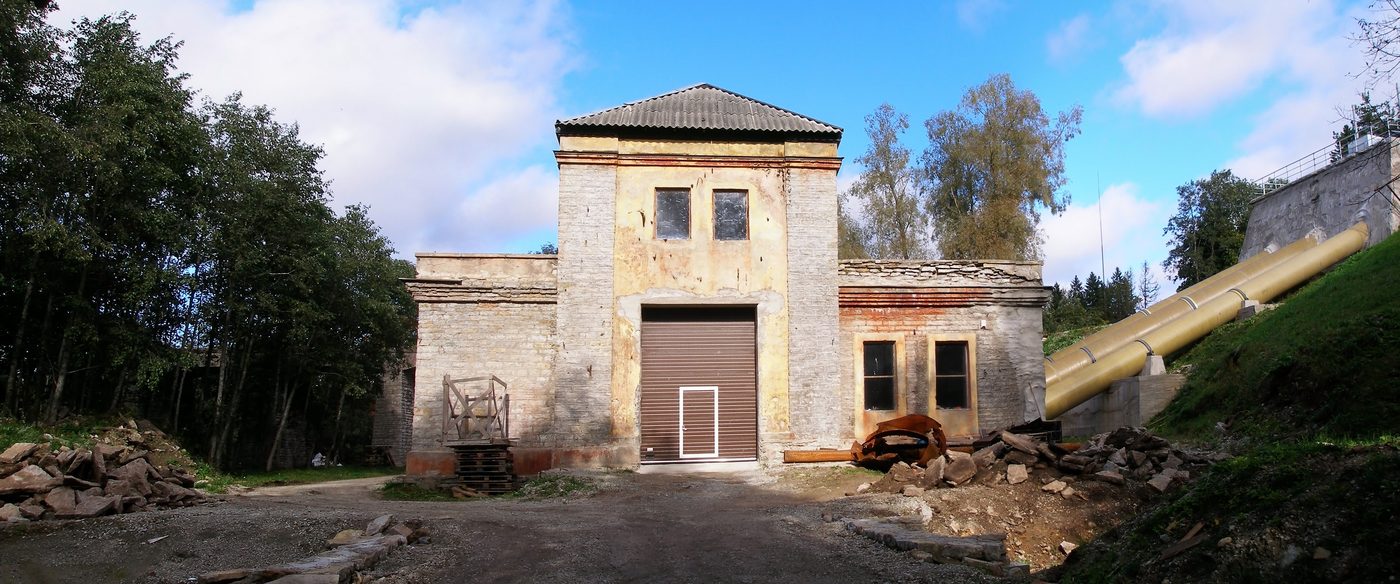
The Zone in Stalker (1979) does not look like a place of wonder. Andrei Tarkovsky and his cinematographer Alexander Knyazhinsky shot mainly in the abandoned water treatment facilities and industrial canals outside Tallinn, in rivers carrying visible contamination, in corridors where long grass had forced itself through cracked concrete.[1][2] That landscape was not art direction. When the original Tajikistan production was destroyed by a flood in 1977 — three weeks of footage lost — Tarkovsky rebuilt the Zone in Estonia because the terrain was already spent: post-industrial, overgrown, carrying the look of aftermath without having to fabricate it.[3]
That practical accident became one of the most precisely realized environments in cinema. Stalker is a film about three men who enter a sealed-off forbidden territory in an unnamed country. A Writer is seeking creative renewal. A Professor carries an undeclared purpose. The Stalker is their guide, a man who has made this journey before and cannot fully explain why he returns. At the Zone's center, a Room is said to grant the deepest unspoken wish of whoever enters. No one enters the Room. The Zone itself is the argument.
The trolley enters the Zone: color as inversion
Stalker opens in sepia monochrome. A cramped apartment. A worn bed. A wife, a child called Monkey, a domestic world rendered in the tones of old photographs — faded, used, already in the past while still present. When the three men cross into the Zone by trolley, the film shifts to color.[1][2]
The inversion is exact. The normal world carries the look of archive; the forbidden landscape arrives as vivid green, water-soaked gray, overgrown ruin in full chromatic presence. Tarkovsky wanted the Zone to feel hyper-real — more materially alive than the exhausted sepia world the characters left behind.[2] The color is not symbolic in a schematic way. It is atmospheric and structural: the Zone is the more present place precisely because it is abandoned. Presence in Stalker belongs to what has been given up on.
The trolley ride into the Zone is long enough to make audiences unfamiliar with Tarkovsky's pace uncomfortable. This discomfort is not incidental. In Sculpting in Time, his collected essays on filmmaking, Tarkovsky described cinema's irreducible gift as the ability to record and transmit time itself — not events inside time, but the actual texture of duration, the specific weight of waiting for something to happen.[4] The trolley enters the Zone at the pace of genuine anticipation. The discomfort is the point of entry.
Water and surface: the archaeology of the Zone
Water is everywhere in the Zone — stagnant in long corridors, flowing under crumbling arches, pooling on broken floors, and at one moment appearing to the Stalker as a place of near-surrender. He lies face down in the shallows. The camera descends to hold on the stones under the water's surface: pages from a book, wire, broken tiles, a syringe, a fragment of Byzantine icon, a calendar, coins, a gun.[1][2]
This extended underwater shot is one of the most discussed images in Tarkovsky's work. It is not decoration. It is an archaeology of what civilization has left behind — sacred object and industrial waste at the same depth, the icon alongside the syringe, nothing ranked above anything else. The Zone preserves without judgment. It does not explain what it holds. It simply holds it, under the same still water, in the same patient light.[1]
A second reading, equally supported by the film, runs in the opposite direction: the Zone is simply a place where the outside world stops providing distraction. Beyond its threshold, there are no roles to perform, no official purposes to announce. The Writer and the Professor both arrive armored — one by the professional self-image of the intellectual, the other by an undisclosed scientific agenda. The Stalker has surrendered his armor. He moves through the Zone in fear and in love, and he is the most afraid of any of them.[2][3]
Tarkovsky's notes on the character describe the Stalker as a man of pure faith — not faith in any institutional or doctrinal sense, but the faith that some places and some experiences deserve a quality of attention we ordinarily spend on less demanding things.[4] The Zone requires exactness. What the Stalker calls traps — the shifting, impassable, suddenly dangerous features of the landscape — are not physical barriers alone. They are failures of being. You cannot move through the Zone as a tourist, an extractor, or a conceptual apparatus. The Zone registers interior state.
The Professor's bomb and the Writer's refusal
What the film withholds, until near the Room, is what the Professor has actually brought with him: a bomb. His declared purpose is the Room's destruction. He does not believe in the Zone's power, but he believes in its danger, and he has decided that a Room that could give anyone their deepest wish should be removed from the world before it grants something catastrophic. His argument is political and philosophical — a genuine one, not a villain's argument.[1][2]
The Writer, for his part, decides he does not want to enter the Room at all. His reasoning is more self-aware and more troubling: he does not trust what his deepest wish might actually be. A man who has spent his career performing the life of a sensitive artist cannot be certain that his innermost desire is what he has advertised to himself. The Room would answer the real question, not the version of it he has been cultivating for public consumption.[2]
This is where Stalker becomes most uncomfortable. Neither the Professor's rational control nor the Writer's practiced sensitivity survives the Zone intact. They argue at the threshold of the Room, and the argument itself is the film's core: not a plot event, but a philosophical confrontation about what it means to want something honestly.[3][4]
The Stalker, who guides others to the Room but never enters it himself, understands this with a certainty that goes beyond reason. His function is not to receive the wish but to make the journey possible for others. His tragedy is that he returns home to a family who sees him as a failure and a fool, to a society that has no use for what he provides, and to a personal faith that grants him nothing but the next expedition.[2][3]
Monkey's gaze and the film's closing argument
The film's final movement returns home. The Stalker arrives back at the apartment. His daughter Monkey, who was born after his first Zone expeditions and whom both parents believe has been marked by the Zone's radiation, sits alone at a table. The Stalker and his wife have decided that she is a cost of his vocation: compromised health, telekinetic ability, a life that will be harder than ordinary lives.[1][2]
The film's last shot is hers. Monkey rests her chin on her hands and looks at three glasses on a table. The glasses begin to move. The camera holds on her face and on the glasses, and then, at the end of the film's long, patient attention, a train passes and the whole building shudders, and it is no longer possible to be certain whether the glasses moved because of Monkey or because of the train or because the film has held its gaze long enough that any movement now carries meaning.[1][2]
Tarkovsky leaves that question open. Whether the Zone is real in the film's physics, whether it grants anything, whether Monkey's gift is consequence or grace — the film refuses to resolve these.[4] What Stalker demonstrates across its entire length, through its tempo and its water and its sepia-to-color inversion, is that clarity of that kind would be a betrayal. The Zone does not clarify. The Zone stays open. That, in Tarkovsky's argument, is the most honest thing cinema can do.
Sources
- BFI, Stalker (1979) — film entry, essays, and programming notes.
- Criterion Collection, Stalker — film and supplementary materials.
- Geoff Dyer, Zona: A Book About a Film About a Journey to a Room. Canongate, 2012.
- Andrei Tarkovsky, Sculpting in Time: Reflections on the Cinema. University of Texas Press, 1989.