Victor Erice's The Spirit of the Beehive begins from a child's question and never fully leaves it behind.[1][2][3] Set in rural Spain in 1940, in the shadow of the recently ended Civil War, the film turns incomplete understanding into its governing form.[2][3][4] Adults speak in fragments, emotional causes arrive late or not at all, and fear enters less as an event than as a texture. That is why Criterion's short video "Observations on Film Art: THE SPIRIT OF THE BEEHIVE - A Child's Point of View" is such a useful anchor.[1] It identifies the real mechanism early: Erice does not merely place a child in the story. He lets the film inherit the limits of what that child can connect.
That distinction matters because the movie is often summarized through its political background or its relation to Frankenstein.[2][3][4] Both are essential, but neither fully explains the film's peculiar hush. The hush comes from focalization. Ana sees gestures, faces, windows, trains, rumors, and absences before she can interpret them. The world reaches her as sensation first and explanation later, if explanation comes at all.[1][3][5] The haunting quality follows from that ordering. Mystery is not layered on top of a stable reality. Mystery is what reality feels like when a child meets adults already trained in silence.
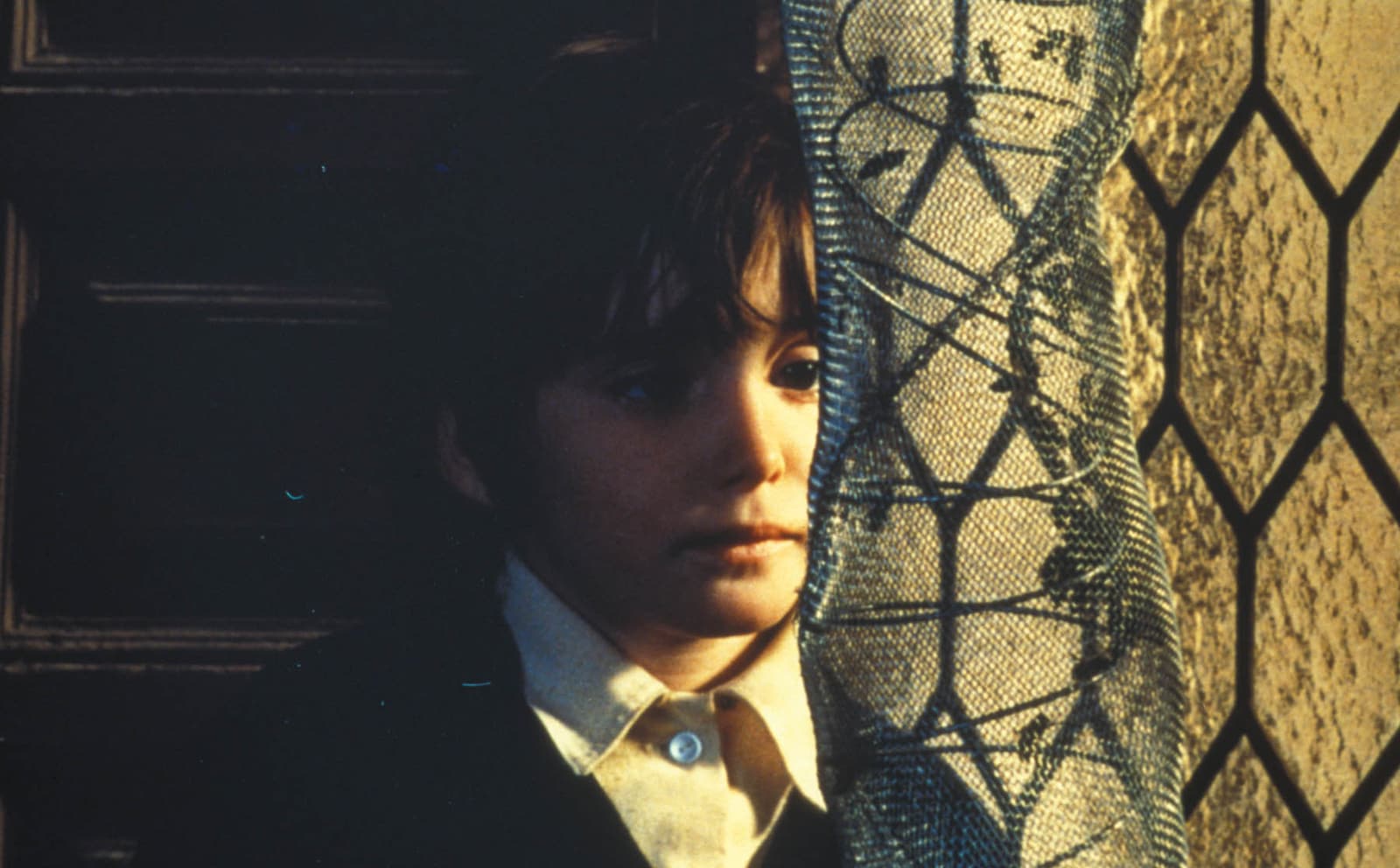
Image context: the cover uses a real Janus still of Ana half-concealed behind a curtain. It is the right image here because the article's claim is that the film's pressure comes from partial visibility: Ana is always looking through, around, or past surfaces that reveal just enough to intensify uncertainty rather than resolve it.[6]
In the video's opening stretch, point of view is treated as a structure, not a theme
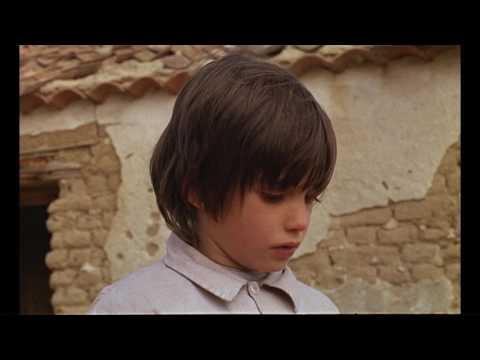
The value of the Criterion piece is that it does not approach Ana's perspective as a sentimental accessory.[1] In its opening movement, the video frames point of view as a formal system: what Ana can see, what she misreads, and what the camera withholds alongside her.[1] That is the correct place to begin. The Spirit of the Beehive is not built around the dramatic revelation of one hidden truth. It is built around uneven access to truth.
That unevenness shapes the movie from the traveling screening of James Whale's Frankenstein onward.[2][4][5] Ana does not experience the monster as a solved literary object or a genre citation. She experiences it as a disturbance that keeps leaking beyond the screen.[4][5] Adults around her can file the image under fiction, instruction, or passing entertainment. She cannot. For her, the movie becomes a method for reading the village itself: if appearances mislead, if death and return are imaginable, if adults answer badly, then perhaps the world is full of beings whose status remains unsettled.
This is where the film's historical setting gains force without needing speeches. BFI's capsule description calls the film an impressionistic distillation of childhood fear and wonder amid the ruins of the recently ended Spanish Civil War.[3] That phrasing is exact because Erice never asks Ana to understand the war discursively. He asks her to inhabit its residue. The residue appears as emotional caution, drained conversation, and a landscape whose emptiness feels occupied by something withheld.[2][3][4]
The middle of the video points toward the film's real genius: adults arrive as fragments before they arrive as people
By the clip's middle section, the argument becomes less about innocence than about partial knowledge.[1] Ana's father is absorbed in his bees and writing. Her mother sends letters outward into absence. Her sister knows more about performance and fear than Ana does, but she also turns that knowledge into games and injuries.[2][4][5] None of these adults is introduced through a clarifying dossier. They reach Ana the way weather reaches a room: as mood, rhythm, and interruption.
That is why the film's famous amber interiors matter so much. They are beautiful, but their beauty is not decorative.[2][4][5] Honeyed light, lace, window grids, and dim corridors make domestic space feel simultaneously sheltered and difficult to read. The house behaves like an emotional filter. It softens surfaces while keeping motives obscure. The title's beehive image is therefore more than metaphor. It suggests a social world made of compartments, labor, vibration, and coded communication, a world that can be sensed before it can be decoded.[2][4]
Seen through Ana, adults become evidence before they become characters. She sees gestures that imply prior histories, disappointments, and political damage, but she does not receive the explanatory file that would sort them. Senses of Cinema is useful here because it stresses how the film binds childhood perception to a larger Spanish atmosphere of memory, secrecy, and aftermath.[5] The child gaze does not remove history. It turns history into pressure on surfaces.
Late in the video, Frankenstein stops being a reference point and becomes Ana's model for contact with the unknown
The later part of the Criterion clip is most revealing when it returns to Ana's belief rather than correcting it.[1] Many adults watching the film want to translate Ana's attachment to the monster back into error: she has confused cinema with life, metaphor with fact. Erice is after something more serious. Ana uses the monster because it is the only figure she has been given that can hold pity, fear, death, return, and exile in one body.[2][4][5]
That is why the encounter with the wounded fugitive lands so hard. The scene does not simply show a child acting out fantasy. It shows fantasy becoming the bridge by which a child can register real violence before she knows the full language of politics.[2][4] The fugitive is not the monster, but Ana's mental route toward him passes through the monster because adult Spain has offered her so little usable explanation. Cinema fills the gap left by official silence.
This is the film's most unsettling achievement. It refuses the easy opposition between imagination and history. Imagination is how history first becomes legible to Ana. The village's empty expanses, the rail lines, the abandoned building, and the offscreen machinery of punishment all remain only partially articulated, yet they acquire shape through the emotional template that Frankenstein leaves behind.[2][3][4][5] The supernatural feeling of the movie is therefore inseparable from political incompletion.
What to watch for after the video ends
On a rewatch, do not ask first whether Ana correctly understands what she sees. Ask what the film gains by letting understanding arrive damaged.[1][4][5] Notice how often Erice frames doors, windows, curtains, and honeycomb patterns as thresholds rather than neutral décor. Notice how adults keep speaking near the child without speaking fully to the child. Notice how the landscape looks open while the emotional life inside it feels sealed. The movie's quiet is active. It keeps converting missing explanation into visual and acoustic tension.
That is why The Spirit of the Beehive feels haunted before anything supernatural appears. The haunting does not come from a ghost entering an otherwise ordinary world. It comes from a postwar world that has already taught itself to communicate obliquely, and from a child who has to build meaning from those oblique signals.[2][3][4][5] Criterion's short video is valuable because it names the formal core of that experience.[1] Child point of view in this film is not softness. It is a precision instrument for showing how historical damage is first learned as atmosphere.
Sources
- CRITERION, "Observations on Film Art: THE SPIRIT OF THE BEEHIVE - A Child's Point of View," YouTube video, published March 30, 2017.
- Janus Films, "The Spirit of the Beehive" film page.
- BFI, "The Spirit of the Beehive (1973)" film page.
- Academy Museum of Motion Pictures, "The Spirit of the Beehive" program page.
- Senses of Cinema, "The Spirit of the Beehive."
- Janus Films stills package for The Spirit of the Beehive (source of the lead image).