Satyajit Ray is often described with a word that is true but incomplete: humanist. The description fits because his films grant ordinary people time, dignity, and emotional scale without inflating them into symbols.[1][6] But if the label stops there, it softens what is hardest and most distinctive in his work. Ray was a precise filmmaker before he was a comforting one. He knew exactly how much dramatic force could be stored in a village path, an apartment dining table, a hallway, a pair of opera glasses, or a broken urban routine.[2][3][4][5]
That precision is what makes the career hold together across very different films. Ray was a graphic designer, illustrator, writer, composer, and eventually one of the central directors of world cinema, so the temptation is to describe him as a many-sided genius and stop there.[1] The more useful description is narrower. He kept finding ways to make social change visible through the texture of everyday life. In Ray, modernization does not arrive as a speech. It arrives as a train cutting across a child's horizon, as a woman taking salaried work in Calcutta, as interior boredom turning into desire and authorship, as city noise and political tension leaking into private rooms.[2][3][4][5][6]
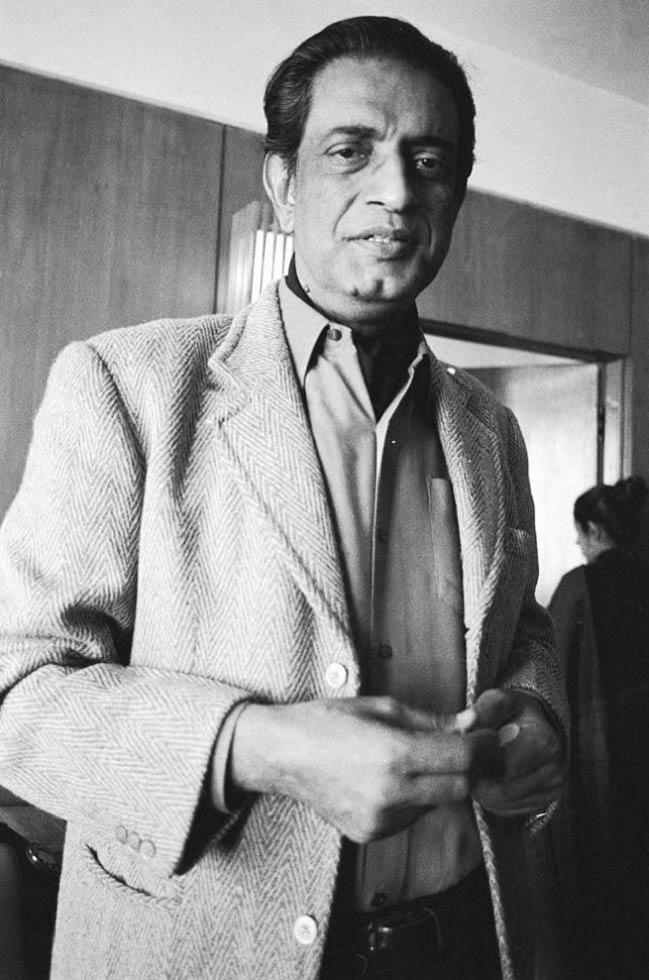
Image context: the cover uses an archival photograph of Ray in New York from Wikimedia Commons. A real documentary image is the right choice here because this piece is about directorial method, not one isolated film image: Ray's face belongs to a body of work built on observation, control, and unusual steadiness of attention.[7]
Before the world canonized Ray, he learned to trust ordinary surfaces
Ray's career did not begin in the same way as the critic-turned-director mythology that shaped so much writing about European postwar cinema. Britannica's profile and later retrospectives keep stressing his mixed training: literature, visual design, music, and a practical eye sharpened by commercial art and illustration.[1] That background matters because his films rarely separate narrative from arrangement. A room in a Ray film is never only a room. It is a social diagram. A prop is never only a prop. It is often a pressure point.
The early breakthrough, Pather Panchali (1955), remains the cleanest example.[2][4] The BFI notes that Ray was inspired by Italian neorealism, especially Bicycle Thieves, when he made his low-budget, open-air debut about ordinary village life.[4] That influence is real, but the result is already unmistakably his own. What makes Pather Panchali feel so alive is not just that it looks outward to poverty, weather, and landscape. It is that Ray understands how discovery works in fragments. A road, tall grass, a pond, the distant rumor of a train, the movement of siblings through a field: these are not decorative observations. They are how childhood learns the scale of the world.[2][4]
That instinct stayed with him. Ray did not need melodramatic overload to make life feel large. He could let motion, spacing, and patient looking accumulate into consequence.
The Big City turns middle-class modernity into a domestic pressure system
If Pather Panchali shows Ray's gift for open space and first perception, The Big City (1963) shows how exact he became with enclosed modern life. Criterion's summary of the film is useful because it names the core situation cleanly: Arati, a middle-class Kolkata housewife, takes a job to help support the family and discovers both independence and conflict inside the same move.[5] Ray does not treat that premise as a simple emancipation story. He tracks what paid work does to a whole household grammar: money, pride, timing, status, child care, and the subtle humiliations of men who thought the city belonged to them in one stable form.[3][5][6]
This is where "humanism" becomes too soft a word. Ray is attentive to Arati, but he is equally attentive to the systems around her. The apartment is crowded. The office has its own codes. Calcutta is a city where aspiration, inflation, English-language prestige, and gendered labor meet each other in cramped rooms and on public streets.[5][6] Ray's gift is that he does not need to announce the sociology. He lets a workplace interaction, a family meal, or a shift in who can speak with confidence at home carry the argument.
In the 1982 Sight and Sound interview, Ray said that from around 1960 onward he became more aware of his surroundings and started bringing more political and social elements into his films, even when those elements were not the overt plot.[3] That remark makes The Big City even sharper in retrospect. The film is not built as a thesis about modernization. It lets modernization show itself as pressure inside ordinary conduct.
Charulata proves that an interior can move as restlessly as a city
Ray's 1964 Charulata may be the most refined statement of this method.[2] In BFI's account of the film, Ray contrasts the sprawling saga with a cinema more concentrated in time, and Charulata is exactly that kind of concentration: a house, its grounds, a marriage, a visitor, a woman with intelligence and nowhere adequate to place it.[2] Many directors can photograph loneliness in a beautiful room. Ray does something more exact. He turns the room into a machine for registering thought.
The film's famous binoculars, corridors, windows, and pauses matter because they convert enclosure into motion.[2] Charu's world is materially rich and mentally starved; the camera keeps measuring that contradiction. What looks static in plot terms keeps moving in perceptual terms. Attention slides across fabric, paper, furniture, garden space, and glances. Desire forms at the speed of hesitation. A colonial Bengali interior becomes an instrument for thinking about gender, leisure, authorship, and the half-open door between domestic respectability and personal awakening.[2][6]
Placed beside Pather Panchali and The Big City, Charulata clarifies Ray's range without breaking his signature. The village road, the middle-class apartment, and the nineteenth-century bhadralok home are different worlds, but Ray treats all three as environments where feeling becomes legible through placement, tempo, and routine rather than verbal overstatement.[2][4][5]
Civic pressure keeps entering the frame, even when Ray stays calm
One reason Ray still feels contemporary is that he did not confuse quietness with neutrality. The same Sight and Sound interview is revealing here. Discussing later films such as Company Limited and The Adversary, he points to details like bombs heard in the distance, comments at a cocktail party, power cuts, and a broken lift as ways social reality enters the film without hijacking it into slogan.[3] That is a crucial Ray lesson. Politics in cinema does not only live in speeches, banners, or direct argument. It also lives in infrastructure, interruptions, ambient fear, and the tiny malfunctions that tell you what kind of city people inhabit.
This helps explain why Ray's films age so well. They are composed with classical clarity, but the world inside them is never sealed. Modernity keeps arriving through labor, technology, noise, and altered expectations about what men, women, parents, children, workers, and artists can ask from one another.[2][3][5][6] Ray's calm style is therefore not an escape from conflict. It is the method by which conflict becomes readable.
Why Ray remains indispensable
Ray's international stature is secure, and it has been for decades.[1][2] That is not the interesting part anymore. The interesting part is why the films still feel instructive instead of merely canonical. The answer is that Ray solved a problem many directors still fail to solve. He made ordinary life cinematic without making it vague, and he made social observation political without turning people into case studies.
That is the precision this director profile keeps circling. In Pather Panchali, he lets movement through landscape become a form of knowledge.[4] In The Big City, he turns work, marriage, and money into a chamber drama about urban modernity.[5] In Charulata, he makes an interior pulse with intelligence, frustration, and unrealized authorship.[2] Across all of them, Ray trusts the viewer to read pressure where another filmmaker might insert explanation.
That trust is why "humanism" remains true and yet insufficient. Ray cared about people, certainly. More importantly, he cared about the exact structures in which people tried to live. He filmed roads, rooms, and civic weather until they started speaking.
Sources
- Encyclopaedia Britannica, "Satyajit Ray" (biography and career overview).
- BFI, "Satyajit Ray: 5 essential films" (includes discussion of Pather Panchali and Charulata).
- BFI Sight and Sound, "Satyajit Ray: a moral attitude" (interview on politics, social detail, and filmmaking).
- BFI, "Pather Panchali (1955)" (film page on Ray's debut and its neorealist context).
- The Criterion Collection, "The Big City (1963)" (film page and essay context).
- The Criterion Collection, "Satyajit Ray" (collection page overview of modernization and Bengali society in his films).
- Wikimedia Commons, "File:Satyajit Ray in New York.jpg" (source page for the article image).