Victor Sjöström's The Phantom Carriage begins with a premise that sounds like folklore and then treats it as a problem of cinema. The last person to die before midnight on New Year's Eve must drive Death's carriage for the coming year, gathering the newly dead; Janus Films uses that legend to frame the 1921 Swedish silent film as a ghost story, a morality tale, and a showcase for special effects.[1] Yet the film's force does not come from the carriage alone. Its deeper invention is that guilt becomes visible before it becomes moral. The image has to learn how to hold accusation, memory, body, and spirit in the same frame.
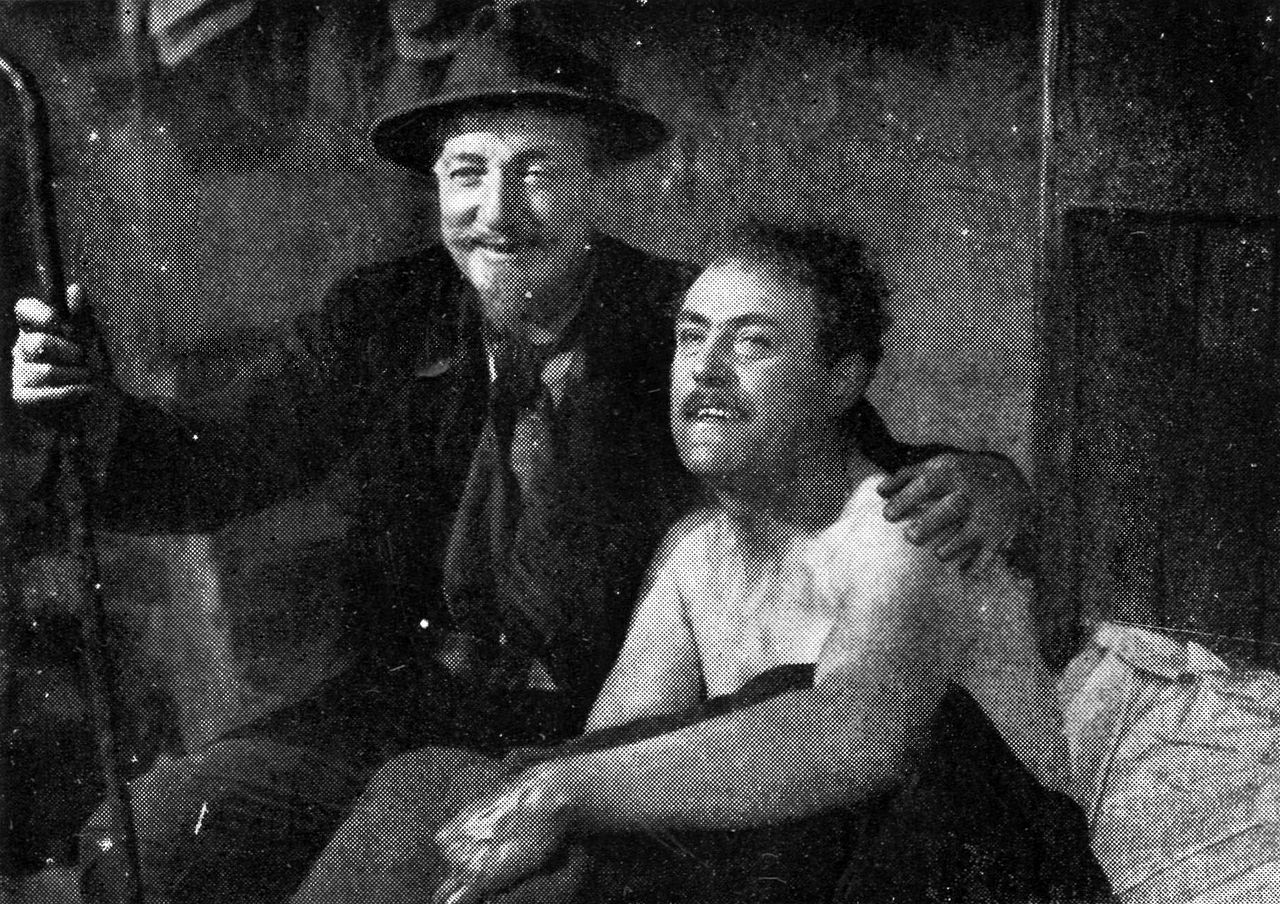
That is why the still used here is not merely illustrative. Tore Svennberg and Sjöström occupy the same photographed space, and the film will keep asking what happens when one figure belongs partly to the world of the dead while another remains trapped in the habits of the living.[6] The movie's famous transparencies are not decorative supernatural shimmer. They are a grammar for moral pressure: the past can stand in the room; a buried harm can return as a body; memory can become a vehicle with wheels.
The clock is a machine, not a symbol
New Year's Eve gives The Phantom Carriage an elegant threshold. The date is public, annual, and ordinary; everyone knows how to count toward midnight. Sjöström turns that shared social clock into an apparatus of reckoning. The film's Swedish release on New Year's Day 1921 sharpened the effect, because its ghostly events were tied to the night viewers had just passed through or were still imaginatively inhabiting.[2]
The timing matters because the film's morality is not abstract. David Holm, played by Sjöström himself, is not brought before a vague court of conscience. He is caught at a calendrical hinge, where the old year has become measurable and the next year is about to begin with a debt attached to it. The carriage myth externalizes what ordinary time usually hides: actions do not vanish because the calendar turns. They roll forward, collecting passengers.
This is the film's first major trick. It does not ask viewers simply to believe in a ghostly vehicle. It makes the carriage feel like a form of bookkeeping. A person dies at a precise hour, enters a role, and inherits labor. Death is not release from consequence; it is employment by consequence. The supernatural world looks frightening because it has procedure.
Flashback makes the past occupy the present
The San Francisco Silent Film Festival essay describes the film's almost experimental narrative as built from lengthy flashbacks, including flashbacks within flashbacks.[2] That structure is the film's moral architecture. A simpler conversion story could move in a straight line: sin, crisis, recognition, reform. The Phantom Carriage works by folding time until cause and consequence seem to press against each other from several directions at once.
The effect is disorienting, but not loose. The flashbacks force David's past to arrive as evidence rather than explanation. A scene from earlier life does not soften him by offering context alone. It gives shape to the damage that other people have had to carry. His wife, his children, Sister Edit, and his companions do not exist as sentimental stations on his road to redemption. They are the record of his impact.
This is where the film's theme becomes sharper than a temperance lesson. Alcohol is present, and Janus' synopsis names David as abusive and alcoholic.[1] But the film's interest is wider than vice as diagnosis. It studies how a man converts weakness into permissions: permission to humiliate, to abandon, to infect, to tear care apart because care exposes him. Flashback does not excuse that pattern. It makes the pattern visible as repetition.
Double exposure turns guilt into shared space
The Swedish Film Institute's guide singles out the film's flashbacks and layers of complicated double exposures as central to the narrative and technical virtuosity that astonished audiences.[4] Swedish Film likewise emphasizes the constructed narrative and advanced trick photography associated with cinematographer Julius Jaenzon.[3] Those effects still matter because they solve a dramatic problem that dialogue cannot solve in a silent film: how can an invisible moral state become something a viewer can inspect?
Double exposure supplies the answer. The dead are not separated from the living by a clean cut. They appear as translucent presences, occupying roads, rooms, shorelines, and bedsides with the weightless insistence of memory. The technique lets the film avoid two easy alternatives. It does not make the supernatural fully material, because that would turn the carriage into ordinary machinery. It also does not leave the supernatural invisible, because then guilt would remain private psychology. Instead, the image becomes layered enough to show that private wrongdoing has public form.
The carriage crossing the world as a phantom vehicle is therefore less a special effect than an ethical effect. The viewer can see that two orders of reality are present at once. David's body can be in the world of drink, anger, and denial, while another order is already moving through him. The transparent image becomes a way of saying that consequence is present before the guilty person consents to recognize it.
Sjöström's body keeps resisting the lesson
The film gains much of its pressure from the fact that Sjöström directs and performs David. Danish Film Institute credits him as director, screenwriter, and star, with Julius Jaenzon as cinematographer and Svensk Filmindustri as production company.[5] That doubled authorship matters. The director who designs the moral machinery also gives his own body to the man being caught inside it.
David is not played as a clean emblem of sin. He slumps, flares, sneers, weakens, and hardens again. The performance has a dangerous elasticity: a viewer can see intelligence and damage in him without mistaking either for absolution. This is crucial to the film's seriousness. Redemption would be cheap if David were only a diagram of bad conduct. It becomes troubling because the camera keeps studying the human being who is also the source of harm.
The body also keeps the film from floating away into allegory. A ghostly cart can pass through waves, and a dead driver can enter the frame as a translucent figure, but David's gestures remain heavy. His violence is physical. His fatigue is physical. His refusal of care is physical. The film's spiritual apparatus keeps returning to ordinary bodies, because those are the places where injury first lands.
The studio makes the supernatural exact
One reason The Phantom Carriage still feels controlled is that its uncanny atmosphere is not vague. It has edges, positions, and densities. Danish Film Institute's database preserves the material facts: a Swedish 1921 silent feature, 106 minutes, 35 mm, black and white, with a 1.33:1 frame.[5] Those details are not trivia. The film's moral imagination depends on the discipline of a frame that can register bodies, shadows, beds, doorways, coats, bottles, and carriage wheels with almost ledger-like attention.
Sjöström's supernatural world is not a blur laid over reality. It is reality re-photographed with a second pressure inside it. That is why the film can move between folktale and social drama without tearing apart. The myth is large, but the rooms are small. The carriage belongs to legend, but the harm belongs to domestic space. The dead can glow, but the living still have to look at the damage done to wives, children, and caretakers.
The San Francisco Silent Film Festival essay notes the film's influence on later filmmakers, including Ingmar Bergman, and describes Bergman's repeated returns to Sjöström's masterpiece.[2] Influence, in this case, is not just a matter of iconic images. It is a way of making metaphysics behave like mise-en-scène. The spiritual question has a floor, a wall, a deadline, a face.
The final wager is whether visibility can change anyone
The film's hardest question is not whether David is guilty. The machinery has already made that visible. The harder question is whether visibility can change the person who has spent his life refusing it. This is where The Phantom Carriage becomes more unsettling than its reputation as a silent classic might suggest. It believes in moral awakening, but it does not pretend that awakening erases the history that made it necessary.
That tension is why the film's sentiment survives. Sister Edit's faith in David could become pious softness in a lesser work. Here, it is placed against the severity of the image itself. The film has shown too much damage to let hope become ornamental. Hope must pass through the same machinery as guilt: flashback, body, clock, carriage, room. It must become visible too.
The result is a ghost story in which the ghosts are only part of the haunting. The true haunting is repeatable action. A man wounds, denies, returns, remembers, and is forced to see. The carriage gathers the dead, but the film gathers consequences. More than a century later, its special effects still feel alive because they are joined to a precise moral task. The Phantom Carriage does not use cinema to decorate death. It uses cinema to make the hidden structure of guilt share the frame with the person who made it.
Sources
- Janus Films, "The Phantom Carriage" film page, with synopsis, country, year, director, and distributor context.
- San Francisco Silent Film Festival, "The Phantom Carriage" essay and 2024 screening note, including flashback structure, double exposure, release context, and Bergman influence.
- Swedish Film, "Körkarlen" streaming and licensing page, with production description, release date, company, and Jaenzon trick-photography note.
- Swedish Film Institute, "Körkarlen" film guide, noting restoration, flashbacks, and layered double exposure.
- Danish Film Institute, "Körkarlen" database entry, with credits, runtime, technical format, release, and production company.
- Wikimedia Commons, "File:Svennberg och Sjöström.jpg," 1921 still of Tore Svennberg and Victor Sjöström in Körkarlen.