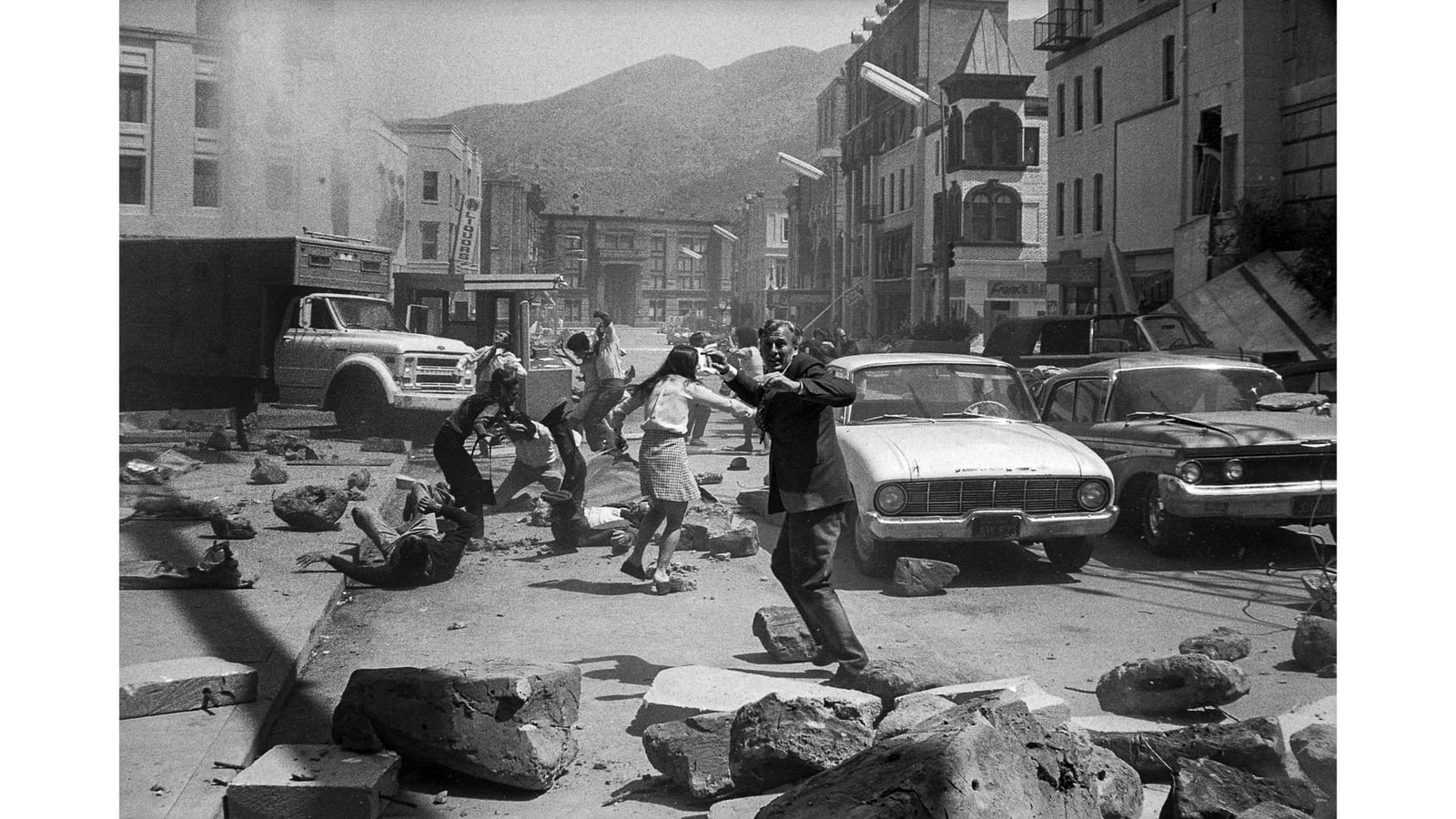
The boulders in the archival photograph are light enough to bounce. Actors scatter across a set dressed as a broken Los Angeles, while a motorized mount shakes the Panavision camera instead of the street. Los Angeles Times photographer Don Cormier recorded this practical deception during the making of Mark Robson's Earthquake. His image exposes how much labor it took to make still ground look unstable.[4]
The film's most radical effect, however, was not on that set. It waited in the auditorium.
When Earthquake opened in November 1974, selected theaters received Sensurround: extra low-frequency horns, amplifiers, control electronics, test film, calibration, and technical support.[2][6] In one self-aware scene, Rosa is watching Universal's High Plains Drifter when the cinema itself begins to shake and collapse. The image shows an audience losing its theater; Sensurround made the real audience feel that its own room might be joining the fiction. Contemporary coverage collected by the American Film Institute described the result as crossing from aural involvement into the illusion of moving seats.[1]
Calling Sensurround a soundtrack therefore misses its most unusual choice. The release print still carried the picture and ordinary program sound, but the full presentation required encoded control information and locally installed equipment.[2][3] The cues traveled on film; much of the force was generated in the theater. Distribution delivered two halves that technicians had to reunite.
The print carried instructions; the theater made the rumble
The first Sensurround system separated the cue from the effect. Very deep bass was difficult to record and reproduce effectively through contemporary film and theater sound chains. Universal's solution was not simply to force a louder rumble onto the release print. In the common 35mm optical configuration, low-frequency control tones traveled with the program track. A control unit detected them and told a noise generator in the theater when—and how forcefully—to feed the dedicated effects horns.[2][3]
The MCA Systems patent by Richard J. Stumpf, Waldon O. Watson, and Robert J. Leonard describes 25- and 35-hertz control signals whose amplitudes yielded two analog control voltages; those voltages were also logically combined to provide four digital function signals. The locally generated effect was pseudorandom energy extending through sonic and infrasonic bass, delivered at enough intensity to create a psychological and bodily impression of movement without mechanically moving the seats.[3]
That architecture matters aesthetically. Random low-frequency energy does not behave like one clean musical note. It arrives as fluctuating acoustic pressure shaped by the horns and the room's modes. Because the print controlled a generator rather than carrying a fixed earthquake recording alone, dimensions, boundaries, placement, and resonance helped determine what the audience felt.
The system even protected the rest of the mix from its own spectacle. The manual transcription says that when the rumble entered, dialogue and ordinary effects seemed to recede, so the control electronics raised the normal soundtrack by 6 decibels during activation.[2] The cues therefore coordinated program level as well as the physical effect.
Fifteen hertz demanded big hardware
The design target was about 15 hertz, which made the horn problem enormous. A theoretically ideal horn mouth at that cutoff would occupy roughly 300 square feet, according to the manual transcription. The engineers folded the horn path, used 18-inch low-frequency drivers, and exploited theater corners so the floor and walls acted as acoustic boundaries. Different cabinet shapes fit different rooms, but none erased the basic fact: moving air efficiently at these frequencies demands volume.[2]
The equipment had to be positioned around the theater and integrated with optical, magnetic, old, new, hybrid, modified, and sometimes undocumented sound chains. Engineers destroyed speakers during development while pursuing the low-frequency target. Field reports later recorded a different set of problems: power-amplifier failures, transducer failures, high-frequency oscillation, poor grounding, and control tones that vanished or triggered at the wrong moment.[2][6]
Calibration translated that bulk into a repeatable promise. The manual transcription specifies 95 dB A-weighted at the theater center and no more than 110 dB C-weighted four feet in front of any horn.[2] Those figures should be read as a period operating specification, not as a timeless safety recommendation. Their historical importance is that a Sensurround booking could not be judged by whether the boxes switched on. Someone had to measure what the room did.
Two theaters could run prints of Earthquake at the same speed and still offer materially different experiences because their dimensions, legacy amplifiers, grounding, horn positions, and adjacent spaces were different. The specification was portable; its result still had to be tuned on site.
The real scale was a service network
Initial planning called for 17 equipped theaters by the end of the first year. About 17 U.S. theaters premiered the film with Sensurround, and nearly 400 theaters showed it over the run using nonpermanent systems that could be moved between engagements.[2][6] Cumulative reach, not 400 simultaneous installations, turned a sound-department invention into a logistics problem.
RCA Technical Services became the field network. Universal trained regional technicians; they trained others; crews evaluated theaters, installed and measured systems, answered maintenance calls, moved equipment onward, and fed recurring faults back to the studio. Cabinets and electronics did not simply remain wherever the film first opened. Some traveled to later engagements, creating narrow windows in which several installations in one city had to be completed before opening day. The records describe missed starts, emergency replacements, noisy booths, incompatible preamplifiers, grounding trouble, accidental triggers, and equipment inventories that had to follow the attraction around the circuit.[2][6]
The attraction was therefore operationally exclusive as well as sensory. An unequipped cinema could show Earthquake, but it could not deliver the presentation Universal was promoting. Availability followed the horns and the technicians.
Before release, the effect had already shown how quickly engineering could become publicity. The Los Angeles Times archive recalls a demonstration in which 93 tourists taken from regular Universal Studios tour buses watched a five-minute segment. The low-frequency assault rattled the room and produced reactions ranging from alarm to nausea.[4] That test did more than assess a speaker system. It established the audience's body as part of the campaign: the film could now be advertised through what viewers did when it hit them.
Its biggest success exposed its boundary problem
Sensurround's promise was that the auditorium would stop feeling neutral. Its weakness was exactly the same. Bass this deep does not respect the ticket boundary.
AFI's production history preserves reports of complaints from patrons in neighboring auditoriums and of a cracked ceiling at Hollywood's Chinese Theatre.[1] The most spectacular anecdote is difficult to separate from promotion, so it is better treated as a period report than as an engineering measurement. The adjoining-auditorium complaints establish the underlying problem without legend: low-frequency energy could cross the boundary between one show and the next.
That leakage reverses the system's intended logic. Sensurround used room coupling to make one audience's experience exceptional, yet the same energy could make a neighboring audience's soundtrack less coherent. Immersion on one side of the wall became interference on the other.
Universal kept revising the idea. For Midway in 1976, Sensurround II replaced the first system's theater-generated quake noise with effects recorded directly on the optical track, added expansion and noise reduction, and used the control tones to steer energy toward front, rear, or all effects horns. Better preparation let almost 300 theaters open with the system on the same date.[2][6] The revision broadened the material the system could reproduce, but it also changed Earthquake's original cue-to-generator architecture.
The format stretched again for Rollercoaster in 1977, the third Universal Sensurround feature and the first whose musical score was also recorded for the system; theaters without the hardware received a regular-sound release.[5] AFI also identifies the theatrical Battlestar Galactica pilot, Saga of a Star World (1978), as another Universal production using the process.[1] Across those four AFI-documented releases, Sensurround moved from locally generated quake noise to recorded battle effects, directionality, and music without becoming ordinary cinema infrastructure.
What the roadshow revealed
It would be too neat to claim every modern cinema subwoofer as Sensurround's descendant. Its more useful legacy is the production problem it exposes: a new exhibition effect is never only a creative idea. It is also a promise about compatible prints, hardware, rooms, installation labor, calibration, maintenance, and enough bookings to keep the system moving.
Sensurround made those dependencies visible because its equipment was nonpermanent. The print arrived with cues; horns, amplifiers, control units, test material, measurements, spares, and technicians followed another route. The attraction succeeded only when the routes met on schedule.
Cormier's photograph shows the image side of that bargain: light rubble, rehearsed panic, and a camera rig that impersonated unstable ground. The exhibition side was assembled elsewhere. The print carried timing and level information; technicians, horns, amplification, placement, and calibration supplied the physical effect. What audiences felt was not recorded in one place. It was built between medium and venue.
Sources
- American Film Institute, “Earthquake (1974).” AFI Catalog of Feature Films — credits, release information, contemporary Sensurround reporting, installation context, adjacent-auditorium complaints, and the reported Chinese Theatre damage.
- “About Sensurround,” unattributed transcription described as “From the Sensurround manual,” in70mm.com, posted March 18, 2004 — horn design, print formats, control logic, calibration, theater reach, field installation, failure analysis, and the revisions made for Midway.
- Richard J. Stumpf, Waldon O. Watson, and Robert J. Leonard, “Special effects generation and control system for motion pictures,” U.S. Patent 3,973,839, filed December 30, 1974 — control frequencies, pseudorandom low-frequency generation, theater integration, and the separation of cue signals from physical effects.
- Scott Harrison, “From the Archives: A cinematic earthquake rocks Los Angeles.” Los Angeles Times, January 26, 2018 — Don Cormier's behind-the-scenes photograph used for this article, which the archive says ran May 3, 1974, plus the lightweight rubble, moving-camera setup, and 93-person Sensurround demonstration.
- American Film Institute, “Rollercoaster (1977).” AFI Catalog of Feature Films — the third Universal Sensurround production, Lalo Schifrin's score and effects work, and the parallel regular-sound release.
- E. G. Holub, “Sensurround—Building Your Own Earthquake.” RCA Engineer 23, no. 2, August–September 1977, pp. 56–60 — nonpermanent installations, cumulative theater reach, RCA field service, calibration, failures, and the Midway rollout.