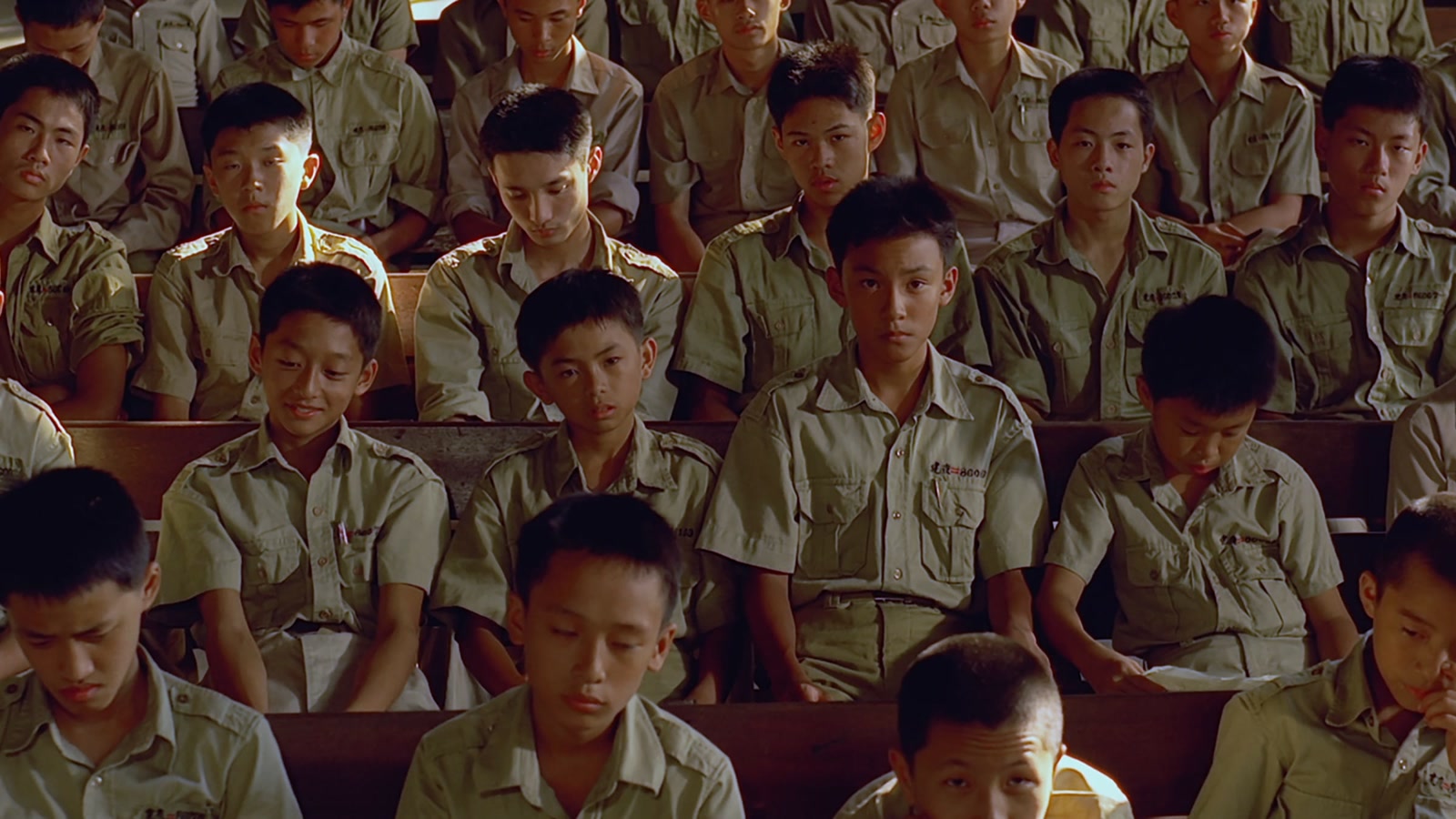
The brightest place in A Brighter Summer Day may be the ice-cream parlor, where teenagers crowd around a band singing American rock and roll. The light is flattering, the microphone works, and for a song or two Cat can sound like someone who belongs to a larger world. Elsewhere, electricity falters. A flashlight cuts faces out of darkness. Candles and a swinging bulb reveal a gang attack in pieces. Edward Yang does not arrange these spaces into a simple contest between good light and evil dark. He asks a more social question: who controls the light, and what role does it permit everyone else to play?
This essay discusses major events, including the ending, in the restored 237-minute version. That is the integral form now presented by the Taiwan Film and Audiovisual Institute and Criterion, not the shorter three-hour cut that circulated early in the film’s life.[2][5][7]
Made in 1991 and set mainly in 1960–61 Taipei, Yang’s film follows fourteen-year-old Xiao Si’r through home, night school, a movie studio, two youth-gang territories, and a romance with Ming. Those places do not merely hold a sprawling plot. Each supplies a different visibility system. School classifies him. The gang notices or ignores him. The studio manufactures images. The state can remove his father without making its own power fully visible. Xiao Si’r keeps trying to answer those systems with one portable beam.
A flashlight stolen from the image factory
Xiao Si’r does not receive the flashlight as a tool of discovery. He steals it from the movie studio next to his school. He and Cat have been hiding above a set, looking down at actors and technicians who possess the legitimate right to illuminate, frame, and watch. Chased out by a guard, the boys take his light with them. Almost immediately, its beam catches two lovers in a dark classroom without resolving their identities. The revelation creates suspense, embarrassment, and leverage—not certainty.[1]
That origin matters. The flashlight is cinema in miniature: it selects a fragment of the world, surrounds it with darkness, and makes the holder feel that selection equals knowledge. But Yang’s own camera refuses the same confidence. He favors fixed, wide views, deep rooms, blocked doorways, and people small within social space. Tony Rayns observed during production that one quiet bedroom scene was filmed at extremely low light levels; in his later account, he argues that Yang’s wide compositions preserve the autonomy of even peripheral characters instead of forcing the audience into one person’s emotional position.[2]
The tension between those two ways of seeing drives the film. Xiao Si’r points. Yang composes. The boy’s beam says: this is the person who matters now. The wide frame says: look at the relations around him before deciding what he means.
Yang linked the motif to an ordinary memory of unreliable electricity, according to Godfrey Cheshire’s Criterion essay.[1] That practical origin keeps the flashlight from becoming a tidy symbol pasted over the drama. It is useful because rooms really are dark. It can help someone read in bed, find a path, expose an intruder, or threaten a rival. Its moral charge changes with the hand holding it. What remains constant is the small authority it grants: for a moment, one teenager decides who must be visible.
Public light offers ready-made selves
The film’s larger pools of light are owned by institutions. Day school and night school divide students before the story can measure their character. Xiao Si’r’s assignment to the less prestigious night program is both an educational setback and a social forecast; adults fear the company he will keep there, while his classmates turn the school’s hierarchy into gang material.[1][2] “Night” is therefore more than atmosphere. It is an administrative label that begins writing his identity for him.
The ice-cream parlor offers a happier script. Bright, pastel, and tuned to imported records, it lets Cat climb onto a chair and sing into a microphone. Yang told Rayns that American popular culture mattered intensely to mainlander children who had arrived in Taiwan detached from older roots: U.S. Forces Radio seemed to produce a new number one every week, while American individualism offered an attractive language for standing alone.[2] Cat does not become Elvis, but performance gives his small body reach. The room makes imitation communal rather than pathetic.
Even here, visibility is allocated. Gang leaders occupy the room differently from younger boys; Ming is watched as someone’s girlfriend; a concert becomes a negotiation between rival groups. The same culture that offers Cat a voice supplies costumes for masculine command. Honey returns in a naval uniform and carries himself like a hero from another story. Sly turns the social event into a power arrangement. Light does not free these teenagers from roles. It gives the roles a stage.
The English title performs a similar transformation. It comes from Cat and Xiao Si’r’s sister trying to catch the words of Elvis Presley’s “Are You Lonesome Tonight?” The heard phrase becomes “a brighter summer day,” an error or reinvention that sounds more spacious than the life around it.[6] Imported sound opens an imaginative exit, yet nobody can simply walk through it. The boys can sing America; they still inhabit a Taipei of inherited displacement, school discipline, family strain, and martial law.
Power can stay outside the beam
Yang’s screenwriters built that historical pressure indirectly. Hung Hung recalled gathering period newspapers and drawing on memories shared by waishengren families, while also stressing that the gang world was reconstructed partly through observation and inference. The real murder provided a container; the writers used it to ask how instability and fear take root across a society.[3] That distinction is essential. The film is neither a police-file reenactment nor an excuse that dissolves individual responsibility into “the times.” It constructs the times as a field of pressures within which choices acquire their tragic shape.
The father’s interrogation makes the field unmistakable. Shortly after the typhoon-night gang assault, agents arrive and pull Mr. Zhang into questioning over old associations. The National Human Rights Museum dates Taiwan’s White Terror to the authoritarian structures imposed from 1949 into 1992, including anti-rebellion and anti-espionage laws that enabled arrests, interrogations, imprisonment, and wrongful convictions. It also emphasizes the durable silence fear produced within families and public life.[4]
Yang does not claim that youth gangs and the state are identical. He places them in a harsher relation: the boys improvise local sovereignty beneath a government whose power is pervasive but whose justice is inaccessible. The gangs make belonging visible through nicknames, territory, debts, girlfriends, weapons, and public challenges. State power needs fewer signs. It can operate through a knock at the door, a name in a file, or a connection reinterpreted as suspicion.
This is why the film’s darkness cannot mean that authority is absent. Often, darkness is where competing authorities become hardest to distinguish. Adults speak softly about connections. Boys borrow military language for games. A samurai sword survives from an earlier occupation and becomes available to a new fantasy of force. The past is not behind the characters; it sits in their houses as architecture, objects, habits, and reasons not to speak.
The beam does not explain the massacre
During the attack on the 217 gang, a typhoon has knocked out the power. Yang withholds the clean geography an action film would normally provide. Candles, a moving bulb, and Xiao Si’r’s flashlight release bodies from the dark only long enough for us to register a blow, a face, a weapon, or its aftermath. The rest arrives as feet, shouts, collisions, and terror beyond the frame.[1]
The scene turns the flashlight’s original promise inside out. At the studio, a controlled light helps fiction become legible. Here, the portable beam cannot organize what it reveals. It produces fragments without mastery. Xiao Si’r remains at the assault’s edge, present enough for his beam to shape what the audience can see but not one of the older allies carrying out the killings. We share his restricted sight without confusing proximity with guilt.
That limit is ethically precise. Total visibility could make the violence exhilarating: clean lines of attack, identifiable winners, a sequence that rewards tactical comprehension. Near-darkness refuses that pleasure. Yet Yang does not hide the violence in order to make it abstract. Each flash returns consequence to a body. We see too little to enjoy control and enough to understand complicity.
The film then cuts from unofficial violence to the father’s encounter with official suspicion. Cheshire notes the abruptness: Yang bypasses a conventional aftermath and moves from the gang cataclysm into the family’s political humiliation.[1] The cut widens causality. Xiao Si’r’s crisis cannot be explained by one bad crowd, one romance, or one storm. His world repeatedly teaches that protection depends on belonging to the right structure—and repeatedly shows those structures failing the people inside them.
Seeing Ming is not the same as knowing her
Xiao Si’r’s most dangerous mistake is to turn looking into a claim. He believes that he sees Ming more truthfully than the other boys do and therefore can rescue, reform, or stabilize her. But Ming has learned to move among fragile arrangements because neither family nor romance guarantees security. When she tells him that he is like the others and only wants to change her, she rejects the flattering version of possession: the boy who calls control understanding.[2]
The flashlight has trained us to recognize the error. A beam can isolate a person while erasing the conditions around her. Xiao Si’r does this emotionally. He converts Ming from an autonomous teenager managing danger into the central figure of his own moral story. When her choices exceed that frame, he treats the mismatch as betrayal.
Yang and his co-writers deliberately fictionalized the real case, developing extensive histories for a huge ensemble rather than reducing the film to a murderer’s psychology.[2][3] That structure protects Ming from becoming merely the final object in Xiao Si’r’s decline. Other people know her differently; her precarity predates his attention; her life continues beyond what he can accept about it. The wide social frame keeps arguing with his spotlight.
The final violence is therefore not darkness suddenly defeating light. It is a boy acting as though his partial view were complete. Earlier, the flashlight exposed only what its narrow cone could catch. Now Xiao Si’r tries to force a whole person to fit the story inside his head. The weapon changes, but the gesture of control remains.
Brightness without ownership
The title promises comparison—brighter than what?—without naming the baseline. Cat’s borrowed lyric can sound like nostalgia for a day that never quite existed, or hope for one still unavailable. Ben Ratliff notes that the song is never allowed to settle into a single explanatory key; its uncertain transcription is precisely what lets it move among memory, American aspiration, and adolescent longing.[6]
Yang’s answer is not to switch on enough light to solve the film. The full 237-minute version preserves density: more relations, more peripheral lives, more evidence that no isolated beam can explain the social field.[2][5][7] The 4K restoration makes the low-light images more legible, but legibility is not the same thing as moral simplicity. We can see the rooms better and still have to decide how their people are connected.
That is the humane force of Yang’s wide frames. They distribute attention without pretending everyone has equal power. Against the school, gang, studio, state, and jealous lover—all systems that assign identities—the film keeps making room for lives that exceed the role offered to them. A brighter day, in this sense, would not be a world without shadows. It would be one in which illumination no longer belongs to the person holding the flashlight.
Sources
- Godfrey Cheshire, “A Brighter Summer Day: Coming of Age in Taipei.” The Criterion Collection, March 21, 2016 — historical setting, the flashlight and lighting motif, gang spaces, and the lead-image source.
- Tony Rayns, “Lonesome tonight: Tony Rayns and Edward Yang on A Brighter Summer Day.” Sight and Sound / British Film Institute, archive feature updated July 8, 2026 — 1990 set report, visual style, release versions, and Yang interview.
- Andrew Chan, “Talking with Screenwriter Hung Hung About A Brighter Summer Day.” The Criterion Collection, March 21, 2016 — collaborative writing process, archival research, fictionalization, and White Terror context.
- National Human Rights Museum, “White Terror Period” — official chronology of martial law, anti-rebellion and anti-espionage systems, political prosecution, and their social legacy in Taiwan.
- Taiwan Film and Audiovisual Institute, “A Brighter Summer Day (Restored)” — official 237-minute program record, production context, historical framing, and awards.
- Ben Ratliff, “From Elvis in Taipei.” The Criterion Collection, April 10, 2020 — the film’s use, transcription, and unresolved meanings of “Are You Lonesome Tonight?”
- The Criterion Collection, “A Brighter Summer Day” — official film and restoration record, 237-minute runtime, credits, aspect ratio, languages, and 2009/4K restoration notes.