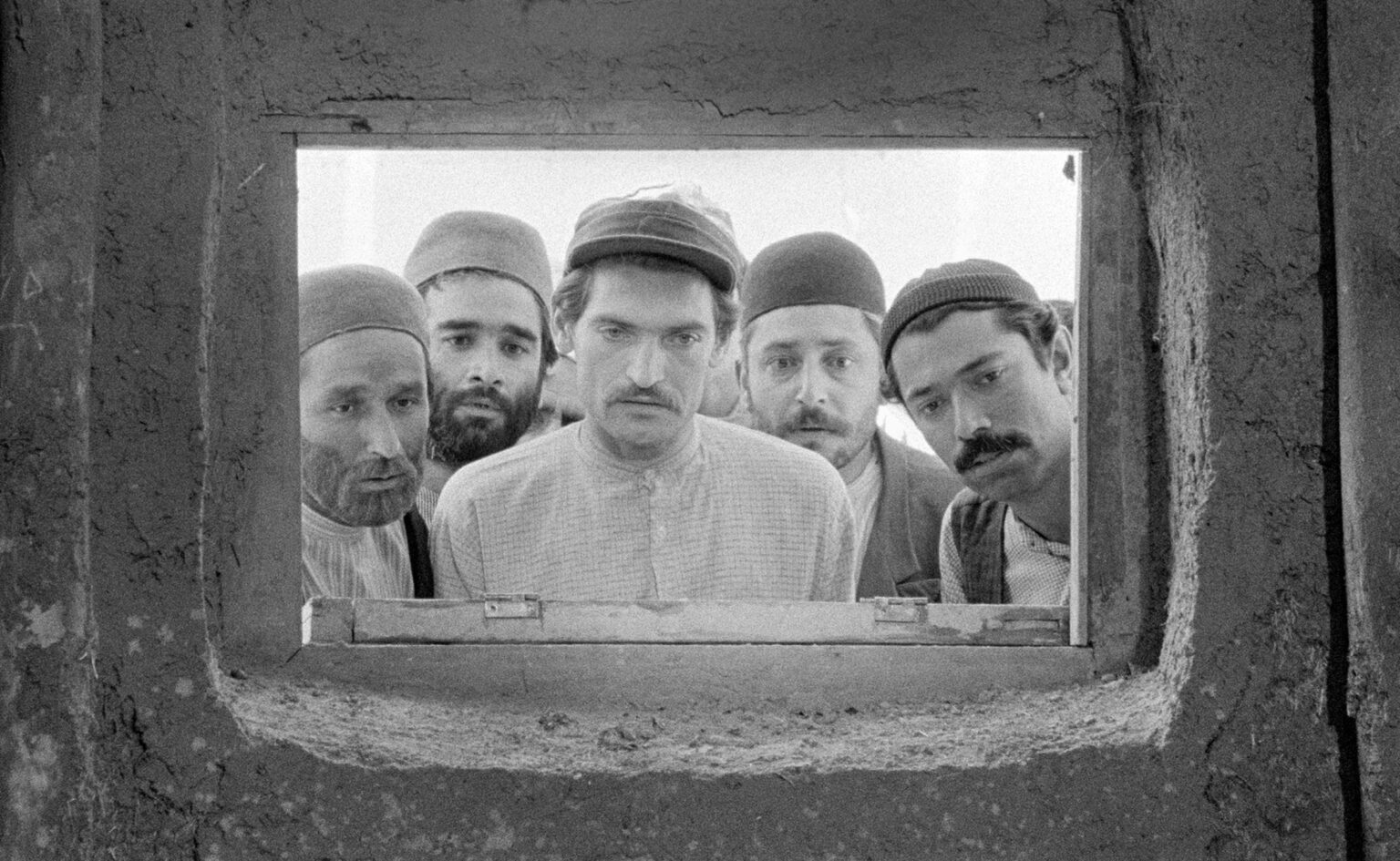
A modern nation likes the image of an open road. The road promises direction, speed and a horizon without obstruction. Prerevolutionary Iranian New Wave cinema kept looking sideways. It found the promises of modernization caught in a taxi's back seat, an unfinished building, a mud-plastered alley, a classroom window and a decaying mansion where every corridor belonged to someone who could watch, inherit or exclude.
Those spaces do not give the films a single look. Ebrahim Golestan's The Brick and the Mirror (1964–65) moves through nocturnal Tehran in expressionistic widescreen. Dariush Mehrjui's The Cow (1969) strips a village down to earth, curved walls and anguished bodies. Bahram Beyzaie's Downpour (1972) turns a school and its surrounding neighborhood into a relay of glances. Mohammad Reza Aslani's Chess of the Wind (1976) seals a struggle over class and gender inside a candlelit mansion.[2][3][4][5][6]
Call this cinema-ye motafavet—“alternative cinema”—or the Iranian New Wave, but do not mistake the name for a coordinated house style. The filmmakers worked across documentary, melodrama, crime, comedy, poetry and theatrical performance. What connects these four films is a formal pressure rather than a manifesto: each makes social contradiction architectural. Official modernity may declare that history is moving forward; a wall can show who is still pinned in place.
Spoiler note: this essay discusses major developments and final images in The Brick and the Mirror and Chess of the Wind.
Image context: the lead image is a real archival still from The Cow, not a later recreation. Mehrjui's village was designed from mud brick and mud plaster, and its surfaces repeatedly hold people inside frames, openings and tight communal circles. The still belongs here because this movement story begins with material space rather than a lineup of celebrated directors.[2]
Patronage built a cinema it could not fully contain
The movement's central irony was already institutional. Under Mohammad Reza Shah Pahlavi, the state sought a cinema that could project cultural distinction while also subjecting films to censorship. In August 1968, the government announced ten million tomans in development-plan support for the industry. The funding helped create conditions for the very countercinema that could challenge both commercial formulas and the government's preferred account of the country.[1][5]
This did not produce a neat opposition in which official money made propaganda and independent money made truth. Government-sponsored agencies, private producers and independent units all contributed to the period. The Center for the Intellectual Development of Children and Young Adults, National Iranian Radio and Television, the Ministry of Culture and Arts and other bodies could provide equipment, commissions, trained performers or exhibition routes. The same environment could suppress a finished work. MoMA's survey of prerevolutionary cinema emphasizes the cross-pollination: filmmakers, poets, playwrights, actors and designers kept working across one another's projects even as particular films were altered, confiscated or banned.[1]
That double bind matters on-screen. Censorship was not simply an external hand arriving after the art was complete. It sharpened an indirect visual language. A film could put power into who occupies the room, who looks through its window, who can leave and who becomes the subject of everybody else's gaze. Architecture became a way to make a political relation visible without reducing the film to a slogan.
The Brick and the Mirror: a city with no address for care
Golestan's The Brick and the Mirror begins with mobility. Hashem drives a taxi through Tehran at night, its lights, signs and radio signals composing a city that seems to be constantly transmitting. A veiled passenger gets out in a distant, half-built district and leaves an infant on the back seat. The taxi—an emblem of circulation and paid passage—suddenly contains a responsibility that cannot be converted into a fare.[2][3]
Hashem spends the night trying to move the baby elsewhere. His girlfriend Taji imagines keeping the child; he looks for an institution or procedure that can relieve him of it. The film carries the crisis through private rooms, official encounters and unfinished urban space. Every change of location appears to offer an answer, but the moral question survives the transfer. The city knows how to transport a person faster than it knows how to accept an obligation.
The final visit to an orphanage enlarges the problem until it becomes almost unbearable. Taji sees rows of infants rather than the singular domestic future she had projected onto one child. The building performs care at scale, but its repetition makes abandonment social rather than exceptional.[2] Golestan does not let the orphanage settle the argument between sentiment and practicality. Instead, the room changes the unit of attention. One baby has become a system full of babies, and Taji's private longing has encountered a public fact.
This is why the film's unfinished buildings matter. They are not a decorative shorthand for “a country in transition.” An unfinished home is already a decision about what has been built first and what remains exposed. The Brick and the Mirror finds modern Tehran bright, mobile and incomplete at once. Its critique is not that the city has become modern. It is that circulation can advance while responsibility stalls.
The Cow: mud walls resist the official picture
Mehrjui's The Cow moves from the capital to an unnamed village, but it does not offer rural life as an untouched refuge. Mashhadi Hassan's cow is the village's only cow and the center of his emotional identity. When it dies during his absence, his neighbors hide the truth. Hassan refuses the loss and begins to live as though he has become the animal himself.[2][4]
The production's political history gives that premise an added edge. The film received state funding, yet authorities initially banned it because its poverty contradicted the Pahlavi regime's public image of modernization. Its later passage to the 1971 Venice Film Festival, where it received a critics' prize, helped make the international reputation of the Iranian New Wave.[4] A government-backed film had made a village that the government did not want representing the nation.
Its force does not come from treating the village as raw documentary evidence. The title credits a designer for the décor, and the mud-brick homes were shaped into an unusually controlled field of arches, apertures, curved roofs and plastered façades.[2] Mehrjui and his collaborators turn material associated with ordinary rural construction into severe stylization. Hassan's distress is staged against surfaces that are at once tactile and theatrical.
The walls do two opposite things. They give the village collective form: neighbors appear in doorways, cross the same alleys and gather around the same crisis. They also make concealment impossible to keep private. News, fear and suspicion circulate through every opening. Hassan's metamorphosis is psychological, social and physical at once because the community cannot place a clean boundary between one man's loss and its own precarious survival.
The film therefore refuses a simple tradition-versus-modernity equation. Its village is neither an authentic past to preserve nor a backward space awaiting rescue. The cow's economic importance and Hassan's attachment are inseparable. Once the animal disappears, grief exposes how little reserve the household or village possesses. Modernization appears from outside as a national trajectory; The Cow measures it from inside a body that has no cushion against catastrophe.
Downpour: every window joins the audience
In Downpour, Mr. Hekmati arrives with his belongings on a cart to teach in a poor South Tehran neighborhood. Children and adults immediately watch him. His developing affection for Atefeh, an independent seamstress supporting her brother and ill mother, becomes public before the couple can define it privately. Pupils look through classroom windows, colleagues trade knowing glances and neighbors convert fragments into rumor.[5]
Beyzaie makes the school more than a setting for enlightened reform. It is a theater in which looking distributes power. Hekmati's effort to repair an auditorium for the children becomes entangled with his rivalry with Rahim, the local butcher and tough guy. The project is useful, but usefulness cannot insulate it from credit, masculinity or control. Even communal improvement has an audience deciding whose gesture counts.
Hamid Naficy reads the film's layers of furtive looking against the surveillance culture of SAVAK, the shah's domestic intelligence service.[5] The connection does not require a literal agent in every window. That is the formal achievement: observation travels from flirtation to gossip to intimidation without changing its basic mechanism. A glance can create intimacy, enforce conformity or make a person wonder what unseen authority has already decided.
Unlike the state-supported paradox around The Cow, Downpour was made independently after Beyzaie and his collaborators failed to secure outside backing. The crew pooled labor and resources and filmed across twenty-four Tehran neighborhoods, close to residents' daily environments.[5] Independence did not remove material limits; it changed how the filmmakers could use them. The streets, schoolyard and battered auditorium feel inhabited rather than supplied as neutral proof of realism.
Modernity here arrives as a teacher carrying books and a plan, but the film will not grant him the fantasy of being the neighborhood's sole author. Atefeh has work, judgment and obligations before he enters. The children reinterpret adult behavior. Rahim commands loyalties that an institutional title cannot erase. The school may be repaired, yet the network of looks around it decides whether change can remain.
Chess of the Wind: the house outlives its owners
Aslani's Chess of the Wind takes the spatial argument to its most concentrated form. Set in the 1920s after the death of a wealthy matriarch, it traps competing relatives, a disabled daughter and a servant inside a mansion where inheritance turns kinship into siege. Crime melodrama, gothic unease and Persian visual traditions meet in interiors lit with a precision that made the film's disastrous 1976 festival projection especially damaging: faulty lamps rendered some candlelit scenes nearly unreadable, and a reel-order mix-up further confused the premiere.[6]
The mansion appears insulated from the street, yet it is a model of a larger transition. Aslani described the film's crime framework as a way to examine Iran's passage from feudalism to modernity through corruption and duplicity. Titles, objects, bodies and rooms establish rank. A wheelchair can resemble a throne; a locked inheritance can turn care into leverage; the women who wash clothes outside the family's chambers carry social memory the household would rather contain.[6]
Then the film breaks its enclosure. Its final movement jumps forward and looks beyond the house toward modern Tehran. The gesture does not announce that a corrupt old order has simply been replaced. It makes the mansion and skyline continuous enough to trouble that comfort. New buildings do not guarantee new relations. A city can change its surface while carrying older arrangements of possession into the view.
The film itself suffered a parallel confinement. It received no regular Iranian theatrical release, disappeared from circulation after the revolution and was not publicly screened again for decades; its restoration eventually returned a major work to the movement's visible history.[6] That afterlife changes how the mansion looks now. The house is not only a metaphor inside the story. It also seems like an archive that nearly kept the film locked away with its defeated claimants.
What a wall can prove
These films do not say that walls are truthful and official speeches are false. Cinema can stylize mud as deliberately as a state can stage a development image. Golestan's orphanage, Mehrjui's village, Beyzaie's school and Aslani's mansion are constructed arguments, not transparent samples of Iranian life. Their value lies in how openly they organize tension.
A room can show distance between two people who claim intimacy. A window can turn a neighborhood into an audience. An alley can bind mutual care to collective surveillance. A mansion can preserve hierarchy while the skyline beyond it changes. None of those meanings resides automatically in brick or plaster; framing, performance, editing and sound activate them.
That is also the boundary of the movement label. The Iranian New Wave was too varied to reduce to one visual grammar, and prerevolutionary Iranian cinema was far larger than the art films later canonized under that name.[1][5][6] But across these four works, architecture performs a common critical task. It interrupts the aerial view of modernization and returns history to human scale.
The road still matters. Taxis cross Tehran; teachers arrive and depart; films travel to festivals and vanish into archives. Yet the most revealing moment often comes when movement stops at a threshold. Someone looks in, someone is kept out, and a national promise has to answer to the room where life is actually being arranged.
Sources
- The Museum of Modern Art, “Iranian Cinema before the Revolution, 1925–1979” press release (2023) — movement chronology, institutional production, censorship and cross-disciplinary collaboration.
- Farbod Honarpisheh, “From the Body of Ruin to the Ruin of Body: On Materiality and the Iranian New Wave Cinema, 1960–1979.” MoMA's post (2023) — material spaces in the movement, analysis of The Brick and the Mirror and The Cow, and provenance for the lead still.
- The Museum of Modern Art, “Khesht va Ayeneh (The Brick and the Mirror)” — film record, restoration note, credits and synopsis.
- The Museum of Modern Art, “The Cow. 1969. Directed by Dariush Mehrjui” — production, censorship and Venice reception context.
- Hamid Naficy, “Downpour: Furtive Glances.” The Criterion Collection (2020) — Iranian New Wave patronage, independent production, neighborhood locations and the film's structures of looking.
- Ehsan Khoshbakht, “Chess of the Wind: The Glorious Miniature of an Upheaval.” The Criterion Collection (2022) — festival history, movement context, mansion imagery and the film's account of feudalism and modernity.